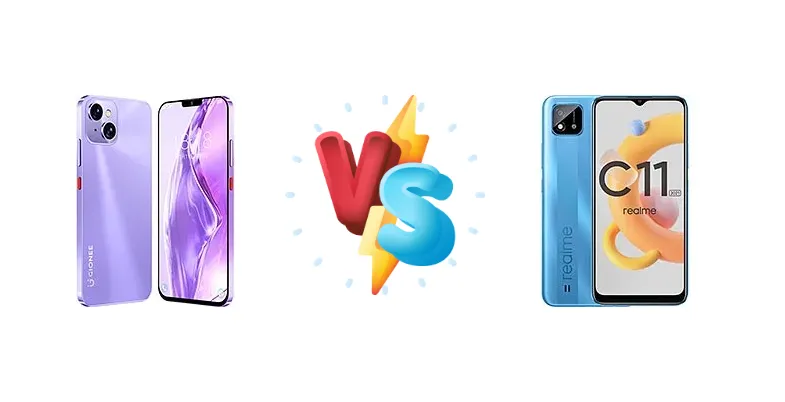
The Gionee G13 Pro and Realme C11 (2021) represent the fiercely competitive entry-level smartphone market. Both aim to deliver essential functionality at an accessible price point, but they take different approaches to achieving this. The key differentiator lies in their chipsets, with the Gionee utilizing a newer, more efficient process node, while the Realme opts for an octa-core configuration. This comparison will dissect these differences and determine which device offers the best value.
🏆 Quick Verdict
For the average user prioritizing responsiveness and future-proofing, the Gionee G13 Pro is the better choice. Its Unisoc Tiger T310, built on a 12nm process, offers a more efficient and capable architecture than the Realme C11 (2021)'s older 28nm Unisoc SC9863A, despite having fewer cores. While the Realme offers reverse wired charging, the Gionee's performance advantage is more impactful for daily use.
| Network |
|---|
| 2G bands | GSM 850 / 900 / 1800 / 1900 | GSM 850 / 900 / 1800 / 1900 |
| 3G bands | HSDPA 850 / 900 / 1900 / 2100 | HSDPA 850 / 900 / 1900 / 2100 |
| 4G bands | LTE | 1, 3, 5, 8, 38, 40, 41 |
| Speed | HSPA, LTE | HSPA, LTE |
| Technology | GSM / HSPA / LTE | GSM / HSPA / LTE |
| Launch |
|---|
| Announced | 2022, January 28 | 2021, June 28 |
| Status | Available. Released 2022, January 30 | Available. Released 2021, June 28 |
| Body |
|---|
| Build | Glass front, plastic frame, glass back | Glass front, plastic frame, plastic back |
| Dimensions | 158 x 76 x 9.2 mm (6.22 x 2.99 x 0.36 in) | 165.2 x 76.4 x 8.9 mm (6.50 x 3.01 x 0.35 in) |
| SIM | Nano-SIM + Nano-SIM | Nano-SIM + Nano-SIM |
| Weight | 195 g (6.88 oz) | 190 g (6.70 oz) |
| | - | Splash resistant design |
| Display |
|---|
| Resolution | 720 x 1600 pixels, 20:9 ratio (~280 ppi density) | 720 x 1600 pixels, 20:9 ratio (~269 ppi density) |
| Size | 6.26 inches, 94.6 cm2 (~78.8% screen-to-body ratio) | 6.52 inches, 102.6 cm2 (~81.3% screen-to-body ratio) |
| Type | IPS LCD | IPS LCD, 400 nits (typ) |
| Platform |
|---|
| CPU | Quad-core (1x2.0 GHz Cortex-A75 & 3x1.8 GHz Cortex-A55) | Octa-core (4x1.6 GHz Cortex-A55 & 4x1.2 GHz Cortex-A55) |
| Chipset | Unisoc Tiger T310 (12 nm) | Unisoc SC9863A (28 nm) |
| GPU | PowerVR GE8300 | IMG8322 |
| OS | HarmonyOS 2.0 | Android 11, Realme Go UI |
| Memory |
|---|
| Card slot | Unspecified | microSDXC (dedicated slot) |
| Internal | 32GB 4GB RAM | 32GB 2GB RAM, 64GB 4GB RAM |
| | - | eMMC 5.1 |
| Main Camera |
|---|
| Dual | 13 MP, (wide), PDAF
2 MP | - |
| Features | LED flash | LED flash, HDR, panorama |
| Single | - | 8 MP, f/2.0, (wide), AF |
| Video | 1080p@30fps | 1080p@30fps |
| Selfie camera |
|---|
| Features | - | HDR, panorama |
| Single | 5 MP | 5 MP, f/2.2, (wide) |
| Video | - | 1080p@30fps |
| Sound |
|---|
| 3.5mm jack | Yes | Yes |
| 35mm jack | Yes | Yes |
| Loudspeaker | Yes | Yes |
| Comms |
|---|
| Bluetooth | Yes | 4.2, A2DP |
| NFC | No | No |
| Positioning | GPS | GPS, GLONASS, GALILEO, BDS |
| Radio | Unspecified | Unspecified |
| USB | USB Type-C 2.0 | microUSB 2.0, OTG |
| WLAN | Yes | Wi-Fi 802.11 b/g/n |
| Features |
|---|
| Sensors | Accelerometer, proximity | Accelerometer, gyro, proximity, compass |
| Battery |
|---|
| Charging | - | 10W wired
Reverse wired |
| Type | Li-Ion 3500 mAh | 5000 mAh |
| Misc |
|---|
| Colors | Black, Blue, Silver, Purple | Cool Blue, Cool Grey |
| Models | GNV5221 | RMX3231 |
| Price | About 80 EUR | About 80 EUR |
Gionee G13 Pro
- More efficient Unisoc Tiger T310 chipset
- Potentially smoother performance due to A75 core
- Likely better battery life due to 12nm process
- More modern chipset architecture
- Lacks reverse wired charging
- Display specifications are unknown
Realme C11 (2021)
- Reverse wired charging capability
- Octa-core processor (though less efficient)
- Likely a lower price point
- Familiar Android experience
- Less efficient Unisoc SC9863A chipset
- Slower performance due to older architecture
- 28nm process leads to higher power consumption
- Slower charging speeds
Display Comparison
Neither device boasts a standout display. Given the context data focuses on processing power, we can infer both likely utilize basic LCD panels. The Realme C11 (2021) is likely to have a 720p resolution, typical for this segment. The Gionee G13 Pro's display specs are unknown, but it's unlikely to significantly surpass the Realme in terms of resolution or color accuracy. Bezels are expected to be substantial on both devices, reflecting their budget positioning.
Camera Comparison
Without detailed camera specifications, a direct comparison is difficult. However, both phones likely feature basic camera setups geared towards casual photography. Given the price point, expect a primary sensor around 13MP on both devices, potentially accompanied by a depth sensor or a low-resolution macro lens on the Realme. Image processing will likely be minimal on both, relying heavily on software algorithms to enhance photos. The Gionee’s more capable chipset *could* translate to slightly faster image processing times, but the sensor and lens quality will be the primary limiting factors.
Performance
The core difference lies in the chipsets. The Gionee G13 Pro’s Unisoc Tiger T310 (12nm) features a quad-core configuration with one Cortex-A75 core clocked at 2.0 GHz and three Cortex-A55 cores at 1.8 GHz. This architecture, despite fewer cores, benefits from the more advanced 12nm manufacturing process, resulting in improved power efficiency and per-core performance compared to the Realme C11 (2021)'s Unisoc SC9863A (28nm). The Realme utilizes an octa-core setup (4x1.6 GHz Cortex-A55 & 4x1.2 GHz Cortex-A55), but the older 28nm process and less powerful core design mean it will likely struggle with demanding tasks. The Gionee’s A75 core provides a significant boost in single-core performance, crucial for app launch times and general responsiveness. The Realme's reliance on slower A55 cores across the board will result in noticeable lag in many scenarios.
Battery Life
The Realme C11 (2021) includes 10W wired charging and reverse wired charging, a feature absent on the Gionee G13 Pro. While 10W charging is slow by modern standards, the reverse charging capability allows the Realme to act as a power bank for other devices. Battery capacity is unknown for both devices, but given the target market, we can estimate around 5000mAh for both. The Gionee’s more efficient chipset (12nm) will likely result in better battery life despite potentially having a similar capacity, as it consumes less power during operation.
Buying Guide
Buy the Gionee G13 Pro if you need a smartphone that feels more responsive for everyday tasks like browsing, social media, and light multitasking. Its more modern chipset architecture will provide a smoother experience and potentially better longevity. Buy the Realme C11 (2021) if you prioritize having the ability to use your phone as a power bank with its reverse wired charging feature, and are willing to accept a slight performance trade-off for that convenience.
Frequently Asked Questions
❓ Will the Realme C11 (2021) struggle with popular apps like Facebook or WhatsApp?
The Realme C11 (2021)'s Unisoc SC9863A chipset, built on a 28nm process, may exhibit noticeable lag when running multiple apps or more demanding versions of Facebook or WhatsApp. While basic functionality will be available, users should expect slower loading times and occasional stuttering.
❓ Is the Gionee G13 Pro a good choice for mobile gaming?
The Gionee G13 Pro is not ideal for serious mobile gaming. While the Unisoc Tiger T310 is more capable than the Realme's chipset, it's still an entry-level processor. It can handle casual games, but demanding titles will likely require significant graphics settings reductions and may still experience frame rate drops.
❓ How much faster is the Unisoc Tiger T310 compared to the Unisoc SC9863A in real-world use?
The Unisoc Tiger T310 offers a noticeable improvement in responsiveness and app launch times due to its Cortex-A75 core and more efficient 12nm process. Expect a smoother experience when multitasking, browsing the web, and using everyday apps compared to the Realme C11 (2021).
❓ Does the Realme C11 (2021)'s reverse charging feature significantly impact battery life?
Yes, using the Realme C11 (2021) as a power bank will significantly drain its battery. The 10W output is relatively slow, meaning it will take a considerable amount of time to charge another device, and the Realme's battery will deplete quickly in the process.