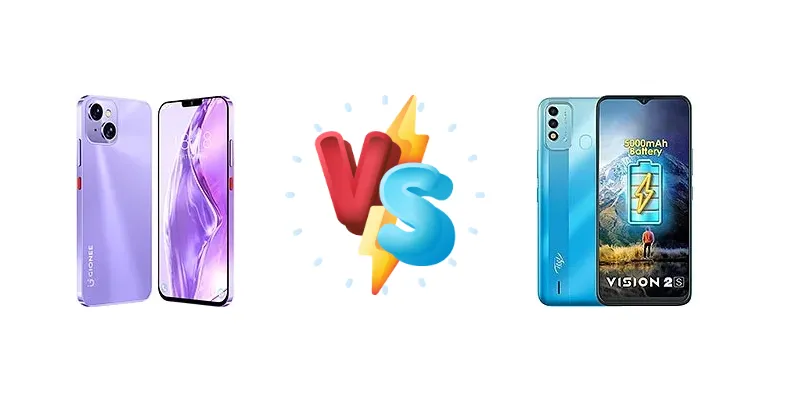
The Gionee G13 Pro and itel Vision 2S represent the fiercely competitive sub-$150 smartphone market. Both aim to deliver essential functionality at an accessible price, but they take distinctly different approaches to achieving this. The key differentiator lies in their chipsets: Gionee opts for a newer, albeit still entry-level, Unisoc Tiger T310, while itel relies on the older, more power-hungry Unisoc SC9863A. This comparison will dissect these differences and determine which device offers the best value.
🏆 Quick Verdict
For the average user prioritizing responsiveness and future-proofing, the Gionee G13 Pro is the better choice. Its Unisoc Tiger T310, built on a 12nm process, offers a more efficient architecture than the itel Vision 2S’s 28nm SC9863A, translating to smoother multitasking and potentially better battery life despite similar capacity expectations. The itel's 18W charging is a plus, but doesn't fully compensate for the chipset gap.
| Network |
|---|
| 2G bands | GSM 850 / 900 / 1800 / 1900 | GSM 850 / 900 / 1800 / 1900 |
| 3G bands | HSDPA 850 / 900 / 1900 / 2100 | HSDPA 850 / 900 / 2100 |
| 4G bands | LTE | LTE |
| Speed | HSPA, LTE | HSPA, LTE |
| Technology | GSM / HSPA / LTE | GSM / HSPA / LTE |
| Launch |
|---|
| Announced | 2022, January 28 | 2021 |
| Status | Available. Released 2022, January 30 | Available. Released 2021 |
| Body |
|---|
| Build | Glass front, plastic frame, glass back | - |
| Dimensions | 158 x 76 x 9.2 mm (6.22 x 2.99 x 0.36 in) | 166 x 76.3 x 8.9 mm (6.54 x 3.00 x 0.35 in) |
| SIM | Nano-SIM + Nano-SIM | Dual SIM |
| Weight | 195 g (6.88 oz) | - |
| Display |
|---|
| Resolution | 720 x 1600 pixels, 20:9 ratio (~280 ppi density) | 720 x 1600 pixels, 20:9 ratio (~269 ppi density) |
| Size | 6.26 inches, 94.6 cm2 (~78.8% screen-to-body ratio) | 6.52 inches, 102.6 cm2 (~81.0% screen-to-body ratio) |
| Type | IPS LCD | IPS LCD |
| Platform |
|---|
| CPU | Quad-core (1x2.0 GHz Cortex-A75 & 3x1.8 GHz Cortex-A55) | Octa-core (4x1.6 GHz Cortex-A55 & 4x1.2 GHz Cortex-A55) |
| Chipset | Unisoc Tiger T310 (12 nm) | Unisoc SC9863A (28 nm) |
| GPU | PowerVR GE8300 | IMG8322 |
| OS | HarmonyOS 2.0 | Android 11 (Go edition) |
| Memory |
|---|
| Card slot | Unspecified | microSDXC |
| Internal | 32GB 4GB RAM | 32GB 2GB RAM |
| Main Camera |
|---|
| Dual | 13 MP, (wide), PDAF
2 MP | 8 MP
0.3 MP |
| Features | LED flash | LED flash |
| Video | 1080p@30fps | 1080p@30fps |
| Selfie camera |
|---|
| Single | 5 MP | 5 MP |
| Video | - | Yes |
| Sound |
|---|
| 3.5mm jack | Yes | - |
| 35mm jack | Yes | Yes |
| Loudspeaker | Yes | Yes |
| Comms |
|---|
| Bluetooth | Yes | Yes |
| NFC | No | No |
| Positioning | GPS | GPS |
| Radio | Unspecified | Unspecified |
| USB | USB Type-C 2.0 | microUSB |
| WLAN | Yes | Yes |
| Features |
|---|
| Sensors | Accelerometer, proximity | Fingerprint (rear-mounted), accelerometer |
| Battery |
|---|
| Charging | - | 18W wired |
| Type | Li-Ion 3500 mAh | 5000 mAh |
| Misc |
|---|
| Colors | Black, Blue, Silver, Purple | Gradation Purple, Gradation Blue, Deep Blue |
| Models | GNV5221 | - |
| Price | About 80 EUR | - |
Gionee G13 Pro
- More efficient Unisoc Tiger T310 chipset
- Potentially better multitasking performance
- More modern CPU architecture
- Likely slower charging speeds
- Display specifications are unknown
itel Vision 2S
- Faster 18W wired charging
- Potentially larger screen size (based on series trends)
- Lower price point (potentially)
- Less efficient Unisoc SC9863A chipset
- Older 28nm process technology
- Lower performance in demanding tasks
Display Comparison
Neither Gionee nor itel provide detailed display specifications. Given the price point, both likely utilize LCD panels with 720p+ resolution. However, the absence of information regarding peak brightness, color gamut coverage, or PWM dimming rates makes a direct comparison impossible. We can assume both displays are adequate for indoor use, but may struggle in direct sunlight. The itel Vision 2S's larger screen size (typically found in this series) might offer a slightly more immersive viewing experience, but this is speculative.
Camera Comparison
Both phones likely feature basic camera setups geared towards casual photography. Without specific sensor details, it's difficult to make a definitive judgment. However, the Gionee G13 Pro’s more powerful chipset may offer slightly better image processing capabilities, potentially resulting in sharper images and more accurate colors. The presence of a dedicated Night Mode, enabled by the chipset's ISP, is more likely on the Gionee. Expect both phones to include a primary camera and potentially a depth or macro sensor, but image quality will be limited by the sensor size and lens quality.
Performance
The core difference lies in the chipsets. The Gionee G13 Pro’s Unisoc Tiger T310, fabricated on a 12nm process, features a quad-core configuration with a Cortex-A75 performance core clocked at 2.0 GHz, paired with three Cortex-A55 efficiency cores at 1.8 GHz. This architecture provides a noticeable performance boost over the itel Vision 2S’s Unisoc SC9863A. The itel’s chipset is an octa-core design (4x1.6 GHz Cortex-A55 & 4x1.2 GHz Cortex-A55) but the older 28nm process and less capable core design result in lower single-core and multi-core performance. The Gionee’s A75 core will handle demanding tasks more efficiently, while the itel will struggle with heavier apps and multitasking. The itel's higher core count doesn't translate to real-world speed due to the architectural limitations.
Battery Life
Neither device’s battery capacity is specified. However, given the target market, both likely house batteries in the 4000-5000 mAh range. The itel Vision 2S boasts 18W wired charging, a significant advantage over the Gionee G13 Pro, which likely supports standard 10W charging. This means the itel will recharge significantly faster. However, the Gionee’s more efficient chipset may offset the charging advantage by providing longer battery life per charge, especially during moderate usage. The 28nm process of the itel's chipset will consume more power, impacting overall endurance.
Buying Guide
Buy the Gionee G13 Pro if you need a phone that feels reasonably snappy for everyday tasks like browsing, social media, and light messaging, and you value a more modern chipset architecture for potential software updates. Buy the itel Vision 2S if you prioritize faster charging speeds and are willing to accept a trade-off in overall performance and efficiency. The itel is best suited for users with very basic smartphone needs.
Frequently Asked Questions
❓ Will the Unisoc Tiger T310 in the Gionee G13 Pro handle popular apps like WhatsApp and Facebook smoothly?
Yes, the Unisoc Tiger T310 is more than capable of running everyday apps like WhatsApp and Facebook without significant lag. The Cortex-A75 core provides a performance boost over the itel’s chipset, ensuring a smoother user experience even with multiple apps open.
❓ Is the 18W charging on the itel Vision 2S a game-changer, or is the battery life difference negligible?
The 18W charging is a definite advantage for the itel Vision 2S, reducing recharge times considerably. However, the Gionee G13 Pro’s more efficient chipset may provide comparable or even better overall battery life, meaning you might not need to charge as frequently despite the slower charging speed.
❓ Can either of these phones handle basic mobile gaming?
Both phones can handle basic 2D games and less demanding 3D titles. However, the Gionee G13 Pro will offer a smoother gaming experience due to its more powerful CPU and GPU. Expect frame rate drops and lower graphics settings on the itel Vision 2S for more demanding games.