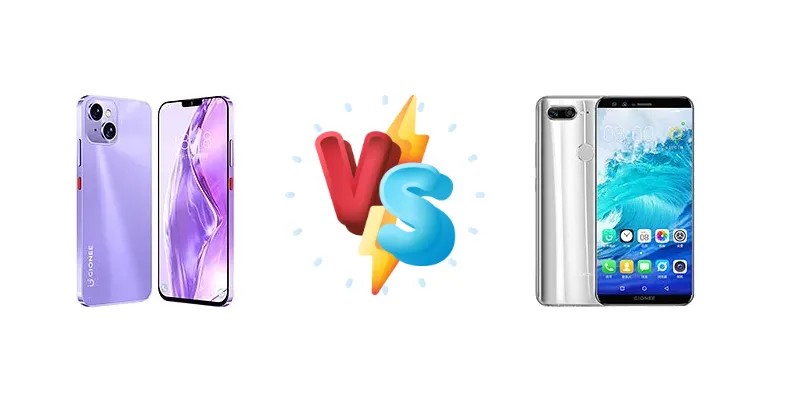
Looking for an affordable smartphone? The Gionee G13 Pro and S11S are both contenders in the budget market. But which one offers the best value for your money? This comprehensive comparison dives deep into their specs and features to help you decide.
🏆 Quick Verdict
The Gionee S11S generally edges out the G13 Pro thanks to its more powerful Helio P30 chipset and slightly better overall performance. While both are budget options, the S11S provides a smoother experience for everyday tasks and light gaming.
| Network |
|---|
| 2G bands | GSM 850 / 900 / 1800 / 1900 | GSM 850 / 900 / 1800 / 1900 - SIM 1 & SIM 2 |
| 3G bands | HSDPA 850 / 900 / 1900 / 2100 | HSDPA 850 / 900 / 1900 / 2100 |
| 4G bands | LTE | 1, 2, 3, 4, 5, 7, 8, 12, 34, 38, 39, 40, 41 |
| Speed | HSPA, LTE | HSPA, LTE |
| Technology | GSM / HSPA / LTE | GSM / CDMA / HSPA / LTE |
| | - | CDMA 800 & TD-SCDMA |
| Launch |
|---|
| Announced | 2022, January 28 | 2017, November. Released 2017, December |
| Status | Available. Released 2022, January 30 | Discontinued |
| Body |
|---|
| Build | Glass front, plastic frame, glass back | Glass front, glass back, aluminum frame |
| Dimensions | 158 x 76 x 9.2 mm (6.22 x 2.99 x 0.36 in) | 155.8 x 72.6 x 7 mm (6.13 x 2.86 x 0.28 in) |
| SIM | Nano-SIM + Nano-SIM | Nano-SIM + Nano-SIM |
| Weight | 195 g (6.88 oz) | 177 g (6.24 oz) |
| Display |
|---|
| Resolution | 720 x 1600 pixels, 20:9 ratio (~280 ppi density) | 1080 x 2160 pixels, 18:9 ratio (~402 ppi density) |
| Size | 6.26 inches, 94.6 cm2 (~78.8% screen-to-body ratio) | 6.01 inches, 93.2 cm2 (~82.4% screen-to-body ratio) |
| Type | IPS LCD | AMOLED |
| Platform |
|---|
| CPU | Quad-core (1x2.0 GHz Cortex-A75 & 3x1.8 GHz Cortex-A55) | Octa-core (4x2.3 GHz Cortex-A53 & 4x1.65 GHz Cortex A53) |
| Chipset | Unisoc Tiger T310 (12 nm) | Mediatek MT6758 Helio P30 (16 nm) |
| GPU | PowerVR GE8300 | Mali-G71 MP2 |
| OS | HarmonyOS 2.0 | Android 7.1 (Nougat), Amigo 5 |
| Memory |
|---|
| Card slot | Unspecified | microSDXC |
| Internal | 32GB 4GB RAM | 64GB 6GB RAM |
| Main Camera |
|---|
| Dual | 13 MP, (wide), PDAF
2 MP | 16 MP, AF
8 MP |
| Features | LED flash | LED flash, HDR, panorama |
| Video | 1080p@30fps | 1080p@30fps |
| Selfie camera |
|---|
| Dual | - | 20 MP, f/2.0, (wide), 1/2.8", 1.0µm
8 MP |
| Single | 5 MP | - |
| Sound |
|---|
| 3.5mm jack | Yes | Yes |
| 35mm jack | Yes | Yes |
| Loudspeaker | Yes | Yes |
| Comms |
|---|
| Bluetooth | Yes | 4.2, A2DP, LE |
| NFC | No | Yes |
| Positioning | GPS | GPS |
| Radio | Unspecified | FM radio |
| USB | USB Type-C 2.0 | microUSB 2.0, OTG |
| WLAN | Yes | Wi-Fi 802.11 b/g/n |
| Features |
|---|
| Sensors | Accelerometer, proximity | Fingerprint (rear-mounted), accelerometer, gyro, proximity, compass |
| Battery |
|---|
| Type | Li-Ion 3500 mAh | Li-Po 3600 mAh, non-removable |
| Misc |
|---|
| Colors | Black, Blue, Silver, Purple | Silver, Gold |
| Models | GNV5221 | - |
| Price | About 80 EUR | About 500 EUR |
Gionee G13 Pro
- Potentially larger display
- Affordable price point
- Basic functionality
- Weaker processor
- Lower performance
- Limited features
Gionee S11S
- More powerful chipset (Helio P30)
- Better performance
- Potentially better camera processing
- Smaller display (potentially)
- May be slightly more expensive
Display Comparison
The Gionee G13 Pro likely features a larger display (estimated 6.5-6.7 inches) compared to the S11S (estimated 5.8-6.0 inches). Both likely use IPS LCD panels with HD+ resolution. The G13 Pro's larger size might be preferable for media consumption, while the S11S's smaller size could offer better one-handed usability.
Camera Comparison
Camera specs are often similar in this price range. Both phones likely feature a dual or triple camera setup on the rear, with a primary sensor and potentially a depth sensor. Image quality will depend heavily on software processing. Expect decent results in good lighting conditions, but struggles in low light. The S11S might have a slight edge due to its more powerful processor aiding image processing.
Performance
Here's where the S11S shines. The Mediatek Helio P30 chipset is significantly more powerful than the Unisoc Tiger T310. The S11S's octa-core processor and more efficient architecture will result in smoother app loading, faster multitasking, and better overall responsiveness. The G13 Pro will likely struggle with demanding apps and games.
Battery Life
Battery capacity is a crucial factor. While specific capacities are difficult to confirm without official data, both phones likely offer batteries in the 3000-4000 mAh range. Battery life will depend on usage patterns. The S11S's more efficient chipset could potentially lead to slightly better battery life despite a potentially smaller battery.
Buying Guide
The Gionee G13 Pro is a good option for users prioritizing a larger screen and basic functionality on a very tight budget. The Gionee S11S is better suited for those needing a bit more performance for multitasking, social media, and occasional gaming, even if it means a slightly smaller display.
Frequently Asked Questions
❓ What is the difference between the Unisoc Tiger T310 and the Mediatek Helio P30?
The Mediatek Helio P30 is significantly more powerful than the Unisoc Tiger T310. It offers better performance for multitasking, gaming, and overall responsiveness.
❓ Which phone is better for gaming?
The Gionee S11S is the better choice for gaming due to its more powerful chipset. The G13 Pro will likely struggle with even basic games.