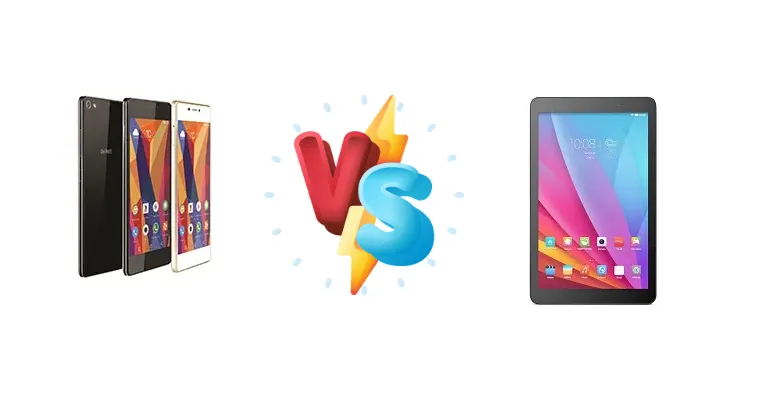
Choosing between a smartphone and a tablet can be tough, especially when considering older models. Today, we're pitting the Gionee Elife S7, a slim smartphone, against the Huawei MediaPad T1 10, a budget-friendly tablet. Let's see which device offers the best experience.
🏆 Quick Verdict
The Gionee Elife S7 boasts a more powerful processor and likely a better camera, making it the better choice for performance-focused users. However, the Huawei MediaPad T1 10's larger screen and potentially longer battery life make it ideal for media consumption and casual use.
| Network |
|---|
| 2G bands | GSM 850 / 900 / 1800 / 1900 - SIM 1 & SIM 2 | GSM 850 / 900 / 1800 / 1900 |
| 3G bands | HSDPA 850 / 900 / 2100 | HSDPA 850 / 900 / 1900 / 2100 |
| 4G bands | 3, 7, 38, 39, 40 | 1, 3, 7, 8, 20, 38, 40 |
| Speed | HSPA, LTE | HSPA, LTE Cat4 150/50 Mbps |
| Technology | GSM / HSPA / LTE | GSM / HSPA / LTE |
| Launch |
|---|
| Announced | 2015, March. Released 2015, April | 2015, March. Released 2015, March |
| Status | Discontinued | Discontinued |
| Body |
|---|
| Dimensions | 148.8 x 72.4 x 5.5 mm (5.86 x 2.85 x 0.22 in) | 248.5 x 150 x 8.3 mm (9.78 x 5.91 x 0.33 in) |
| SIM | Dual SIM (Micro-SIM, dual stand-by) | Micro-SIM |
| Weight | 125.3 g (4.41 oz) | 433 g (15.27 oz) |
| Display |
|---|
| Protection | Corning Gorilla Glass 3 | - |
| Resolution | 1080 x 1920 pixels, 16:9 ratio (~424 ppi density) | 800 x 1280 pixels, 16:10 ratio (~157 ppi density) |
| Size | 5.2 inches, 74.5 cm2 (~69.2% screen-to-body ratio) | 9.6 inches, 267.2 cm2 (~71.7% screen-to-body ratio) |
| Type | Super AMOLED | IPS LCD |
| Platform |
|---|
| CPU | Octa-core 1.7 GHz Cortex-A53 | Quad-core 1.2 GHz Cortex-A53 |
| Chipset | Mediatek MT6752 (28 nm) | Qualcomm MSM8916 Snapdragon 410 (28 nm) |
| GPU | Mali-T760MP2 | Adreno 306 |
| OS | Android 5 (Lollipop), Amigo OS 3 | Android 4.4.4 (KitKat), EMUI 3 |
| Memory |
|---|
| Card slot | No | microSDHC (dedicated slot) |
| Internal | 16GB 2GB RAM | 8GB 1GB RAM, 16GB 1GB RAM |
| | - | eMMC 4.5 |
| Main Camera |
|---|
| Features | LED flash, panorama, HDR | LED flash |
| Single | 13 MP, f/2.0 AF | 5 MP, AF |
| Video | 1080p@30fps | Yes |
| Selfie camera |
|---|
| Single | 8 MP, 1/4.0" | 2 MP |
| Sound |
|---|
| 3.5mm jack | Yes | Yes |
| 35mm jack | Yes | Yes |
| Loudspeaker | Yes | Yes |
| Comms |
|---|
| Bluetooth | 4.0, A2DP | 4.0, A2DP |
| NFC | No | No |
| Positioning | GPS | GPS, GLONASS/ BDS (market dependant) |
| Radio | FM radio | FM radio |
| USB | microUSB 2.0, OTG | microUSB 2.0 |
| WLAN | Wi-Fi 802.11 b/g/n, Wi-Fi Direct, hotspot | Wi-Fi 802.11 a/b/g/n, dual-band |
| Features |
|---|
| Sensors | Accelerometer, proximity, compass | Accelerometer |
| Battery |
|---|
| Stand-by | Up to 270 h | Up to 570 h |
| Talk time | Up to 24 h (2G) / Up to 15 h 30 min (3G) | Up to 10 h (multimedia) |
| Type | Li-Ion 2700 mAh, non-removable | Li-Po 4800 mAh, non-removable |
| Misc |
|---|
| Colors | White, Black, Maldives Blue | Black/Silver, White/Silver |
| Models | S7 | T1-A21L |
| Price | About 400 EUR | About 180 EUR |
| SAR | 0.52 W/kg (head) 0.64 W/kg (body) | - |
Gionee Elife S7
- Slim and stylish design
- Faster processor (Octa-core)
- Likely better camera quality
- Compact size for portability
- Smaller screen
- Potentially shorter battery life
- Older model - limited software updates
Huawei MediaPad T1 10
- Larger screen for media consumption
- Potentially longer battery life
- Budget-friendly price
- Good for reading and browsing
- Slower processor (Quad-core)
- Basic camera
- Larger size - less portable
- Older model - limited software updates
Display Comparison
The Huawei MediaPad T1 10 clearly wins in the display department with its 10-inch screen, offering a significantly larger viewing area compared to the Elife S7's likely 5-inch display. Expect better media consumption and multitasking capabilities on the tablet.
Camera Comparison
While specific camera specs are limited, the Elife S7 likely features a better camera setup due to Gionee's focus on design and features at the time. Expect better image quality and potentially more camera features compared to the MediaPad T1 10's likely basic camera.
Performance
The Gionee Elife S7 holds a significant advantage here. Its Octa-core 1.7 GHz processor is considerably faster than the MediaPad T1 10's Quad-core 1.2 GHz processor. This translates to smoother app performance, faster loading times, and a more responsive user experience.
Battery Life
The Huawei MediaPad T1 10 likely has a larger battery capacity due to its larger size, potentially offering longer battery life than the Gionee Elife S7. However, actual battery performance depends on usage patterns.
Buying Guide
The Gionee Elife S7 is perfect for users who prioritize speed, a compact design, and a decent camera for everyday photography. The Huawei MediaPad T1 10 is a good fit for those seeking a larger screen for reading, watching videos, and browsing the web on a budget.
Frequently Asked Questions
❓ Are these phones/tablets still worth buying in 2024?
Both devices are quite old. While they can still function for basic tasks, their performance and software support are limited. Consider them only if you're on a very tight budget and need a simple device.
❓ Which device is better for gaming?
The Gionee Elife S7 is the better choice for gaming due to its more powerful processor. However, don't expect high-end gaming performance from either device.