
Fairphone 6 vs Samsung Galaxy A55: A Deep Dive into Sustainability and Performance
| Phones Images | |||||
|---|---|---|---|---|---|
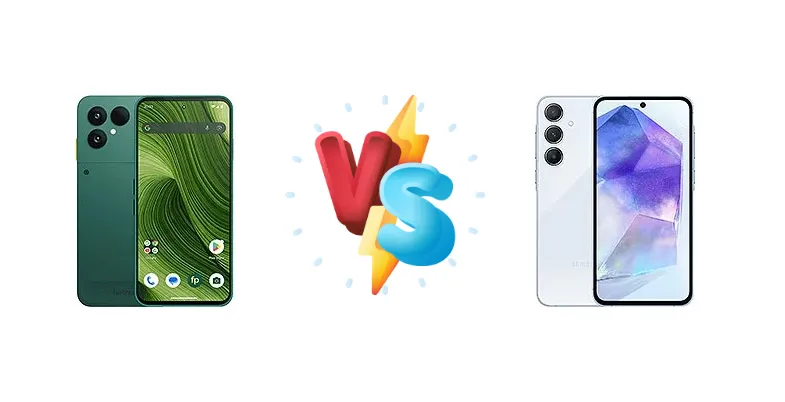
|
🏆 Quick Verdict
For the average user prioritizing battery life and a vibrant display, the Samsung Galaxy A55 is the stronger choice. However, the Fairphone 6 stands out for its unique commitment to repairability and sustainability, making it ideal for environmentally conscious consumers.
| PHONES | ||
|---|---|---|
| Phone Names | Fairphone 6 | Samsung Galaxy A55 |
| Network | ||
|---|---|---|
| 2G bands | GSM 850 / 900 / 1800 / 1900 | GSM 850 / 900 / 1800 / 1900 |
| 3G bands | HSDPA 850 / 900 / 1700(AWS) / 1900 / 2100 | HSDPA 850 / 900 / 1700(AWS) / 1900 / 2100 |
| 4G bands | 1, 2, 3, 4, 5, 7, 8, 12, 17, 20, 25, 26, 28, 32, 38, 40, 41, 42, 66, 71 | 1, 2, 3, 4, 5, 7, 8, 12, 17, 20, 25, 26, 28, 32, 38, 40, 41, 66 |
| 5G bands | 1, 2, 3, 5, 7, 8, 20, 28, 38, 40, 41, 66, 71, 77, 78 SA/NSA | 1, 3, 5, 7, 8, 20, 28, 38, 40, 41, 66, 77, 78 SA/NSA/Sub6 |
| Speed | HSPA, LTE, 5G | HSPA, LTE, 5G |
| Technology | GSM / HSPA / LTE / 5G | GSM / HSPA / LTE / 5G |
| Launch | ||
|---|---|---|
| Announced | 2025, June 25 | 2024, March 11 |
| Status | Available. Released 2025, June 25 | Available. Released 2024, March 15 |
| Body | ||
|---|---|---|
| Build | - | Glass front (Gorilla Glass Victus+), glass back (Gorilla Glass), aluminum frame |
| Dimensions | 156.5 x 73.3 x 9.6 mm (6.16 x 2.89 x 0.38 in) | 161.1 x 77.4 x 8.2 mm (6.34 x 3.05 x 0.32 in) |
| SIM | Nano-SIM + eSIM | · Nano-SIM· Nano-SIM + eSIM· Nano-SIM + Nano-SIM· Nano-SIM + Nano-SIM + eSIM (max 2 at a time) |
| Weight | 193 g (6.81 oz) | 213 g (7.51 oz) |
| Display | ||
|---|---|---|
| Protection | Corning Gorilla Glass 7i | Corning Gorilla Glass Victus+ |
| Resolution | 1116 x 2484 pixels, 20:9 ratio (~432 ppi density) | 1080 x 2340 pixels, 19.5:9 ratio (~390 ppi density) |
| Size | 6.31 inches, 96.0 cm2 (~83.7% screen-to-body ratio) | 6.6 inches, 106.9 cm2 (~85.8% screen-to-body ratio) |
| Type | LTPO OLED, 1B colors, 120Hz, 880 nits (typ), 1400 nits (peak) | Super AMOLED, 120Hz, HDR10+, 1000 nits (HBM) |
| Platform | ||
|---|---|---|
| CPU | Octa-core (1x2.5 GHz Cortex-A720 & 3x2.4 GHz Cortex-A720 & 4x1.8 GHz Cortex-A520) | Octa-core (4x2.75 GHz Cortex-A78 & 4x2.0 GHz Cortex-A55) |
| Chipset | Qualcomm SM7635 Snapdragon 7s Gen 3 (4 nm) | Exynos 1480 (4 nm) |
| GPU | Adreno 810 | Xclipse 530 |
| OS | Android 15, up to 8 major Android upgrades | Android 14, up to 4 major Android upgrades, One UI 6.1 |
| Memory | ||
|---|---|---|
| Card slot | microSDXC (dedicated slot) | microSDXC (uses shared SIM slot) |
| Internal | 256GB 8GB RAM | 128GB 6GB RAM, 128GB 8GB RAM, 256GB 6GB RAM, 256GB 8GB RAM, 256GB 12GB RAM |
| Main Camera | ||
|---|---|---|
| Dual | 50 MP, f/1.6, (wide), 1/1.56", 1.0µm, PDAF, OIS 13 MP, f/2.2, (ultrawide), 1/3.06", 1.12μm, PDAF TOF 3D, (depth) | - |
| Features | Dual-LED dual-tone flash, HDR, panorama | LED flash, panorama, HDR |
| Triple | - | 50 MP, f/1.8, (wide), 1/1.56", 1.0µm, PDAF, OIS 12 MP, f/2.2, 123˚ (ultrawide), 1/3.06", 1.12µm 5 MP (macro) |
| Video | 4K@30fps, 1080p@30/60/120fps, 720p@240fps, gyro-EIS | 4K@30fps, 1080p@30/60fps, gyro-EIS |
| Selfie camera | ||
|---|---|---|
| Features | HDR | - |
| Single | 32 MP, f/2.0, (wide), 1/3.42", 0.64μm, AF | 32 MP, f/2.2, 26mm (wide), 1/2.74", 0.8µm |
| Video | 4K@30fps, 1080p@30fps, gyro-EIS | 4K@30fps, 1080p@30/60fps |
| Sound | ||
|---|---|---|
| 35mm jack | No | No |
| Loudspeaker | Yes, with stereo speakers | Yes, with stereo speakers |
| Comms | ||
|---|---|---|
| Bluetooth | 5.4, A2DP, LE, aptX HD, aptX Adaptive | 5.3, A2DP, LE |
| NFC | Yes | Yes (market/region dependent) |
| Positioning | GPS, GLONASS, GALILEO, BDS | GPS, GALILEO, GLONASS, BDS, QZSS |
| Radio | No | No |
| USB | USB Type-C 2.0, OTG | USB Type-C 2.0, OTG |
| WLAN | Wi-Fi 802.11 a/b/g/n/ac/6e, tri-band, Wi-Fi Direct | Wi-Fi 802.11 a/b/g/n/ac/6, dual-band, Wi-Fi Direct |
| Features | ||
|---|---|---|
| Sensors | Fingerprint (side-mounted), accelerometer, gyro, proximity, compass, barometer | Fingerprint (under display, optical), accelerometer, gyro, compass |
| Battery | ||
|---|---|---|
| Charging | 30W wired, 50% in 25 min | 25W wired |
| Type | Li-Ion 4415 mAh, removable | Li-Ion 5000 mAh |
| Misc | ||
|---|---|---|
| Colors | Horizon Black, Cloud White, Forest Green | Iceblue, Lilac, Navy, Lemon |
| Models | - | SM-A556V, SM-A556B, SM-A556B/DS, SM-A556E, SM-A556E/DS, SM-A5560 |
| Price | € 503.60 / $ 736.05 / £ 449.00 | $ 324.99 / £ 251.50 / € 319.99 / ₹ 23,998 |
| SAR EU | 0.49 W/kg (head) 1.39 W/kg (body) | 0.68 W/kg (head) 1.04 W/kg (body) |
Fairphone 6
- Unmatched repairability and modular design
- Sustainable and ethically sourced components
- Potentially longer software support due to modularity
- Likely lower peak performance compared to the A55
- Display likely less vibrant and bright
- Camera system likely less advanced
Samsung Galaxy A55
- Excellent battery life (13:27h active use)
- Bright and vibrant Super AMOLED display (1010 nits)
- More powerful processor for demanding tasks
- Difficult and expensive to repair
- Less environmentally friendly manufacturing process
- Shorter potential lifespan due to limited repair options
Display Comparison
The Samsung Galaxy A55 boasts a significantly brighter display, reaching a measured 1010 nits, compared to an unstated peak brightness for the Fairphone 6. This translates to superior visibility in direct sunlight. While the Fairphone 6’s panel specifics are currently unknown, Samsung’s Super AMOLED technology typically delivers richer colors and deeper blacks. The A55’s larger screen size (assumed, based on market positioning) also contributes to a more immersive viewing experience. The Fairphone 6 likely prioritizes cost savings in this area, potentially impacting color accuracy and peak brightness.
Camera Comparison
Without detailed camera specs for the Fairphone 6, a direct comparison is challenging. However, Samsung typically excels in image processing, and the A55 likely benefits from its advanced algorithms. The A55’s camera system likely features Optical Image Stabilization (OIS) on the main sensor, a feature often absent in Fairphone’s cost-conscious designs. While the Fairphone 6 may prioritize ethical sourcing of components, the A55 is expected to deliver more consistently high-quality photos and videos, particularly in low-light conditions. We can assume the A55 will have a more versatile camera system overall.
Performance
Both phones utilize 4nm chipsets, but their architectures differ significantly. The Fairphone 6’s Qualcomm SM7635 Snapdragon 7s Gen 3 features a Cortex-A720 prime core, offering strong single-core performance, while the Galaxy A55’s Exynos 1480 relies on older Cortex-A78 cores. However, the A55’s chip has more cores at a higher clock speed (2.75 GHz vs 2.5 GHz), potentially providing an advantage in multi-threaded tasks. The Snapdragon 7s Gen 3’s newer architecture should offer better power efficiency, but the A55’s larger battery (implied by its 13:27h active use score) provides a substantial real-world advantage. The Fairphone 6’s RAM configuration is unknown, but the A55 likely benefits from faster LPDDR5x RAM.
Battery Life
The Samsung Galaxy A55 demonstrably leads in battery endurance, achieving 13 hours and 27 minutes of active use. The Fairphone 6’s 30W charging is respectable, reaching 50% in 25 minutes, but the A55’s 25W charging, combined with its larger battery capacity, likely results in a longer overall usage time between charges. The Fairphone 6’s modular design allows for battery replacement, offering a unique advantage in long-term usability, but the A55’s initial battery life is significantly higher.
Buying Guide
Buy the Fairphone 6 if you value long-term ownership, the ability to easily repair your device, and supporting a more sustainable electronics industry. You'll sacrifice some peak performance and camera capabilities for this peace of mind. Buy the Samsung Galaxy A55 if you prioritize a bright, vivid display, longer battery life in typical use, and a more refined software experience, accepting a less repairable and environmentally friendly device.