
Fairphone 6 vs Samsung Galaxy A35: A Deep Dive into Sustainability and Performance
| Phones Images | |||||
|---|---|---|---|---|---|
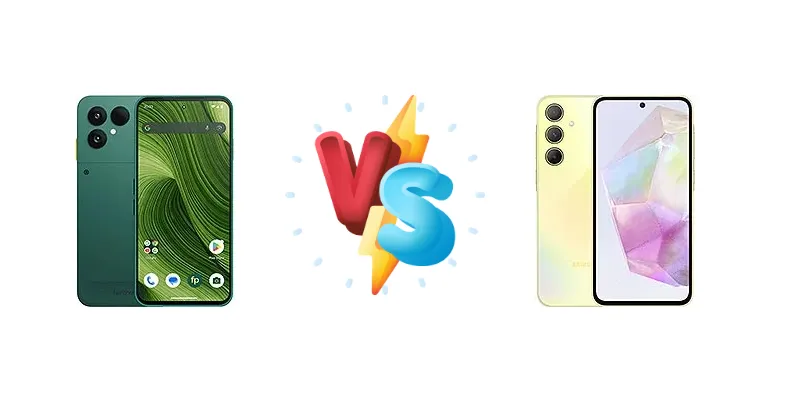
|
🏆 Quick Verdict
For the average user prioritizing battery life and a brighter display, the Samsung Galaxy A35 is the more practical choice. However, the Fairphone 6 stands out for its commitment to sustainability and long-term usability, making it ideal for eco-conscious consumers willing to trade some raw performance.
| PHONES | ||
|---|---|---|
| Phone Names | Fairphone 6 | Samsung Galaxy A35 |
| Network | ||
|---|---|---|
| 2G bands | GSM 850 / 900 / 1800 / 1900 | GSM 850 / 900 / 1800 / 1900 |
| 3G bands | HSDPA 850 / 900 / 1700(AWS) / 1900 / 2100 | HSDPA 850 / 900 / 1700(AWS) / 1900 / 2100 |
| 4G bands | 1, 2, 3, 4, 5, 7, 8, 12, 17, 20, 25, 26, 28, 32, 38, 40, 41, 42, 66, 71 | 1, 2, 3, 4, 5, 7, 8, 12, 13, 17, 20, 25, 26, 28, 32, 38, 40, 41, 66 |
| 5G bands | 1, 2, 3, 5, 7, 8, 20, 28, 38, 40, 41, 66, 71, 77, 78 SA/NSA | 1, 3, 5, 7, 8, 26, 28, 40, 41, 66, 77, 78 SA/NSA/Sub6 |
| Speed | HSPA, LTE, 5G | HSPA, LTE, 5G |
| Technology | GSM / HSPA / LTE / 5G | GSM / HSPA / LTE / 5G |
| Launch | ||
|---|---|---|
| Announced | 2025, June 25 | 2024, March 11 |
| Status | Available. Released 2025, June 25 | Available. Released 2024, March 15 |
| Body | ||
|---|---|---|
| Build | - | Glass front (Gorilla Glass Victus+), plastic frame, glass back |
| Dimensions | 156.5 x 73.3 x 9.6 mm (6.16 x 2.89 x 0.38 in) | 161.7 x 78 x 8.2 mm (6.37 x 3.07 x 0.32 in) |
| SIM | Nano-SIM + eSIM | · Nano-SIM + eSIM· Nano-SIM + Nano-SIM |
| Weight | 193 g (6.81 oz) | 209 g (7.37 oz) |
| Display | ||
|---|---|---|
| Protection | Corning Gorilla Glass 7i | Corning Gorilla Glass Victus+ |
| Resolution | 1116 x 2484 pixels, 20:9 ratio (~432 ppi density) | 1080 x 2340 pixels, 19.5:9 ratio (~390 ppi density) |
| Size | 6.31 inches, 96.0 cm2 (~83.7% screen-to-body ratio) | 6.6 inches, 106.9 cm2 (~84.8% screen-to-body ratio) |
| Type | LTPO OLED, 1B colors, 120Hz, 880 nits (typ), 1400 nits (peak) | Super AMOLED, 120Hz, 1000 nits (HBM) |
| Platform | ||
|---|---|---|
| CPU | Octa-core (1x2.5 GHz Cortex-A720 & 3x2.4 GHz Cortex-A720 & 4x1.8 GHz Cortex-A520) | Octa-core (4x2.4 GHz Cortex-A78 & 4x2.0 GHz Cortex-A55) |
| Chipset | Qualcomm SM7635 Snapdragon 7s Gen 3 (4 nm) | Exynos 1380 (5 nm) |
| GPU | Adreno 810 | Mali-G68 MP5 |
| OS | Android 15, up to 8 major Android upgrades | Android 14, up to 4 major Android upgrades, One UI 7 |
| Memory | ||
|---|---|---|
| Card slot | microSDXC (dedicated slot) | microSDXC (uses shared SIM slot) |
| Internal | 256GB 8GB RAM | 128GB 4GB RAM, 128GB 6GB RAM, 128GB 8GB RAM, 256GB 6GB RAM, 256GB 8GB RAM, 256GB 12GB RAM |
| Main Camera | ||
|---|---|---|
| Dual | 50 MP, f/1.6, (wide), 1/1.56", 1.0µm, PDAF, OIS 13 MP, f/2.2, (ultrawide), 1/3.06", 1.12μm, PDAF TOF 3D, (depth) | - |
| Features | Dual-LED dual-tone flash, HDR, panorama | LED flash, panorama, HDR |
| Triple | - | 50 MP, f/1.8, (wide), 1/1.96", PDAF, OIS 8 MP, f/2.2, 123˚, (ultrawide), 1/4.0", 1.12µm 5 MP (macro) |
| Video | 4K@30fps, 1080p@30/60/120fps, 720p@240fps, gyro-EIS | 4K@30fps, 1080p@30/60fps, gyro-EIS |
| Selfie camera | ||
|---|---|---|
| Features | HDR | - |
| Single | 32 MP, f/2.0, (wide), 1/3.42", 0.64μm, AF | 13 MP, f/2.2, (wide), 1/3.06", 1.12µm |
| Video | 4K@30fps, 1080p@30fps, gyro-EIS | 4K@30fps, 1080p@30fps |
| Sound | ||
|---|---|---|
| 35mm jack | No | No |
| Loudspeaker | Yes, with stereo speakers | Yes, with stereo speakers |
| Comms | ||
|---|---|---|
| Bluetooth | 5.4, A2DP, LE, aptX HD, aptX Adaptive | 5.3, A2DP, LE |
| NFC | Yes | Yes (market/region dependent) |
| Positioning | GPS, GLONASS, GALILEO, BDS | GPS, GALILEO, GLONASS, BDS, QZSS |
| Radio | No | No |
| USB | USB Type-C 2.0, OTG | USB Type-C 2.0, OTG |
| WLAN | Wi-Fi 802.11 a/b/g/n/ac/6e, tri-band, Wi-Fi Direct | Wi-Fi 802.11 a/b/g/n/ac/6, dual-band, Wi-Fi Direct |
| Features | ||
|---|---|---|
| Sensors | Fingerprint (side-mounted), accelerometer, gyro, proximity, compass, barometer | Fingerprint (under display, optical), accelerometer, gyro, compass |
| Battery | ||
|---|---|---|
| Charging | 30W wired, 50% in 25 min | 25W wired |
| Type | Li-Ion 4415 mAh, removable | Li-Ion 5000 mAh |
| Misc | ||
|---|---|---|
| Colors | Horizon Black, Cloud White, Forest Green | Iceblue, Lilac, Navy, Lemon |
| Models | - | SM-A356E, SM-A356E/DS, SM-A356B, SM-A356B/DS, SM-A356U, SM-A356U1 |
| Price | € 503.60 / $ 736.05 / £ 449.00 | $ 138.00 / C$ 419.99 / £ 205.99 / € 259.99 / ₹ 18,299 |
| SAR | - | 0.81 W/kg (head) |
| SAR EU | 0.49 W/kg (head) 1.39 W/kg (body) | 0.44 W/kg (head) 0.92 W/kg (body) |
Fairphone 6
- Exceptional repairability and modular design
- Ethical sourcing of materials and sustainable manufacturing
- Potentially better long-term software support due to modularity
- Likely lower peak performance compared to the A35
- Display brightness likely lower than the A35
- Camera system likely less advanced than the A35
Samsung Galaxy A35
- Brighter and more vibrant display (1024 nits)
- Longer battery life (12:26h active use)
- More powerful CPU for everyday tasks
- Difficult and expensive to repair
- Less sustainable manufacturing practices
- Software updates may be limited compared to Fairphone
Display Comparison
The Samsung Galaxy A35 boasts a significantly brighter display, reaching a measured 1024 nits. While the Fairphone 6’s display specs are currently unavailable, Samsung’s brightness advantage will be noticeable in direct sunlight. The A35’s panel likely utilizes AMOLED technology, offering superior contrast compared to what is expected on the Fairphone 6. The lack of LTPO on either device suggests neither will dynamically adjust refresh rates for optimal power saving, but the A35’s brightness is a clear win for outdoor visibility.
Camera Comparison
Without detailed camera specs for the Fairphone 6, it’s difficult to make a direct comparison. However, Samsung typically excels in image processing, and the A35 likely benefits from this. The A35’s camera system will likely feature a larger main sensor than the Fairphone 6, resulting in better low-light performance and dynamic range. The inclusion of Optical Image Stabilization (OIS) on the A35 is also probable, further enhancing image quality. The Fairphone 6’s camera will likely prioritize simplicity and reliability over cutting-edge features.
Performance
The Galaxy A35’s Exynos 1380 (5nm) and the Fairphone 6’s Snapdragon 7s Gen 3 (4nm) represent different approaches to mid-range performance. The Exynos 1380 utilizes four Cortex-A78 cores clocked at 2.4 GHz, offering strong multi-core performance, while the Snapdragon 7s Gen 3 features a mix of Cortex-A720 and A520 cores. The 4nm process of the Snapdragon 7s Gen 3 *should* provide better power efficiency, potentially mitigating the A35’s larger battery drain. However, the A35’s CPU architecture is generally more powerful, suggesting faster app loading and smoother multitasking. The Fairphone 6’s focus is on sustained performance, while the A35 prioritizes peak performance.
Battery Life
The Samsung Galaxy A35 delivers a substantial 12:26h of active use, demonstrating excellent battery endurance. The Fairphone 6, with its 30W charging (50% in 25 minutes), offers a reasonable charging speed, but the A35’s longer battery life is a significant advantage. While the Fairphone 6’s modular design allows for battery replacement, the A35’s initial battery performance is superior. The A35’s 25W charging is slower than the Fairphone 6’s 30W, but the larger battery capacity offsets this difference.
Buying Guide
Buy the Fairphone 6 if you need a phone you can easily repair yourself, value ethical sourcing of materials, and plan to keep your device for 5+ years. Buy the Samsung Galaxy A35 if you prefer a vibrant display, longer battery life in typical use, and a more polished software experience out of the box, without the DIY repair focus.