
Fairphone 6 vs Nokia G42: A Deep Dive into Sustainability and Performance
| Phones Images | |||||
|---|---|---|---|---|---|
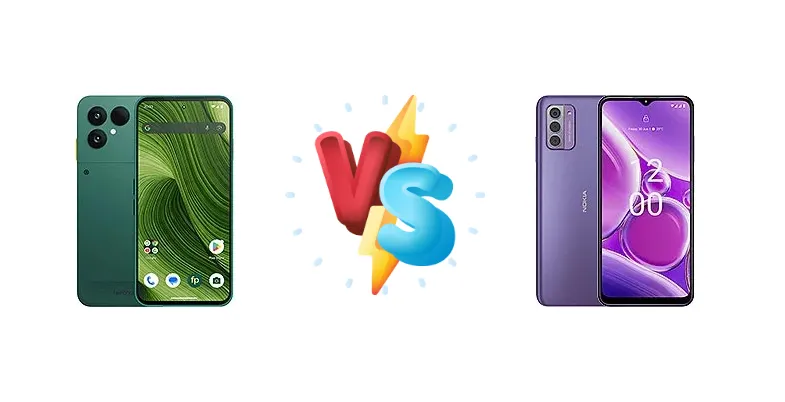
|
🏆 Quick Verdict
For users prioritizing long-term ownership, repairability, and a smoother user experience, the Fairphone 6 is the clear winner. Its Snapdragon 7s Gen 3 chipset provides significantly better performance and efficiency. However, the Nokia G42 offers compelling value for budget-conscious buyers needing 5G and basic functionality.
| PHONES | ||
|---|---|---|
| Phone Names | Fairphone 6 | Nokia G42 |
| Network | ||
|---|---|---|
| 2G bands | GSM 850 / 900 / 1800 / 1900 | GSM 850 / 900 / 1800 / 1900 |
| 3G bands | HSDPA 850 / 900 / 1700(AWS) / 1900 / 2100 | HSDPA 850 / 900 / 1700(AWS) / 1900 / 2100 |
| 4G bands | 1, 2, 3, 4, 5, 7, 8, 12, 17, 20, 25, 26, 28, 32, 38, 40, 41, 42, 66, 71 | 1, 2, 3, 4, 5, 7, 8, 12, 17, 13, 20, 28, 38, 39, 40, 41, 66 |
| 5G bands | 1, 2, 3, 5, 7, 8, 20, 28, 38, 40, 41, 66, 71, 77, 78 SA/NSA | 1, 2, 3, 5, 7, 8, 28, 40, 41, 66, 77, 78 SA/NSA |
| Speed | HSPA, LTE, 5G | HSPA, LTE, 5G |
| Technology | GSM / HSPA / LTE / 5G | GSM / HSPA / LTE / 5G |
| Launch | ||
|---|---|---|
| Announced | 2025, June 25 | 2023, June 28 |
| Status | Available. Released 2025, June 25 | Available. Released 2023, June 28 |
| Body | ||
|---|---|---|
| Build | - | Glass front, plastic back, plastic frame |
| Dimensions | 156.5 x 73.3 x 9.6 mm (6.16 x 2.89 x 0.38 in) | 165 x 75.8 x 8.6 mm (6.50 x 2.98 x 0.34 in) |
| SIM | Nano-SIM + eSIM | · Nano-SIM· Nano-SIM + Nano-SIM |
| Weight | 193 g (6.81 oz) | 193.8 g (6.84 oz) |
| Display | ||
|---|---|---|
| Protection | Corning Gorilla Glass 7i | Corning Gorilla Glass 3 |
| Resolution | 1116 x 2484 pixels, 20:9 ratio (~432 ppi density) | 720 x 1612 pixels, 20:9 ratio (~269 ppi density) |
| Size | 6.31 inches, 96.0 cm2 (~83.7% screen-to-body ratio) | 6.56 inches, 103.4 cm2 (~82.7% screen-to-body ratio) |
| Type | LTPO OLED, 1B colors, 120Hz, 880 nits (typ), 1400 nits (peak) | IPS LCD, 90Hz, 450 nits (typ), 560 nits (peak) |
| Platform | ||
|---|---|---|
| CPU | Octa-core (1x2.5 GHz Cortex-A720 & 3x2.4 GHz Cortex-A720 & 4x1.8 GHz Cortex-A520) | Octa-core (2x2.2 GHz Kryo 460 & 6x1.8 GHz Kryo 460) |
| Chipset | Qualcomm SM7635 Snapdragon 7s Gen 3 (4 nm) | Qualcomm SM4350-AC Snapdragon 480+ 5G (8 nm) |
| GPU | Adreno 810 | Adreno 619 |
| OS | Android 15, up to 8 major Android upgrades | Android 13, upgradable to Android 14 |
| Memory | ||
|---|---|---|
| Card slot | microSDXC (dedicated slot) | microSDXC |
| Internal | 256GB 8GB RAM | 128GB 4GB RAM, 128GB 6GB RAM, 256GB 8GB RAM |
| Main Camera | ||
|---|---|---|
| Dual | 50 MP, f/1.6, (wide), 1/1.56", 1.0µm, PDAF, OIS 13 MP, f/2.2, (ultrawide), 1/3.06", 1.12μm, PDAF TOF 3D, (depth) | - |
| Features | Dual-LED dual-tone flash, HDR, panorama | LED flash, HDR, panorama |
| Triple | - | 50 MP, f/1.8, (wide), AF 2 MP (macro) Auxiliary lens |
| Video | 4K@30fps, 1080p@30/60/120fps, 720p@240fps, gyro-EIS | 1080p@30fps |
| Selfie camera | ||
|---|---|---|
| Features | HDR | - |
| Single | 32 MP, f/2.0, (wide), 1/3.42", 0.64μm, AF | 8 MP |
| Video | 4K@30fps, 1080p@30fps, gyro-EIS | Yes |
| Sound | ||
|---|---|---|
| 35mm jack | No | Yes |
| Loudspeaker | Yes, with stereo speakers | Yes |
| Comms | ||
|---|---|---|
| Bluetooth | 5.4, A2DP, LE, aptX HD, aptX Adaptive | 5.1, A2DP, LE |
| NFC | Yes | Yes (market/region dependent) |
| Positioning | GPS, GLONASS, GALILEO, BDS | GPS, GLONASS, GALILEO, BDS |
| Radio | No | FM radio |
| USB | USB Type-C 2.0, OTG | USB Type-C 2.0, OTG |
| WLAN | Wi-Fi 802.11 a/b/g/n/ac/6e, tri-band, Wi-Fi Direct | Wi-Fi 802.11 a/b/g/n/ac/6, dual-band |
| Features | ||
|---|---|---|
| Sensors | Fingerprint (side-mounted), accelerometer, gyro, proximity, compass, barometer | Fingerprint (side-mounted), accelerometer, proximity, compass |
| Battery | ||
|---|---|---|
| Charging | 30W wired, 50% in 25 min | 20W wired, PD3.0, QC3 |
| Type | Li-Ion 4415 mAh, removable | Li-Po 5000 mAh |
| Misc | ||
|---|---|---|
| Colors | Horizon Black, Cloud White, Forest Green | Gray, Purple, Red |
| Price | € 503.60 / $ 736.05 / £ 449.00 | $ 545.00 / £ 124.99 |
| SAR EU | 0.49 W/kg (head) 1.39 W/kg (body) | - |
Fairphone 6
- Significantly faster and more efficient Snapdragon 7s Gen 3 chipset
- Faster 30W charging
- Modular design for easy repair and upgrades
- Likely higher price point
- May have a less vibrant display than competitors
Nokia G42
- Affordable price
- 5G connectivity
- Simple and straightforward Android experience
- Slower Snapdragon 480+ chipset
- Slower 20W charging
- Limited repairability
Display Comparison
While display specifications are missing for both devices, the Nokia G42, typical of its price bracket, likely utilizes an LCD panel. The Fairphone 6, given its higher overall positioning, may incorporate an AMOLED display for richer colors and deeper blacks. The Nokia G42’s focus on cost-cutting likely means larger bezels and a lower peak brightness compared to what the Fairphone 6 could offer. The Fairphone’s potential for a higher quality panel will translate to a more immersive viewing experience.
Camera Comparison
Without detailed camera specs, it’s difficult to make precise comparisons. However, the Fairphone 6, positioned as a premium device, is expected to feature a more capable main sensor and image processing pipeline. The Nokia G42 likely relies on a more basic camera setup to keep costs down. The Fairphone’s focus on user control and software updates may also result in better long-term camera performance through software optimizations. We can expect the Fairphone 6 to offer more detailed images and better low-light performance.
Performance
The core difference lies in the chipsets. The Fairphone 6’s Qualcomm SM7635 Snapdragon 7s Gen 3 (4nm) is a substantial upgrade over the Nokia G42’s Snapdragon 480+ 5G (8nm). The 4nm process node of the Snapdragon 7s Gen 3 delivers superior power efficiency and thermal performance, meaning less throttling during sustained workloads. The Fairphone 6’s CPU configuration – 1x2.5 GHz Cortex-A720, 3x2.4 GHz Cortex-A720, and 4x1.8 GHz Cortex-A520 – provides a more balanced and powerful processing core compared to the Nokia G42’s 2x2.2 GHz Kryo 460 & 6x1.8 GHz Kryo 460. This translates to faster app loading times, smoother multitasking, and improved gaming performance on the Fairphone 6.
Battery Life
The Fairphone 6’s 30W wired charging, capable of reaching 50% in 25 minutes, is faster than the Nokia G42’s 20W charging with PD3.0 and QC3. While battery capacity is unknown for both, the Snapdragon 7s Gen 3’s superior efficiency in the Fairphone 6 will likely result in comparable or better real-world battery life despite potentially having a smaller battery capacity. The faster charging speed of the Fairphone 6 is a significant convenience factor for users who need to quickly top up their device.
Buying Guide
Buy the Fairphone 6 if you need a phone designed to last for years, value the ability to repair it yourself, and demand a responsive user experience for everyday tasks and moderate gaming. Buy the Nokia G42 if you prioritize affordability, 5G connectivity, and a simple, straightforward Android experience, and are less concerned with long-term repairability or peak performance.