
Fairphone 6 vs. Google Pixel 7a: A Deep Dive into Sustainability and Performance
| Phones Images | |||||
|---|---|---|---|---|---|
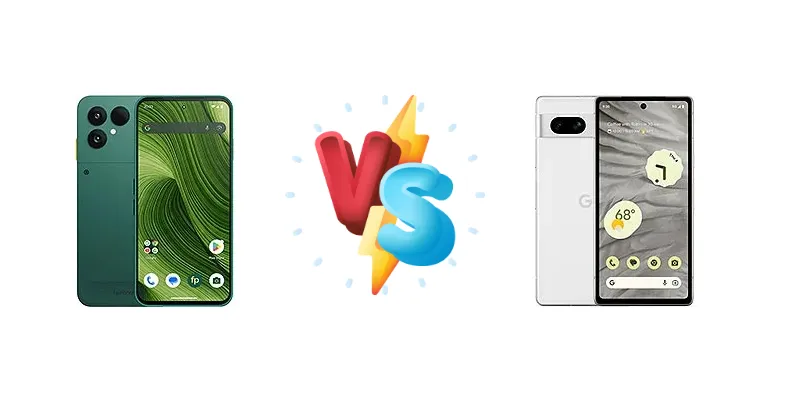
|
🏆 Quick Verdict
For the average user prioritizing camera quality and a seamless software experience, the Google Pixel 7a is the better choice. However, the Fairphone 6 stands out for its unparalleled repairability and commitment to sustainability, making it ideal for environmentally conscious users and those seeking long-term device ownership.
| PHONES | ||
|---|---|---|
| Phone Names | Fairphone 6 | Google Pixel 7a |
| Network | ||
|---|---|---|
| 2G bands | GSM 850 / 900 / 1800 / 1900 | GSM 850 / 900 / 1800 / 1900 |
| 3G bands | HSDPA 850 / 900 / 1700(AWS) / 1900 / 2100 | HSDPA 800 / 850 / 900 / 1700(AWS) / 1900 / 2100 |
| 4G bands | 1, 2, 3, 4, 5, 7, 8, 12, 17, 20, 25, 26, 28, 32, 38, 40, 41, 42, 66, 71 | 1, 2, 3, 4, 5, 7, 8, 12, 13, 14, 17, 20, 25, 26, 28, 29, 30, 38, 40, 41, 48, 66, 71 - GWKK3, G0DZQ |
| 5G bands | 1, 2, 3, 5, 7, 8, 20, 28, 38, 40, 41, 66, 71, 77, 78 SA/NSA | 1, 2, 3, 5, 7, 8, 12, 14, 20, 25, 28, 30, 38, 41, 48, 66, 71, 77, 78 SA/NSA/Sub6 - GWKK3 |
| Speed | HSPA, LTE, 5G | HSPA, LTE, 5G |
| Technology | GSM / HSPA / LTE / 5G | GSM / HSPA / LTE / 5G |
| - | 1, 2, 3, 5, 7, 8, 12, 20, 25, 28, 38, 40, 41, 66, 75, 76, 77, 78, 79 SA/NSA/Sub6 - GHL1X, G82U8 | |
| Launch | ||
|---|---|---|
| Announced | 2025, June 25 | 2023, May 10 |
| Status | Available. Released 2025, June 25 | Available. Released 2023, May 10 |
| Body | ||
|---|---|---|
| Build | - | Glass front (Gorilla Glass 3), aluminum frame, plastic back |
| Dimensions | 156.5 x 73.3 x 9.6 mm (6.16 x 2.89 x 0.38 in) | 152 x 72.9 x 9 mm (5.98 x 2.87 x 0.35 in) |
| SIM | Nano-SIM + eSIM | Nano-SIM + eSIM |
| Weight | 193 g (6.81 oz) | 193.5 g (6.84 oz) |
| - | IP67 dust/water resistant (up to 1m for 30 min) | |
| Display | ||
|---|---|---|
| Protection | Corning Gorilla Glass 7i | Corning Gorilla Glass 3 |
| Resolution | 1116 x 2484 pixels, 20:9 ratio (~432 ppi density) | 1080 x 2400 pixels, 20:9 ratio (~429 ppi density) |
| Size | 6.31 inches, 96.0 cm2 (~83.7% screen-to-body ratio) | 6.1 inches, 90.7 cm2 (~81.8% screen-to-body ratio) |
| Type | LTPO OLED, 1B colors, 120Hz, 880 nits (typ), 1400 nits (peak) | OLED, HDR, 90Hz |
| - | Always-on display | |
| Platform | ||
|---|---|---|
| CPU | Octa-core (1x2.5 GHz Cortex-A720 & 3x2.4 GHz Cortex-A720 & 4x1.8 GHz Cortex-A520) | Octa-core (2x2.85 GHz Cortex-X1 & 2x2.35 GHz Cortex-A78 & 4x1.80 GHz Cortex-A55) |
| Chipset | Qualcomm SM7635 Snapdragon 7s Gen 3 (4 nm) | Google Tensor G2 (5 nm) |
| GPU | Adreno 810 | Mali-G710 MP7 |
| OS | Android 15, up to 8 major Android upgrades | Android 13, upgradable to Android 15, up to 5 major Android upgrades |
| Memory | ||
|---|---|---|
| Card slot | microSDXC (dedicated slot) | No |
| Internal | 256GB 8GB RAM | 128GB 8GB RAM |
| - | UFS 3.1 | |
| Main Camera | ||
|---|---|---|
| Dual | 50 MP, f/1.6, (wide), 1/1.56", 1.0µm, PDAF, OIS 13 MP, f/2.2, (ultrawide), 1/3.06", 1.12μm, PDAF TOF 3D, (depth) | 64 MP, f/1.9, 26mm (wide), 1/1.73", 0.8µm, dual pixel PDAF, OIS 13 MP, f/2.2, 120˚ (ultrawide), 1.12µm |
| Features | Dual-LED dual-tone flash, HDR, panorama | Dual-LED flash, Pixel Shift, Auto-HDR, panorama |
| Video | 4K@30fps, 1080p@30/60/120fps, 720p@240fps, gyro-EIS | 4K@30/60fps, 1080p@30/60/120/240fps, OIS |
| Selfie camera | ||
|---|---|---|
| Features | HDR | HDR, panorama |
| Single | 32 MP, f/2.0, (wide), 1/3.42", 0.64μm, AF | 13 MP, f/2.2, 20mm (ultrawide), 1.12µm |
| Video | 4K@30fps, 1080p@30fps, gyro-EIS | 4K@30fps, 1080p@30fps |
| Sound | ||
|---|---|---|
| 3.5mm jack | - | No |
| 35mm jack | No | No |
| Loudspeaker | Yes, with stereo speakers | Yes, with stereo speakers |
| Comms | ||
|---|---|---|
| Bluetooth | 5.4, A2DP, LE, aptX HD, aptX Adaptive | 5.3, A2DP, LE |
| NFC | Yes | Yes |
| Positioning | GPS, GLONASS, GALILEO, BDS | GPS, GLONASS, GALILEO, BDS, QZSS, NavIC |
| Radio | No | No |
| USB | USB Type-C 2.0, OTG | USB Type-C 3.2 |
| WLAN | Wi-Fi 802.11 a/b/g/n/ac/6e, tri-band, Wi-Fi Direct | Wi-Fi 802.11 a/b/g/n/ac/6e, tri-band |
| Features | ||
|---|---|---|
| Sensors | Fingerprint (side-mounted), accelerometer, gyro, proximity, compass, barometer | Fingerprint (under display, optical), accelerometer, gyro, proximity, compass, barometer |
| Battery | ||
|---|---|---|
| Charging | 30W wired, 50% in 25 min | 18W wired, PD3.0 7.5W wireless |
| Type | Li-Ion 4415 mAh, removable | Li-Po 4385 mAh |
| Misc | ||
|---|---|---|
| Colors | Horizon Black, Cloud White, Forest Green | Charcoal, Snow, Sea, Coral |
| Models | - | GWKK3, GHL1X, G0DZQ, G82U8 |
| Price | € 503.60 / $ 736.05 / £ 449.00 | € 179.90 / $ 150.00 / £ 170.00 / ₹ 25,980 |
| SAR EU | 0.49 W/kg (head) 1.39 W/kg (body) | - |
Fairphone 6
- Unmatched repairability and modular design
- Commitment to ethical sourcing and sustainability
- Faster 30W charging
- Long-term software support through community
- Potentially lower peak performance compared to the Pixel 7a
- Camera system likely not as advanced as the Pixel 7a
Google Pixel 7a
- Superior camera quality and computational photography
- Powerful Google Tensor G2 chip with AI features
- Brighter display for better outdoor visibility
- Smooth and optimized Android experience
- Limited repairability and difficult to upgrade
- Slower 18W charging
Display Comparison
The Pixel 7a boasts a significantly brighter display, reaching a measured 1070 nits, compared to the Fairphone 6’s unspecified peak brightness. This translates to better outdoor visibility for the Pixel 7a. While the Fairphone 6’s display specifications are currently limited, the Pixel 7a’s OLED panel delivers vibrant colors and deep blacks. The Pixel 7a’s display is likely to have a standard 60Hz refresh rate, while the Fairphone 6’s refresh rate is currently unknown, but a higher refresh rate would be a benefit for smoother scrolling and animations.
Camera Comparison
The Pixel 7a is expected to excel in camera performance, leveraging Google’s computational photography expertise. While specific sensor details are missing for both phones, the Pixel 7a’s image processing pipeline is renowned for its dynamic range and accurate color reproduction. The Fairphone 6’s camera system, while likely competent, will likely not match the Pixel 7a’s capabilities in challenging lighting conditions or complex scenes. The Pixel 7a’s video recording capabilities are also expected to be superior, benefiting from the Tensor G2’s image signal processor.
Performance
The Google Pixel 7a’s Tensor G2 (5nm) chip, with its Cortex-X1 prime cores clocked at 2.85 GHz, offers a performance advantage over the Fairphone 6’s Snapdragon 7s Gen 3 (4nm). The Tensor G2’s architecture is optimized for machine learning tasks, powering features like Magic Eraser and Real Tone. While the Snapdragon 7s Gen 3 is a capable mid-range processor, its Cortex-A720 cores, even at 2.5 GHz, don’t match the raw processing power of the X1 cores. The 4nm process of the Snapdragon 7s Gen 3 should provide good efficiency, but the Tensor G2’s 5nm node may offer slightly better thermal management under sustained load. The Pixel 7a also benefits from potentially faster LPDDR5x RAM, further enhancing performance.
Battery Life
The Pixel 7a has an endurance rating of 76 hours, suggesting solid battery life despite its 18W wired charging and 7.5W wireless charging. The Fairphone 6 offers faster 30W wired charging, reaching 50% charge in 25 minutes, which is a significant advantage for quick top-ups. However, without knowing the Fairphone 6’s battery capacity, it’s difficult to definitively say which phone offers better overall battery life. The Pixel 7a’s PD3.0 support ensures compatibility with a wider range of chargers, while the Fairphone 6’s charging speed prioritizes convenience.
Buying Guide
Buy the Fairphone 6 if you need a phone you can easily repair yourself, value long-term software support through community efforts, and prioritize ethical sourcing and environmental responsibility. Buy the Google Pixel 7a if you prefer a superior camera system, benefit from Google’s AI features, and desire a consistently smooth and optimized Android experience out of the box.