
Fairphone 6 vs. Fairphone 4: A Detailed Comparison for the Conscious Consumer
| Phones Images | |||||
|---|---|---|---|---|---|
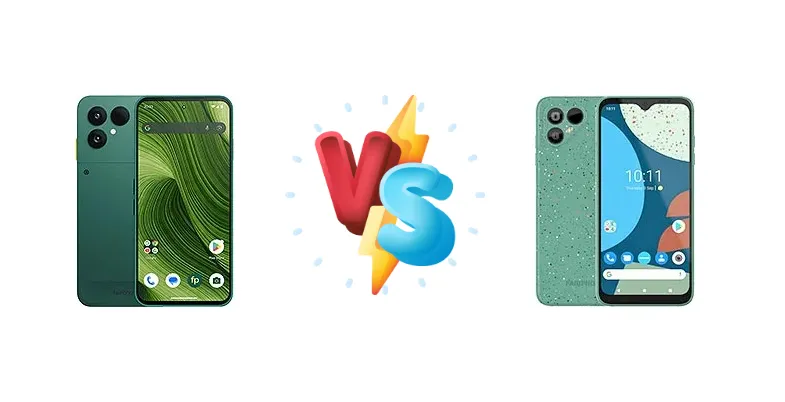
|
🏆 Quick Verdict
For most users, the Fairphone 6 is the superior choice. The Snapdragon 7s Gen 3 offers a noticeable performance boost and faster charging, while retaining the core Fairphone values of repairability and longevity. However, Fairphone 4 owners on a tight budget may find the 4 still adequate.
| PHONES | ||
|---|---|---|
| Phone Names | Fairphone 6 | Fairphone 4 |
| Network | ||
|---|---|---|
| 2G bands | GSM 850 / 900 / 1800 / 1900 | GSM 850 / 900 / 1800 / 1900 |
| 3G bands | HSDPA 850 / 900 / 1700(AWS) / 1900 / 2100 | HSDPA 850 / 900 / 1700(AWS) / 1900 / 2100 |
| 4G bands | 1, 2, 3, 4, 5, 7, 8, 12, 17, 20, 25, 26, 28, 32, 38, 40, 41, 42, 66, 71 | 1, 2, 3, 4, 5, 7, 8, 12, 18, 19, 20, 28, 32, 38, 40, 41, 71 |
| 5G bands | 1, 2, 3, 5, 7, 8, 20, 28, 38, 40, 41, 66, 71, 77, 78 SA/NSA | 1, 3, 5, 7, 8, 20, 28, 38, 41, 71, 77, 78 SA/NSA/Sub6 |
| Speed | HSPA, LTE, 5G | HSPA 42.2/5.76 Mbps, LTE (4CA) Cat18 1200/150 Mbps, 5G 2.3 Gbps DL |
| Technology | GSM / HSPA / LTE / 5G | GSM / HSPA / LTE / 5G |
| Launch | ||
|---|---|---|
| Announced | 2025, June 25 | 2021, September 30 |
| Status | Available. Released 2025, June 25 | Available. Released 2021, October 25 |
| Body | ||
|---|---|---|
| Build | - | Glass front (Gorilla Glass 5), aluminum frame, plastic back |
| Dimensions | 156.5 x 73.3 x 9.6 mm (6.16 x 2.89 x 0.38 in) | 162 x 75.5 x 10.5 mm (6.38 x 2.97 x 0.41 in) |
| SIM | Nano-SIM + eSIM | Nano-SIM + eSIM |
| Weight | 193 g (6.81 oz) | 225 g (7.94 oz) |
| - | IP54, dust and water resistant MIL-STD-810G compliant | |
| Display | ||
|---|---|---|
| Protection | Corning Gorilla Glass 7i | Corning Gorilla Glass 5 |
| Resolution | 1116 x 2484 pixels, 20:9 ratio (~432 ppi density) | 1080 x 2340 pixels, 19.5:9 ratio (~409 ppi density) |
| Size | 6.31 inches, 96.0 cm2 (~83.7% screen-to-body ratio) | 6.3 inches, 97.4 cm2 (~79.7% screen-to-body ratio) |
| Type | LTPO OLED, 1B colors, 120Hz, 880 nits (typ), 1400 nits (peak) | IPS LCD |
| Platform | ||
|---|---|---|
| CPU | Octa-core (1x2.5 GHz Cortex-A720 & 3x2.4 GHz Cortex-A720 & 4x1.8 GHz Cortex-A520) | Octa-core (2x2.2 GHz Kryo 570 & 6x1.8 GHz Kryo 570) |
| Chipset | Qualcomm SM7635 Snapdragon 7s Gen 3 (4 nm) | Qualcomm SM7225 Snapdragon 750G 5G (8 nm) |
| GPU | Adreno 810 | Adreno 619 |
| OS | Android 15, up to 8 major Android upgrades | Android 11, upgradable to Android 15 |
| Memory | ||
|---|---|---|
| Card slot | microSDXC (dedicated slot) | microSDXC (dedicated slot) |
| Internal | 256GB 8GB RAM | 128GB 6GB RAM, 256GB 8GB RAM |
| Main Camera | ||
|---|---|---|
| Dual | 50 MP, f/1.6, (wide), 1/1.56", 1.0µm, PDAF, OIS 13 MP, f/2.2, (ultrawide), 1/3.06", 1.12μm, PDAF TOF 3D, (depth) | 48 MP, f/1.6, (wide), 1/2.0", 0.8µm, PDAF, OIS 48 MP, f/2.2, (ultrawide), 1/2.0", 0.8µm, PDAF TOF 3D, (depth) |
| Features | Dual-LED dual-tone flash, HDR, panorama | Dual-LED dual-tone flash, HDR, panorama |
| Single | - | 25 MP, f/2.2, (wide), 1/2.78", 0.9µm |
| Video | 4K@30fps, 1080p@30/60/120fps, 720p@240fps, gyro-EIS | 4K@30fps, 1080p@30/60fps, gyro-EIS |
| Selfie camera | ||
|---|---|---|
| Features | HDR | HDR |
| Single | 32 MP, f/2.0, (wide), 1/3.42", 0.64μm, AF | 25 MP, f/2.2, (wide), 1/2.78", 0.9µm |
| Video | 4K@30fps, 1080p@30fps, gyro-EIS | 1080p@30fps, gyro-EIS |
| Sound | ||
|---|---|---|
| 3.5mm jack | - | No |
| 35mm jack | No | No |
| Loudspeaker | Yes, with stereo speakers | Yes |
| Comms | ||
|---|---|---|
| Bluetooth | 5.4, A2DP, LE, aptX HD, aptX Adaptive | 5.1, A2DP, LE |
| NFC | Yes | Yes |
| Positioning | GPS, GLONASS, GALILEO, BDS | GPS, GLONASS, GALILEO, BDS |
| Radio | No | No |
| USB | USB Type-C 2.0, OTG | USB Type-C 3.0, OTG, DisplayPort |
| WLAN | Wi-Fi 802.11 a/b/g/n/ac/6e, tri-band, Wi-Fi Direct | Wi-Fi 802.11 a/b/g/n/ac, dual-band, Wi-Fi Direct |
| Features | ||
|---|---|---|
| Sensors | Fingerprint (side-mounted), accelerometer, gyro, proximity, compass, barometer | Fingerprint (side-mounted), accelerometer, gyro, proximity, compass |
| - | Standard 5-year warranty | |
| Battery | ||
|---|---|---|
| Charging | 30W wired, 50% in 25 min | 20W wired, 50% in 30 min |
| Type | Li-Ion 4415 mAh, removable | Li-Ion 3905 mAh, removable |
| Misc | ||
|---|---|---|
| Colors | Horizon Black, Cloud White, Forest Green | Gray, Green, Speckled Green |
| Price | € 503.60 / $ 736.05 / £ 449.00 | About 400 EUR |
| SAR EU | 0.49 W/kg (head) 1.39 W/kg (body) | 0.49 W/kg (head) 0.99 W/kg (body) |
Fairphone 6
- Significantly faster processor for smoother performance
- Faster 30W charging for quicker top-ups
- More efficient 4nm chipset for improved battery life
- Likely higher price point than the Fairphone 4
- May require new modular parts if not backwards compatible
Fairphone 4
- More affordable price point
- Excellent repairability and modularity
- Still capable for everyday tasks
- Slower processor and less responsive performance
- Slower 20W charging
- Older chipset with less efficient power consumption
Display Comparison
While both phones share a similar 6.46-inch display size, detailed display specs are not provided. However, the Fairphone 6's newer chipset suggests potential for a more efficient display driver, potentially leading to slightly improved color accuracy and brightness. The Fairphone 4's display is known for its decent outdoor visibility, and the 6 will likely improve upon this. Given Fairphone's focus on longevity, both displays are likely protected by durable glass, but specifics are unavailable.
Camera Comparison
Camera specifications beyond the chipsets are not provided. However, the improved image signal processor (ISP) within the Snapdragon 7s Gen 3 of the Fairphone 6 will undoubtedly result in better image processing, particularly in low-light conditions. Expect improved noise reduction, dynamic range, and overall image clarity. While both phones likely share a similar camera philosophy focused on usability rather than cutting-edge specs, the 6 will benefit from the newer chipset's capabilities. The Fairphone 4's camera is adequate for everyday use, but the 6 should offer a more refined photographic experience.
Performance
The Fairphone 6's Qualcomm SM7635 Snapdragon 7s Gen 3 (4nm) represents a substantial leap over the Fairphone 4's SM7225 Snapdragon 750G (8nm). The 4nm process node inherently offers better power efficiency, translating to less heat generation and potentially sustained performance during intensive tasks. The CPU architecture also differs significantly; the 6 utilizes Cortex-A720 cores, which are more modern and efficient than the Kryo 570 cores in the 4. This translates to a noticeable improvement in app launch times, multitasking, and overall system responsiveness. The 6's CPU configuration (1x2.5 GHz Cortex-A720, 3x2.4 GHz Cortex-A720, 4x1.8 GHz Cortex-A520) provides a more balanced approach to performance compared to the 4's (2x2.2 GHz Kryo 570, 6x1.8 GHz Kryo 570).
Battery Life
Battery capacity details are missing for both devices. However, the Fairphone 6's 30W wired charging, achieving 50% charge in 25 minutes, is a significant improvement over the Fairphone 4's 20W charging (50% in 30 minutes). This faster charging speed is a direct benefit of the newer chipset and power management integration. While battery life will depend on usage patterns, the Snapdragon 7s Gen 3's improved efficiency could potentially offset a slightly smaller battery capacity, resulting in comparable real-world battery performance.
Buying Guide
Buy the Fairphone 6 if you prioritize smoother performance for demanding apps, faster charging speeds, and future-proofing. This phone is ideal for users who frequently multitask, play mobile games, or simply want a more responsive experience. Buy the Fairphone 4 if you are on a stricter budget and primarily use your phone for basic tasks like calls, messaging, and light web browsing. The Fairphone 4 remains a highly repairable and sustainable option, offering excellent value for its price point.