
Fairphone 5 vs. Google Pixel 8a: A Deep Dive into Repairability, Performance, and Value
| Phones Images | |||||
|---|---|---|---|---|---|
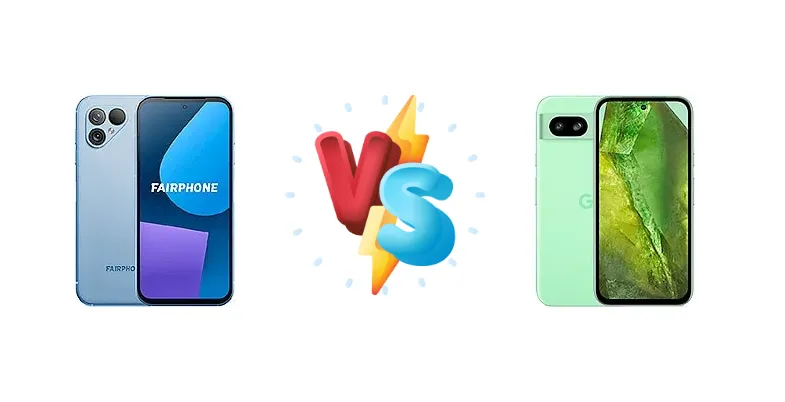
|
🏆 Quick Verdict
For the average user prioritizing camera quality, software support, and AI features, the Google Pixel 8a is the stronger choice. However, the Fairphone 5 stands alone for those who value repairability, sustainability, and long-term ownership, making it a unique offering.
| PHONES | ||
|---|---|---|
| Phone Names | Fairphone 5 | Google Pixel 8a |
| Network | ||
|---|---|---|
| 2G bands | GSM 850 / 900 / 1800 / 1900 | GSM 850 / 900 / 1800 / 1900 |
| 3G bands | HSDPA 850 / 900 / 1700(AWS) / 1900 / 2100 | HSDPA 800 / 850 / 900 / 1700(AWS) / 1900 / 2100 |
| 4G bands | 1, 2, 3, 4, 5, 7, 8, 12, 20, 28, 32, 38, 40, 41, 42, 48, 66, 71 | 1, 2, 3, 4, 5, 7, 8, 12, 17, 18, 19, 20, 26, 28, 32, 38, 40, 41, 42, 66 - G6GPR (International) |
| 5G bands | 1, 2, 3, 5, 7, 8, 20, 28, 38, 41, 48, 66, 71, 77, 78 SA/NSA | 1, 2, 3, 5, 7, 8, 12, 20, 26, 28, 38, 40, 41, 66, 75, 76, 77, 78 SA/NSA/Sub6 - G6GPR (International) |
| Speed | HSPA, LTE (4CA), 5G | HSPA, LTE, 5G |
| Technology | GSM / HSPA / LTE / 5G | GSM / HSPA / LTE / 5G |
| Launch | ||
|---|---|---|
| Announced | 2023, August 30 | 2024, May 07 |
| Status | Available. Released 2023, September 14 | Available. Released 2024, May 14 |
| Body | ||
|---|---|---|
| Build | Glass front (Gorilla Glass 5), aluminum frame, plastic back | Glass front (Gorilla Glass 3), aluminum frame, plastic back |
| Dimensions | 161.6 x 75.8 x 9.6 mm (6.36 x 2.98 x 0.38 in) | 152.1 x 72.7 x 8.9 mm (5.99 x 2.86 x 0.35 in) |
| SIM | Nano-SIM + eSIM | Nano-SIM + eSIM |
| Weight | 212 g (7.48 oz) | 188 g (6.63 oz) |
| Display | ||
|---|---|---|
| Protection | Corning Gorilla Glass 5 | Corning Gorilla Glass 3, Mohs level 5 |
| Resolution | 1224 x 2700 pixels (~459 ppi density) | 1080 x 2400 pixels, 20:9 ratio (~430 ppi density) |
| Size | 6.46 inches, 101.2 cm2 (~82.7% screen-to-body ratio) | 6.1 inches, 90.3 cm2 (~81.6% screen-to-body ratio) |
| Type | OLED, 90Hz, 880 nits (peak) | OLED, HDR, 120Hz, 2000 nits (peak) |
| Platform | ||
|---|---|---|
| CPU | Octa-core (1x2.7 GHz Cortex-A78 & 3x2.4 GHz Cortex-A78 & 4x1.9 GHz Cortex-A55) | Nona-core (1x3.0 GHz Cortex-X3 & 4x2.45 GHz Cortex-A715 & 4x2.15 GHz Cortex-A510) |
| Chipset | Qualcomm QCM6490 (6 nm) | Google Tensor G3 (4 nm) |
| GPU | Adreno 643 | Immortalis-G715s MC10 |
| OS | Android 13, upgradable to Android 14, up to 5 major Android upgrades | Android 14, upgradable to Android 16, up to 7 major Android upgrades |
| Memory | ||
|---|---|---|
| Card slot | microSDXC (dedicated slot) | No |
| Internal | 128GB 6GB RAM, 256GB 8GB RAM | 128GB 8GB RAM, 256GB 8GB RAM |
| Main Camera | ||
|---|---|---|
| Dual | 50 MP, f/1.9, (wide), 1/1.49", 1.0µm, PDAF, OIS 50 MP, f/2.2, (ultrawide), 1/2.51", 0.7µm, PDAF TOF 3D, (depth) | 64 MP (16 MP eff.), f/1.9, 26mm (wide), 1/1.73", 0.8µm, dual pixel PDAF, OIS 13 MP, f/2.2, 120˚ (ultrawide), 1.12µm |
| Features | Dual-LED dual-tone flash, HDR, panorama | Dual-LED flash, Pixel Shift, Ultra HDR, panorama, Best Take |
| Video | 4K@30fps, 1080p@30/60/120fps, 720p@240fps, gyro-EIS | 4K@30/60fps, 1080p@30/60/120/240fps, OIS |
| Selfie camera | ||
|---|---|---|
| Features | HDR | HDR, panorama |
| Single | 50 MP, f/2.5, (wide), 1/2.76", 0.74µm | 13 MP, f/2.2, 20mm (ultrawide), 1.12µm |
| Video | 4K@30fps, 1080p@30fps, gyro-EIS | 4K@30fps, 1080p@30/60fps |
| Sound | ||
|---|---|---|
| 35mm jack | No | No |
| Loudspeaker | Yes, with stereo speakers | Yes, with stereo speakers |
| Comms | ||
|---|---|---|
| Bluetooth | 5.2, A2DP, LE | 5.3, A2DP, LE |
| NFC | Yes | Yes |
| Positioning | GPS, GLONASS, GALILEO, BDS | GPS, GLONASS, GALILEO, BDS, QZSS, NavIC |
| Radio | No | No |
| USB | USB Type-C 3.0, OTG, DisplayPort | USB Type-C 3.2 |
| WLAN | Wi-Fi 802.11 a/b/g/n/ac/6e, dual-band, Wi-Fi Direct | Wi-Fi 802.11 a/b/g/n/ac/6e, dual/tri-band (market/region dependent) |
| Features | ||
|---|---|---|
| Sensors | Fingerprint (side-mounted), accelerometer, gyro, proximity, compass | Fingerprint (under display, optical), accelerometer, gyro, proximity, compass, barometer |
| Battery | ||
|---|---|---|
| Charging | 30W wired, 50% in 20 min | 18W wired, PD3.0 7.5W wireless Bypass charging |
| Type | Li-Ion 4200 mAh, removable | Li-Po 4492 mAh |
| Misc | ||
|---|---|---|
| Colors | Matte Black, Sky Blue, Transparent | Obsidian, Porcelain, Bay, Aloe |
| Models | - | GKV4X, G6GPR, G8HHN, G576D |
| Price | € 389.00 / $ 549.68 / £ 460.97 | $ 229.98 / C$ 417.99 / £ 279.00 / € 299.99 / ₹ 33,300 |
| SAR EU | 0.40 W/kg (head) 0.85 W/kg (body) | - |
| EU LABEL | ||
|---|---|---|
| Battery | - | 40:06h endurance, 1000 cycles |
| Energy | - | Class B |
| Free fall | - | Class A (270 falls) |
| Repairability | - | Class B |
Fairphone 5
- Exceptional repairability and modular design
- Long-term software support commitment
- Ethical and sustainable sourcing of materials
- Lower peak performance compared to the Pixel 8a
- Less vibrant display
- Camera performance likely lags behind the Pixel 8a
Google Pixel 8a
- Superior camera quality and AI features
- Brighter and more vibrant display
- Faster software updates and longer support
- Difficult and expensive to repair
- Less sustainable manufacturing practices
- Slower wired charging than the Fairphone 5
Display Comparison
The Pixel 8a boasts a significantly brighter display, reaching 1508 nits compared to the Fairphone 5’s 772 nits. This translates to superior visibility outdoors under direct sunlight. While both likely utilize OLED panels, the Pixel 8a’s higher peak brightness and potentially better color calibration offer a more vibrant viewing experience. The Fairphone 5’s display, while adequate, is clearly outmatched in terms of raw brightness and likely color accuracy, impacting media consumption and outdoor usability.
Camera Comparison
While detailed camera specs are limited, the Pixel 8a benefits from Google’s renowned computational photography. The Pixel’s image processing excels in dynamic range and low-light performance, leveraging the Tensor G3’s AI capabilities. The Fairphone 5, while offering photo and video capabilities, likely relies more on hardware and less on software trickery. The Pixel 8a’s superior image processing pipeline will likely result in more consistently pleasing images, especially in challenging conditions. Ignoring the likely presence of a low-resolution macro lens on both, the Pixel 8a’s software advantage is the key differentiator.
Performance
The Google Pixel 8a’s Tensor G3 (4nm) chipset offers a more modern architecture than the Fairphone 5’s Qualcomm QCM6490 (6nm). The Tensor G3’s nona-core configuration, featuring a Cortex-X3 prime core, provides a performance advantage in demanding tasks like AI processing and gaming. While the Fairphone 5’s octa-core CPU is capable, the 6nm process and older Cortex-A78 cores suggest lower peak performance and potentially higher power consumption. The Pixel 8a’s 4nm node also contributes to better thermal efficiency, reducing the likelihood of throttling during sustained workloads.
Battery Life
The Fairphone 5’s endurance rating of 88 hours surpasses the Pixel 8a’s 83 hours, but this doesn’t tell the whole story. The Pixel 8a’s active use score of 11:25h provides a more realistic measure of real-world battery life. The Fairphone 5’s 30W charging is faster than the Pixel 8a’s 18W charging, reaching 50% in 20 minutes. However, the Pixel 8a adds the convenience of 7.5W wireless charging and bypass charging, allowing the phone to remain cool while plugged in. The Pixel 8a also boasts a claimed 1000 charge cycles, suggesting a longer overall battery lifespan.
Buying Guide
Buy the Fairphone 5 if you need a phone you can easily repair yourself, prioritize ethical sourcing and sustainability, and are willing to trade some performance for longevity. Buy the Google Pixel 8a if you prefer a polished software experience, exceptional camera capabilities powered by Google’s AI, and faster charging, even if it means a less repairable device.