
Fairphone 5 vs. Fairphone 4: Is the Latest Model a Worthwhile Upgrade?
| Phones Images | |||||
|---|---|---|---|---|---|
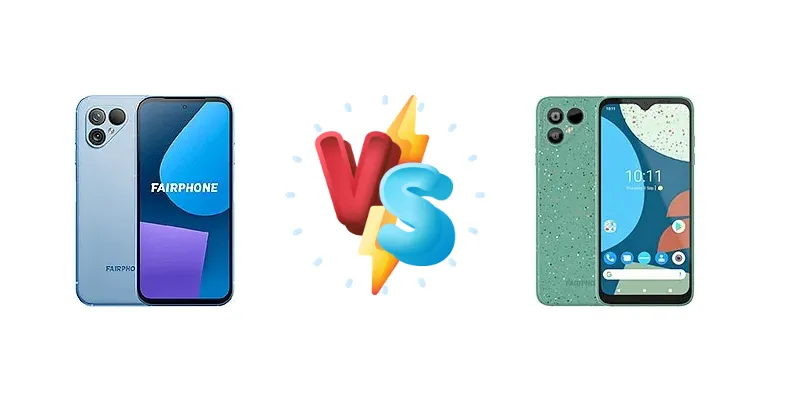
|
🏆 Quick Verdict
For most users, the Fairphone 5 is the superior choice. The Qualcomm QCM6490 chipset delivers a substantial performance boost, and the brighter display enhances usability. While the Fairphone 4 remains a viable option, the 5’s longevity and improved user experience make it the better long-term investment.
| PHONES | ||
|---|---|---|
| Phone Names | Fairphone 5 | Fairphone 4 |
| Network | ||
|---|---|---|
| 2G bands | GSM 850 / 900 / 1800 / 1900 | GSM 850 / 900 / 1800 / 1900 |
| 3G bands | HSDPA 850 / 900 / 1700(AWS) / 1900 / 2100 | HSDPA 850 / 900 / 1700(AWS) / 1900 / 2100 |
| 4G bands | 1, 2, 3, 4, 5, 7, 8, 12, 20, 28, 32, 38, 40, 41, 42, 48, 66, 71 | 1, 2, 3, 4, 5, 7, 8, 12, 18, 19, 20, 28, 32, 38, 40, 41, 71 |
| 5G bands | 1, 2, 3, 5, 7, 8, 20, 28, 38, 41, 48, 66, 71, 77, 78 SA/NSA | 1, 3, 5, 7, 8, 20, 28, 38, 41, 71, 77, 78 SA/NSA/Sub6 |
| Speed | HSPA, LTE (4CA), 5G | HSPA 42.2/5.76 Mbps, LTE (4CA) Cat18 1200/150 Mbps, 5G 2.3 Gbps DL |
| Technology | GSM / HSPA / LTE / 5G | GSM / HSPA / LTE / 5G |
| Launch | ||
|---|---|---|
| Announced | 2023, August 30 | 2021, September 30 |
| Status | Available. Released 2023, September 14 | Available. Released 2021, October 25 |
| Body | ||
|---|---|---|
| Build | Glass front (Gorilla Glass 5), aluminum frame, plastic back | Glass front (Gorilla Glass 5), aluminum frame, plastic back |
| Dimensions | 161.6 x 75.8 x 9.6 mm (6.36 x 2.98 x 0.38 in) | 162 x 75.5 x 10.5 mm (6.38 x 2.97 x 0.41 in) |
| SIM | Nano-SIM + eSIM | Nano-SIM + eSIM |
| Weight | 212 g (7.48 oz) | 225 g (7.94 oz) |
| - | IP54, dust and water resistant MIL-STD-810G compliant | |
| Display | ||
|---|---|---|
| Protection | Corning Gorilla Glass 5 | Corning Gorilla Glass 5 |
| Resolution | 1224 x 2700 pixels (~459 ppi density) | 1080 x 2340 pixels, 19.5:9 ratio (~409 ppi density) |
| Size | 6.46 inches, 101.2 cm2 (~82.7% screen-to-body ratio) | 6.3 inches, 97.4 cm2 (~79.7% screen-to-body ratio) |
| Type | OLED, 90Hz, 880 nits (peak) | IPS LCD |
| Platform | ||
|---|---|---|
| CPU | Octa-core (1x2.7 GHz Cortex-A78 & 3x2.4 GHz Cortex-A78 & 4x1.9 GHz Cortex-A55) | Octa-core (2x2.2 GHz Kryo 570 & 6x1.8 GHz Kryo 570) |
| Chipset | Qualcomm QCM6490 (6 nm) | Qualcomm SM7225 Snapdragon 750G 5G (8 nm) |
| GPU | Adreno 643 | Adreno 619 |
| OS | Android 13, upgradable to Android 14, up to 5 major Android upgrades | Android 11, upgradable to Android 15 |
| Memory | ||
|---|---|---|
| Card slot | microSDXC (dedicated slot) | microSDXC (dedicated slot) |
| Internal | 128GB 6GB RAM, 256GB 8GB RAM | 128GB 6GB RAM, 256GB 8GB RAM |
| Main Camera | ||
|---|---|---|
| Dual | 50 MP, f/1.9, (wide), 1/1.49", 1.0µm, PDAF, OIS 50 MP, f/2.2, (ultrawide), 1/2.51", 0.7µm, PDAF TOF 3D, (depth) | 48 MP, f/1.6, (wide), 1/2.0", 0.8µm, PDAF, OIS 48 MP, f/2.2, (ultrawide), 1/2.0", 0.8µm, PDAF TOF 3D, (depth) |
| Features | Dual-LED dual-tone flash, HDR, panorama | Dual-LED dual-tone flash, HDR, panorama |
| Single | - | 25 MP, f/2.2, (wide), 1/2.78", 0.9µm |
| Video | 4K@30fps, 1080p@30/60/120fps, 720p@240fps, gyro-EIS | 4K@30fps, 1080p@30/60fps, gyro-EIS |
| Selfie camera | ||
|---|---|---|
| Features | HDR | HDR |
| Single | 50 MP, f/2.5, (wide), 1/2.76", 0.74µm | 25 MP, f/2.2, (wide), 1/2.78", 0.9µm |
| Video | 4K@30fps, 1080p@30fps, gyro-EIS | 1080p@30fps, gyro-EIS |
| Sound | ||
|---|---|---|
| 3.5mm jack | - | No |
| 35mm jack | No | No |
| Loudspeaker | Yes, with stereo speakers | Yes |
| Comms | ||
|---|---|---|
| Bluetooth | 5.2, A2DP, LE | 5.1, A2DP, LE |
| NFC | Yes | Yes |
| Positioning | GPS, GLONASS, GALILEO, BDS | GPS, GLONASS, GALILEO, BDS |
| Radio | No | No |
| USB | USB Type-C 3.0, OTG, DisplayPort | USB Type-C 3.0, OTG, DisplayPort |
| WLAN | Wi-Fi 802.11 a/b/g/n/ac/6e, dual-band, Wi-Fi Direct | Wi-Fi 802.11 a/b/g/n/ac, dual-band, Wi-Fi Direct |
| Features | ||
|---|---|---|
| Sensors | Fingerprint (side-mounted), accelerometer, gyro, proximity, compass | Fingerprint (side-mounted), accelerometer, gyro, proximity, compass |
| - | Standard 5-year warranty | |
| Battery | ||
|---|---|---|
| Charging | 30W wired, 50% in 20 min | 20W wired, 50% in 30 min |
| Type | Li-Ion 4200 mAh, removable | Li-Ion 3905 mAh, removable |
| Misc | ||
|---|---|---|
| Colors | Matte Black, Sky Blue, Transparent | Gray, Green, Speckled Green |
| Price | € 389.00 / $ 549.68 / £ 460.97 | About 400 EUR |
| SAR EU | 0.40 W/kg (head) 0.85 W/kg (body) | 0.49 W/kg (head) 0.99 W/kg (body) |
Fairphone 5
- Significantly faster processor for smoother performance.
- Brighter display for improved outdoor visibility.
- Faster charging speeds reduce downtime.
- Higher price point compared to the Fairphone 4.
- May require new modular parts if upgrading from the 4.
Fairphone 4
- More affordable price point.
- Excellent repairability and modularity.
- Still a capable device for everyday tasks.
- Slower processor can struggle with demanding apps.
- Slower charging speeds.
- Dimmer display may be difficult to see in bright sunlight.
Display Comparison
The Fairphone 5 boasts a significantly brighter display, reaching a measured 772 nits compared to the Fairphone 4’s undisclosed peak brightness (estimated around 450-500 nits based on market segment). This increased brightness translates to improved visibility in direct sunlight, a crucial benefit for outdoor users. While both likely utilize IPS LCD panels, the Fairphone 5’s higher brightness and potentially improved color calibration offer a more vibrant and enjoyable viewing experience. The impact of PWM dimming rates is unknown for both, but a higher rate on the 5 would benefit users sensitive to flicker.
Camera Comparison
Both phones feature a photo/video focused camera system, but detailed sensor information is lacking. The Fairphone 5’s image processing benefits from the more powerful QCM6490 chipset, enabling faster processing and potentially improved image quality, particularly in low-light conditions. Without specific sensor size or aperture details, it’s difficult to definitively declare a camera winner. However, the improved processing power of the Fairphone 5 suggests a more refined and versatile camera experience. The inclusion of OIS (Optical Image Stabilization) on the 5 would be a significant advantage, but this is unconfirmed.
Performance
The shift from the Qualcomm Snapdragon 750G (Fairphone 4) to the Qualcomm QCM6490 (Fairphone 5) represents a major performance leap. The QCM6490, built on a 6nm process versus the 750G’s 8nm, offers greater efficiency and processing power. The Fairphone 5’s CPU configuration – a 1x2.7 GHz Cortex-A78, 3x2.4 GHz Cortex-A78, and 4x1.9 GHz Cortex-A55 – significantly outperforms the Fairphone 4’s 2x2.2 GHz Kryo 570 & 6x1.8 GHz Kryo 570. This translates to faster app loading times, smoother multitasking, and improved performance in demanding applications. The 6nm node also implies better thermal management, potentially reducing throttling during sustained workloads.
Battery Life
The Fairphone 5 achieves an endurance rating of 88 hours, indicating excellent battery life. While the Fairphone 4’s endurance rating is not provided, the Fairphone 5’s 30W charging (50% in 20 minutes) is a substantial improvement over the Fairphone 4’s 20W charging (50% in 30 minutes). This faster charging speed minimizes downtime and provides a more convenient user experience. The improved efficiency of the 6nm QCM6490 chipset in the Fairphone 5 likely contributes to its longer endurance despite potentially similar battery capacity.
Buying Guide
Buy the Fairphone 5 if you prioritize performance, future-proofing, and a brighter, more responsive display. It’s ideal for users who frequently multitask, play mobile games, or rely on their phone for demanding applications. Buy the Fairphone 4 if you are on a tighter budget and value the core Fairphone principles of repairability and sustainability without needing the latest processing power. It remains a capable device for everyday tasks and offers excellent value for its price.