
Fairphone 4 vs Samsung Galaxy A34: A Head-to-Head Comparison
| Phones Images | |||||
|---|---|---|---|---|---|
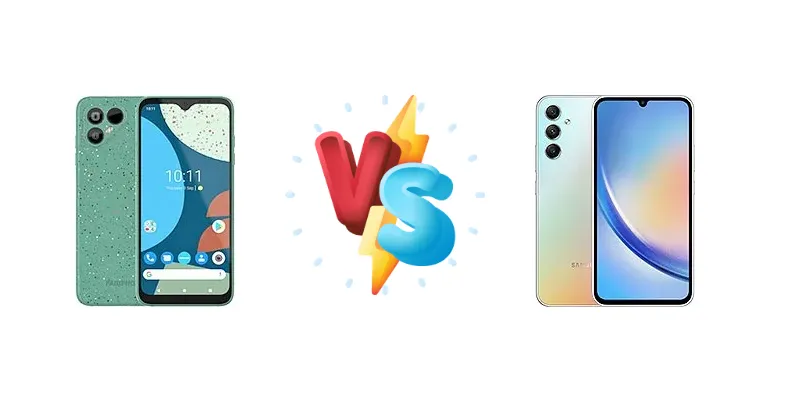
|
🏆 Quick Verdict
The Samsung Galaxy A34 offers a brighter display, faster performance, and a more polished camera experience. However, the Fairphone 4 stands out with its modular design, repairability, and commitment to ethical sourcing, making it a compelling choice for eco-conscious consumers willing to compromise slightly on raw power.
| PHONES | ||
|---|---|---|
| Phone Names | Fairphone 4 | Samsung Galaxy A34 |
| Network | ||
|---|---|---|
| 2G bands | GSM 850 / 900 / 1800 / 1900 | GSM 850 / 900 / 1800 / 1900 |
| 3G bands | HSDPA 850 / 900 / 1700(AWS) / 1900 / 2100 | HSDPA 850 / 900 / 1700(AWS) / 1900 / 2100 |
| 4G bands | 1, 2, 3, 4, 5, 7, 8, 12, 18, 19, 20, 28, 32, 38, 40, 41, 71 | 1, 2, 3, 4, 5, 7, 8, 12, 17, 20, 26, 28, 32, 38, 40, 41, 66 |
| 5G bands | 1, 3, 5, 7, 8, 20, 28, 38, 41, 71, 77, 78 SA/NSA/Sub6 | 1, 3, 7, 8, 20, 28, 38, 40, 41, 77, 78 SA/NSA/Sub6 |
| Speed | HSPA 42.2/5.76 Mbps, LTE (4CA) Cat18 1200/150 Mbps, 5G 2.3 Gbps DL | HSPA, LTE, 5G |
| Technology | GSM / HSPA / LTE / 5G | GSM / HSPA / LTE / 5G |
| Launch | ||
|---|---|---|
| Announced | 2021, September 30 | 2023, March 14 |
| Status | Available. Released 2021, October 25 | Available. Released 2023, March 24 |
| Body | ||
|---|---|---|
| Build | Glass front (Gorilla Glass 5), aluminum frame, plastic back | Glass front (Gorilla Glass 5), plastic frame, plastic back |
| Dimensions | 162 x 75.5 x 10.5 mm (6.38 x 2.97 x 0.41 in) | 161.3 x 78.1 x 8.2 mm (6.35 x 3.07 x 0.32 in) |
| SIM | Nano-SIM + eSIM | · Nano-SIM· Nano-SIM + Nano-SIM |
| Weight | 225 g (7.94 oz) | 199 g (7.02 oz) |
| IP54, dust and water resistant MIL-STD-810G compliant | IP67 dust/water resistant (up to 1m for 30 min) | |
| Display | ||
|---|---|---|
| Protection | Corning Gorilla Glass 5 | Corning Gorilla Glass 5 |
| Resolution | 1080 x 2340 pixels, 19.5:9 ratio (~409 ppi density) | 1080 x 2340 pixels, 19.5:9 ratio (~390 ppi density) |
| Size | 6.3 inches, 97.4 cm2 (~79.7% screen-to-body ratio) | 6.6 inches, 106.9 cm2 (~84.9% screen-to-body ratio) |
| Type | IPS LCD | Super AMOLED, 120Hz, 1000 nits (HBM) |
| Platform | ||
|---|---|---|
| CPU | Octa-core (2x2.2 GHz Kryo 570 & 6x1.8 GHz Kryo 570) | Octa-core (2x2.6 GHz Cortex-A78 & 6x2.0 GHz Cortex-A55) |
| Chipset | Qualcomm SM7225 Snapdragon 750G 5G (8 nm) | Mediatek Dimensity 1080 (6 nm) |
| GPU | Adreno 619 | Mali-G68 MC4 |
| OS | Android 11, upgradable to Android 15 | Android 13, up to 4 major Android upgrades, One UI 6.1 |
| Memory | ||
|---|---|---|
| Card slot | microSDXC (dedicated slot) | microSDXC (uses shared SIM slot) |
| Internal | 128GB 6GB RAM, 256GB 8GB RAM | 128GB 4GB RAM, 128GB 6GB RAM, 128GB 8GB RAM, 256GB 6GB RAM, 256GB 8GB RAM |
| Main Camera | ||
|---|---|---|
| Dual | 48 MP, f/1.6, (wide), 1/2.0", 0.8µm, PDAF, OIS 48 MP, f/2.2, (ultrawide), 1/2.0", 0.8µm, PDAF TOF 3D, (depth) | - |
| Features | Dual-LED dual-tone flash, HDR, panorama | LED flash, panorama, HDR |
| Single | 25 MP, f/2.2, (wide), 1/2.78", 0.9µm | - |
| Triple | - | 48 MP, f/1.8, 26mm (wide), 1/2.0", 0.8µm, PDAF, OIS 8 MP, f/2.2, 123˚, (ultrawide), 1/4.0", 1.12µm 5 MP (macro) |
| Video | 4K@30fps, 1080p@30/60fps, gyro-EIS | 4K@30fps, 1080p@30/60fps, 720p@480fps |
| Selfie camera | ||
|---|---|---|
| Features | HDR | - |
| Single | 25 MP, f/2.2, (wide), 1/2.78", 0.9µm | 13 MP, f/2.2, 26mm (wide), 1/3.1", 1.12µm |
| Video | 1080p@30fps, gyro-EIS | 4K@30fps, 1080p@30fps |
| Sound | ||
|---|---|---|
| 3.5mm jack | No | No |
| 35mm jack | No | No |
| Loudspeaker | Yes | Yes, with stereo speakers |
| Comms | ||
|---|---|---|
| Bluetooth | 5.1, A2DP, LE | 5.3, A2DP, LE |
| NFC | Yes | Yes (market/region dependent) |
| Positioning | GPS, GLONASS, GALILEO, BDS | GPS, GLONASS, GALILEO, BDS |
| Radio | No | No |
| USB | USB Type-C 3.0, OTG, DisplayPort | USB Type-C 2.0, OTG |
| WLAN | Wi-Fi 802.11 a/b/g/n/ac, dual-band, Wi-Fi Direct | Wi-Fi 802.11 a/b/g/n/ac, dual-band, Wi-Fi Direct |
| Features | ||
|---|---|---|
| Sensors | Fingerprint (side-mounted), accelerometer, gyro, proximity, compass | Fingerprint (under display, optical), accelerometer, gyro, compass |
| Standard 5-year warranty | Virtual proximity sensing | |
| Battery | ||
|---|---|---|
| Charging | 20W wired, 50% in 30 min | 25W wired |
| Type | Li-Ion 3905 mAh, removable | Li-Ion 5000 mAh |
| Misc | ||
|---|---|---|
| Colors | Gray, Green, Speckled Green | Lime, Graphite, Violet, Silver |
| Models | - | SM-A346E, SM-A346B, SM-A346B/DS, SM-A346B/DSN, SM-A346E/DS, SM-A346E/DSN, SM-A346M, SM-A346M/N, SM-A346M/DSN, SM-A3460 |
| Price | About 400 EUR | € 169.99 / $ 175.00 / £ 164.99 / ₹ 23,999 |
| SAR EU | 0.49 W/kg (head) 0.99 W/kg (body) | 0.55 W/kg (head) 1.49 W/kg (body) |
| Tests | ||
|---|---|---|
| Battery life | - | Endurance rating 133h |
| Camera | - | Photo / Video |
| Display | - | Contrast ratio: Infinite (nominal) |
| Loudspeaker | - | -26.1 LUFS (Good) |
| Performance | - | AnTuTu: 472126 (v9) GeekBench: 2316 (v5.5), 2518 (v6) GFXBench: 23fps (ES 3.1 onscreen) |
Fairphone 4
- Modular and repairable design
- Sustainable and ethical sourcing
- Long-term software support
- Unique selling proposition
- Lower performance compared to competitors
- Camera not as advanced
- Design less premium than some rivals
Samsung Galaxy A34
- Brighter and more vibrant display
- Faster performance
- Better camera system
- Polished software experience
- Water and dust resistance (IP67)
- Less sustainable than Fairphone 4
- Repairability limited
- Potential for planned obsolescence
Display Comparison
The Samsung Galaxy A34 boasts a significantly brighter display (1009 nits peak) compared to the Fairphone 4, offering better visibility in direct sunlight. While the A34 advertises an 'infinite' contrast ratio (a nominal value), both phones offer vibrant colors and good viewing angles. The A34's Super AMOLED panel generally provides a richer visual experience.
Camera Comparison
The Samsung Galaxy A34's camera system is more versatile and generally produces higher-quality photos and videos. It likely offers better low-light performance and more advanced features. The Fairphone 4's camera is adequate for casual photography but lacks the refinement of the A34.
Performance
The Samsung Galaxy A34's Dimensity 1080 chipset generally outperforms the Fairphone 4's Snapdragon 750G in benchmarks and real-world usage. Expect smoother multitasking and faster app loading times on the A34. However, the Fairphone 4 is still capable of handling everyday tasks without significant issues.
Battery Life
Both phones offer excellent battery life, with the Galaxy A34 achieving an endurance rating of 133h. The Fairphone 4's battery capacity is likely comparable, ensuring all-day usage for most users. Charging speeds are decent on both, with the A34 supporting slightly faster 25W charging.
Buying Guide
The Fairphone 4 is ideal for users prioritizing sustainability, longevity, and the ability to repair their device. It's a great choice for those who want to reduce electronic waste and support ethical manufacturing. The Samsung Galaxy A34 is best suited for users seeking a well-rounded mid-range phone with a vibrant display, good camera, and reliable performance, without a strong focus on repairability.