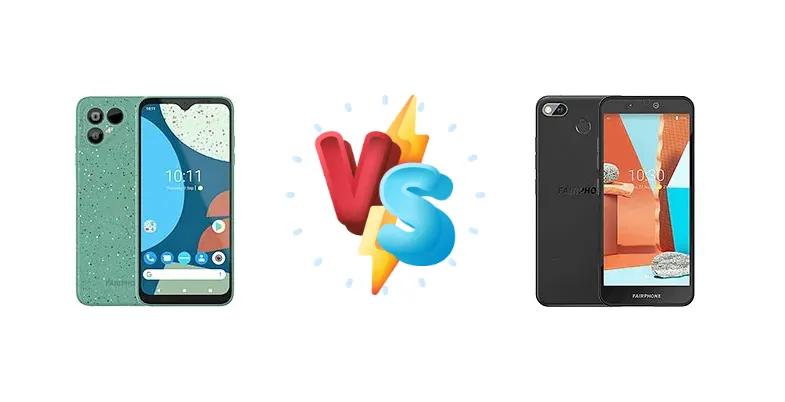
Fairphone is synonymous with ethical and sustainable smartphones. The Fairphone 4 represents a significant upgrade over its predecessor, the Fairphone 3+. But is the jump in price and features worth it? This comprehensive comparison will help you decide which Fairphone best aligns with your needs and values.
🏆 Quick Verdict
The Fairphone 4 is the clear winner, offering a substantial performance boost, 5G connectivity, and a more modern design. However, the Fairphone 3+ remains a compelling option for budget-conscious users prioritizing repairability and a familiar Android experience, especially if 5G isn't a necessity.
| Network |
|---|
| 2G bands | GSM 850 / 900 / 1800 / 1900 | GSM 850 / 900 / 1800 / 1900 |
| 3G bands | HSDPA 850 / 900 / 1700(AWS) / 1900 / 2100 | HSDPA 800 / 850 / 900 / 1700(AWS) / 1900 / 2100 |
| 4G bands | 1, 2, 3, 4, 5, 7, 8, 12, 18, 19, 20, 28, 32, 38, 40, 41, 71 | 1, 2, 3, 4, 5, 7, 8, 13, 20, 26 |
| 5G bands | 1, 3, 5, 7, 8, 20, 28, 38, 41, 71, 77, 78 SA/NSA/Sub6 | - |
| Speed | HSPA 42.2/5.76 Mbps, LTE (4CA) Cat18 1200/150 Mbps, 5G 2.3 Gbps DL | HSPA 42.2/5.76 Mbps, LTE (2CA) Cat6 300/150 Mbps |
| Technology | GSM / HSPA / LTE / 5G | GSM / HSPA / LTE |
| Launch |
|---|
| Announced | 2021, September 30 | 2020, August 27. Released 2020, September 14 |
| Status | Available. Released 2021, October 25 | Discontinued |
| Body |
|---|
| Build | Glass front (Gorilla Glass 5), aluminum frame, plastic back | Glass front (Gorilla Glass 5), plastic back, plastic frame |
| Dimensions | 162 x 75.5 x 10.5 mm (6.38 x 2.97 x 0.41 in) | 158 x 71.8 x 9.9 mm (6.22 x 2.83 x 0.39 in) |
| SIM | Nano-SIM + eSIM | Nano-SIM + Nano-SIM |
| Weight | 225 g (7.94 oz) | 189 g (6.67 oz) |
| | IP54, dust and water resistant
MIL-STD-810G compliant | - |
| Display |
|---|
| Protection | Corning Gorilla Glass 5 | Corning Gorilla Glass 5 |
| Resolution | 1080 x 2340 pixels, 19.5:9 ratio (~409 ppi density) | 1080 x 2160 pixels, 18:9 ratio (~427 ppi density) |
| Size | 6.3 inches, 97.4 cm2 (~79.7% screen-to-body ratio) | 5.65 inches, 82.4 cm2 (~72.6% screen-to-body ratio) |
| Type | IPS LCD | IPS LCD |
| Platform |
|---|
| CPU | Octa-core (2x2.2 GHz Kryo 570 & 6x1.8 GHz Kryo 570) | Octa-core (4x1.8 GHz Kryo 250 Gold & 4x1.8 GHz Kryo 250 Silver) |
| Chipset | Qualcomm SM7225 Snapdragon 750G 5G (8 nm) | Qualcomm SDM632 Snapdragon 632 (14 nm) |
| GPU | Adreno 619 | Adreno 506 |
| OS | Android 11, upgradable to Android 15 | Android 10, upgradable to Android 13 |
| Memory |
|---|
| Card slot | microSDXC (dedicated slot) | microSDXC (dedicated slot) |
| Internal | 128GB 6GB RAM, 256GB 8GB RAM | 64GB 4GB RAM |
| | - | eMMC 5.1 |
| Main Camera |
|---|
| Dual | 48 MP, f/1.6, (wide), 1/2.0", 0.8µm, PDAF, OIS
48 MP, f/2.2, (ultrawide), 1/2.0", 0.8µm, PDAF
TOF 3D, (depth) | - |
| Features | Dual-LED dual-tone flash, HDR, panorama | Dual-LED dual-tone flash, HDR, panorama |
| Single | 25 MP, f/2.2, (wide), 1/2.78", 0.9µm | 48 MP, f/1.8, (wide), 1/2.0", 0.8µm, PDAF |
| Video | 4K@30fps, 1080p@30/60fps, gyro-EIS | 4K@30fps, 1080p@30fps, gyro-EIS |
| Selfie camera |
|---|
| Features | HDR | HDR |
| Single | 25 MP, f/2.2, (wide), 1/2.78", 0.9µm | 16 MP, f/2.0, (wide), 1/3.1" |
| Video | 1080p@30fps, gyro-EIS | 1080p@30fps, gyro-EIS |
| Sound |
|---|
| 3.5mm jack | No | Yes |
| 35mm jack | No | Yes |
| Loudspeaker | Yes | Yes |
| Comms |
|---|
| Bluetooth | 5.1, A2DP, LE | 5.0, A2DP, LE |
| NFC | Yes | Yes |
| Positioning | GPS, GLONASS, GALILEO, BDS | GPS, GLONASS, GALILEO |
| Radio | No | No |
| USB | USB Type-C 3.0, OTG, DisplayPort | USB Type-C 2.0 |
| WLAN | Wi-Fi 802.11 a/b/g/n/ac, dual-band, Wi-Fi Direct | Wi-Fi 802.11 a/b/g/n/ac, dual-band, Wi-Fi Direct |
| Features |
|---|
| Sensors | Fingerprint (side-mounted), accelerometer, gyro, proximity, compass | Fingerprint (rear-mounted), accelerometer, gyro, proximity, compass |
| | Standard 5-year warranty | - |
| Battery |
|---|
| Charging | 20W wired, 50% in 30 min | - |
| Type | Li-Ion 3905 mAh, removable | Li-Ion 3040 mAh, removable |
| Misc |
|---|
| Colors | Gray, Green, Speckled Green | Black |
| Price | About 400 EUR | About 440 EUR |
| SAR EU | 0.49 W/kg (head) 0.99 W/kg (body) | 0.41 W/kg (head) 1.41 W/kg (body) |
Fairphone 4
- Significantly improved performance
- 5G connectivity
- Better camera system
- Larger and smoother OLED display
- Improved repairability
- Higher price
- Design is a departure from the 3+
- No wireless charging
Fairphone 3+
- More affordable
- Excellent repairability
- Familiar Android experience
- Compact size
- Outdated chipset
- Lower performance
- Less impressive camera
- IPS LCD display
Display Comparison
The Fairphone 4 boasts a larger 6.3-inch OLED display with a 90Hz refresh rate, offering a smoother and more vibrant visual experience compared to the Fairphone 3+'s 5.93-inch IPS LCD display. The OLED provides better contrast and deeper blacks, making it a noticeable upgrade for media consumption and gaming.
Camera Comparison
The Fairphone 4 features a 48MP main camera and a 48MP ultrawide camera, offering improved image quality and versatility compared to the Fairphone 3+'s 12MP main and 12MP depth camera. Low-light performance is also expected to be better on the Fairphone 4.
Performance
The Fairphone 4's Snapdragon 750G chipset is a significant leap over the Fairphone 3+'s Snapdragon 632. Expect noticeably faster app loading times, smoother multitasking, and improved gaming performance. The 8nm process also contributes to better power efficiency.
Battery Life
While both phones offer decent battery life, the Fairphone 4's larger 3905mAh battery and more efficient chipset should provide slightly longer usage times. The Fairphone 4 also supports 20W fast charging, while the 3+ supports 18W.
Buying Guide
The Fairphone 4 is ideal for users who want a modern smartphone experience with 5G, improved performance, and a better camera, and are willing to pay a premium for sustainability. The Fairphone 3+ is a great choice for those on a tighter budget who value repairability, a familiar Android experience, and don't require the latest features.
Frequently Asked Questions
❓ Is the Fairphone 4 worth the upgrade from the Fairphone 3+?
If you prioritize performance, 5G, and a better camera, the Fairphone 4 is a worthwhile upgrade. However, if you're on a budget and happy with the 3+'s capabilities, it remains a solid choice.
❓ How repairable are the Fairphone devices?
Both the Fairphone 4 and 3+ are designed for easy repairability. Modules can be replaced individually, extending the lifespan of the device and reducing electronic waste.