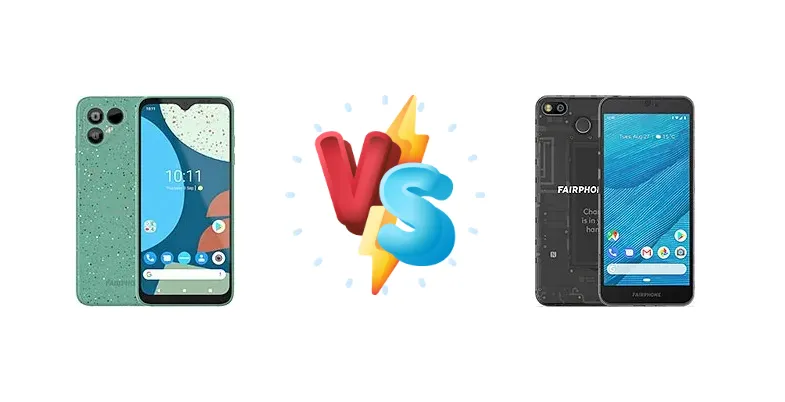
The Fairphone series champions modularity, repairability, and ethical sourcing in a world of disposable tech. But with two generations available, choosing between the Fairphone 4 and Fairphone 3 can be tricky. This comprehensive comparison breaks down the key differences to help you decide which sustainable smartphone best fits your needs.
🏆 Quick Verdict
The Fairphone 4 offers a significant upgrade in performance and camera quality thanks to its Snapdragon 750G chipset. However, the Fairphone 3 remains a compelling option for budget-conscious buyers prioritizing repairability and a familiar software experience. The 4 is the clear winner for most users, but the 3 still holds value.
| Network |
|---|
| 2G bands | GSM 850 / 900 / 1800 / 1900 | GSM 850 / 900 / 1800 / 1900 |
| 3G bands | HSDPA 850 / 900 / 1700(AWS) / 1900 / 2100 | HSDPA 800 / 850 / 900 / 1700(AWS) / 1900 / 2100 |
| 4G bands | 1, 2, 3, 4, 5, 7, 8, 12, 18, 19, 20, 28, 32, 38, 40, 41, 71 | 1, 2, 3, 4, 5, 7, 8, 13, 20, 26 |
| 5G bands | 1, 3, 5, 7, 8, 20, 28, 38, 41, 71, 77, 78 SA/NSA/Sub6 | - |
| Speed | HSPA 42.2/5.76 Mbps, LTE (4CA) Cat18 1200/150 Mbps, 5G 2.3 Gbps DL | HSPA 42.2/5.76 Mbps, LTE (2CA) Cat6 300/150 Mbps |
| Technology | GSM / HSPA / LTE / 5G | GSM / HSPA / LTE |
| Launch |
|---|
| Announced | 2021, September 30 | 2019, August 27. Released 2019, September 03 |
| Status | Available. Released 2021, October 25 | Discontinued |
| Body |
|---|
| Build | Glass front (Gorilla Glass 5), aluminum frame, plastic back | - |
| Dimensions | 162 x 75.5 x 10.5 mm (6.38 x 2.97 x 0.41 in) | 158 x 71.8 x 9.9 mm (6.22 x 2.83 x 0.39 in) |
| SIM | Nano-SIM + eSIM | Nano-SIM + Nano-SIM |
| Weight | 225 g (7.94 oz) | 189 g (6.67 oz) |
| | IP54, dust and water resistant
MIL-STD-810G compliant | - |
| Display |
|---|
| Protection | Corning Gorilla Glass 5 | Corning Gorilla Glass 5 |
| Resolution | 1080 x 2340 pixels, 19.5:9 ratio (~409 ppi density) | 1080 x 2160 pixels, 18:9 ratio (~427 ppi density) |
| Size | 6.3 inches, 97.4 cm2 (~79.7% screen-to-body ratio) | 5.65 inches, 82.4 cm2 (~72.6% screen-to-body ratio) |
| Type | IPS LCD | IPS LCD |
| Platform |
|---|
| CPU | Octa-core (2x2.2 GHz Kryo 570 & 6x1.8 GHz Kryo 570) | Octa-core (4x1.8 GHz Kryo 250 Gold & 4x1.8 GHz Kryo 250 Silver) |
| Chipset | Qualcomm SM7225 Snapdragon 750G 5G (8 nm) | Qualcomm SDM632 Snapdragon 632 (14 nm) |
| GPU | Adreno 619 | Adreno 506 |
| OS | Android 11, upgradable to Android 15 | Android 9.0 (Pie), upgradable to Android 13 |
| Memory |
|---|
| Card slot | microSDXC (dedicated slot) | microSDXC (dedicated slot) |
| Internal | 128GB 6GB RAM, 256GB 8GB RAM | 64GB 4GB RAM |
| | - | eMMC 5.1 |
| Main Camera |
|---|
| Dual | 48 MP, f/1.6, (wide), 1/2.0", 0.8µm, PDAF, OIS
48 MP, f/2.2, (ultrawide), 1/2.0", 0.8µm, PDAF
TOF 3D, (depth) | - |
| Features | Dual-LED dual-tone flash, HDR, panorama | Dual-LED dual-tone flash, HDR, panorama |
| Single | 25 MP, f/2.2, (wide), 1/2.78", 0.9µm | 12 MP, f/1.8, (wide), 1/2.55", 1.4µm, dual pixel PDAF |
| Video | 4K@30fps, 1080p@30/60fps, gyro-EIS | 4K@30fps, 1080p@30fps, gyro-EIS |
| Selfie camera |
|---|
| Features | HDR | - |
| Single | 25 MP, f/2.2, (wide), 1/2.78", 0.9µm | 8 MP, f/2.0, (wide), 1/4.0" |
| Video | 1080p@30fps, gyro-EIS | 1080p@30fps, gyro-EIS |
| Sound |
|---|
| 3.5mm jack | No | Yes |
| 35mm jack | No | Yes |
| Loudspeaker | Yes | Yes |
| Comms |
|---|
| Bluetooth | 5.1, A2DP, LE | 5.0, A2DP, LE |
| NFC | Yes | Yes |
| Positioning | GPS, GLONASS, GALILEO, BDS | GPS, GLONASS, GALILEO |
| Radio | No | No |
| USB | USB Type-C 3.0, OTG, DisplayPort | USB Type-C 2.0 |
| WLAN | Wi-Fi 802.11 a/b/g/n/ac, dual-band, Wi-Fi Direct | Wi-Fi 802.11 a/b/g/n/ac, dual-band, Wi-Fi Direct |
| Features |
|---|
| Sensors | Fingerprint (side-mounted), accelerometer, gyro, proximity, compass | Fingerprint (rear-mounted), accelerometer, gyro, proximity, compass |
| | Standard 5-year warranty | - |
| Battery |
|---|
| Charging | 20W wired, 50% in 30 min | - |
| Type | Li-Ion 3905 mAh, removable | Li-Ion 3040 mAh, removable |
| Misc |
|---|
| Colors | Gray, Green, Speckled Green | Black |
| Price | About 400 EUR | About 400 EUR |
| SAR EU | 0.49 W/kg (head) 0.99 W/kg (body) | 0.39 W/kg (head) 1.41 W/kg (body) |
Fairphone 4
- Improved Performance (Snapdragon 750G)
- Better Camera System
- Larger 90Hz OLED Display
- 5G Connectivity
- Faster Charging (20W)
- Higher Price
- Slightly Larger Size
- Software updates may be slower than some competitors
Fairphone 3
- Lower Price
- Excellent Repairability & Module Availability
- Familiar Software Experience
- Compact Size
- Slower Performance (Snapdragon 632)
- Less Impressive Camera
- IPS LCD Display
- No 5G
Display Comparison
The Fairphone 4 boasts a larger 6.3-inch 90Hz OLED display, offering smoother scrolling and vibrant colors compared to the Fairphone 3's 5.99-inch IPS LCD. While the Fairphone 3's display is perfectly adequate, the 4's OLED provides a noticeably better viewing experience.
Camera Comparison
The Fairphone 4 features a significantly improved camera system with a 48MP main sensor and a 48MP ultrawide lens, offering better image quality, dynamic range, and low-light performance compared to the Fairphone 3's 12MP main and 8MP ultrawide cameras. Video recording capabilities are also enhanced on the 4.
Performance
The Fairphone 4's Snapdragon 750G chipset delivers a substantial performance boost over the Fairphone 3's Snapdragon 632. Expect faster app loading times, smoother multitasking, and improved gaming performance on the Fairphone 4. The 4's 8nm process also contributes to better power efficiency.
Battery Life
Both phones offer decent battery life, but the Fairphone 4's larger 3905mAh battery and more efficient chipset generally provide slightly longer usage times. The Fairphone 4 also supports 20W fast charging, while the Fairphone 3 is limited to 18W.
Buying Guide
The Fairphone 4 is ideal for users who want a modern smartphone experience with improved performance, a better camera, and 5G connectivity, while still valuing sustainability. The Fairphone 3 is a great choice for those on a tighter budget, who appreciate a simpler software experience, and prioritize maximum repairability and module availability.
Frequently Asked Questions
❓ Are Fairphone phones truly repairable?
Yes, Fairphones are designed with modularity in mind, making them significantly easier to repair than most smartphones. Replacement parts and repair guides are readily available.
❓ How long will Fairphone provide software updates?
Fairphone commits to providing software updates for an extended period, typically 5-6 years. This is a significant advantage over many mainstream smartphone manufacturers.
❓ What makes Fairphone ethical?
Fairphone focuses on ethical sourcing of materials, fair labor practices in its supply chain, and reducing environmental impact through modular design and repairability.