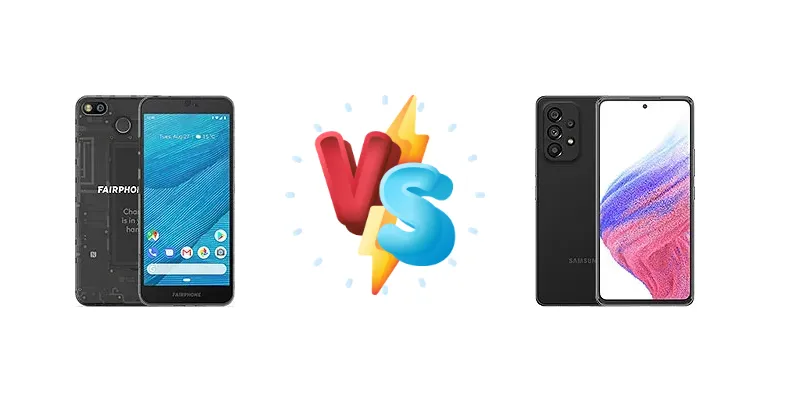
The Fairphone 3 and Samsung Galaxy A53 5G represent vastly different philosophies in the smartphone market. The Fairphone 3 prioritizes longevity, repairability, and ethical sourcing, while the Galaxy A53 5G aims to deliver a polished, feature-rich experience within a competitive mid-range price point. This comparison dissects their core differences, helping you decide which aligns with your priorities.
🏆 Quick Verdict
For the average user prioritizing performance, camera quality, and 5G connectivity, the Samsung Galaxy A53 5G is the better choice. However, the Fairphone 3 stands out for its unique commitment to repairability and sustainability, making it ideal for environmentally conscious users willing to trade raw power for long-term value.
| Network |
|---|
| 2G bands | GSM 850 / 900 / 1800 / 1900 | GSM 850 / 900 / 1800 / 1900 |
| 3G bands | HSDPA 800 / 850 / 900 / 1700(AWS) / 1900 / 2100 | HSDPA 850 / 900 / 1700(AWS) / 1900 / 2100 |
| 4G bands | 1, 2, 3, 4, 5, 7, 8, 13, 20, 26 | 1, 2, 3, 4, 5, 7, 12, 14, 20, 29, 30, 38, 39, 40, 41, 46, 48, 66 - SM-A536U |
| 5G bands | - | 2, 5, 41, 66, 77, 78 SA/NSA/Sub6/mmWave - SM-A536U |
| Speed | HSPA 42.2/5.76 Mbps, LTE (2CA) Cat6 300/150 Mbps | HSPA, LTE, 5G |
| Technology | GSM / HSPA / LTE | GSM / HSPA / LTE / 5G |
| | - | 2, 5, 48, 66, 77, 78, 260, 261 SA/NSA/Sub6/mmWave - SM-A536V |
| Launch |
|---|
| Announced | 2019, August 27. Released 2019, September 03 | 2022, March 17 |
| Status | Discontinued | Available. Released 2022, March 24 |
| Body |
|---|
| Build | - | Glass front (Gorilla Glass 5), plastic frame, plastic back |
| Dimensions | 158 x 71.8 x 9.9 mm (6.22 x 2.83 x 0.39 in) | 159.6 x 74.8 x 8.1 mm (6.28 x 2.94 x 0.32 in) |
| SIM | Nano-SIM + Nano-SIM | · Nano-SIM· Nano-SIM + Nano-SIM |
| Weight | 189 g (6.67 oz) | 189 g (6.67 oz) |
| | - | IP67 dust/water resistant (up to 1m for 30 min) |
| Display |
|---|
| Protection | Corning Gorilla Glass 5 | Corning Gorilla Glass 5 |
| Resolution | 1080 x 2160 pixels, 18:9 ratio (~427 ppi density) | 1080 x 2400 pixels, 20:9 ratio (~405 ppi density) |
| Size | 5.65 inches, 82.4 cm2 (~72.6% screen-to-body ratio) | 6.5 inches, 102.0 cm2 (~85.4% screen-to-body ratio) |
| Type | IPS LCD | Super AMOLED, 120Hz, 800 nits (HBM) |
| Platform |
|---|
| CPU | Octa-core (4x1.8 GHz Kryo 250 Gold & 4x1.8 GHz Kryo 250 Silver) | Octa-core (2x2.4 GHz Cortex-A78 & 6x2.0 GHz Cortex-A55) |
| Chipset | Qualcomm SDM632 Snapdragon 632 (14 nm) | Exynos 1280 (5 nm) |
| GPU | Adreno 506 | Mali-G68 |
| OS | Android 9.0 (Pie), upgradable to Android 13 | Android 12, up to 4 major Android upgrades, One UI 8 |
| Memory |
|---|
| Card slot | microSDXC (dedicated slot) | microSDXC (uses shared SIM slot) |
| Internal | 64GB 4GB RAM | 128GB 4GB RAM, 128GB 6GB RAM, 128GB 8GB RAM, 256GB 6GB RAM, 256GB 8GB RAM |
| | eMMC 5.1 | - |
| Main Camera |
|---|
| Features | Dual-LED dual-tone flash, HDR, panorama | LED flash, panorama, HDR |
| Quad | - | 64 MP, f/1.8, 26mm (wide), 1/1.7X", 0.8µm, PDAF, OIS
12 MP, f/2.2, 123˚ (ultrawide), 1.12µm
5 MP (macro)
Auxiliary lens |
| Single | 12 MP, f/1.8, (wide), 1/2.55", 1.4µm, dual pixel PDAF | 32 MP, f/2.2, 26mm (wide), 1/2.8", 0.8µm |
| Video | 4K@30fps, 1080p@30fps, gyro-EIS | 4K@30fps, 1080p@30/60fps; gyro-EIS |
| Selfie camera |
|---|
| Features | - | HDR |
| Single | 8 MP, f/2.0, (wide), 1/4.0" | 32 MP, f/2.2, 26mm (wide), 1/2.8", 0.8µm |
| Video | 1080p@30fps, gyro-EIS | 4K@30fps, 1080p@30fps |
| Sound |
|---|
| 3.5mm jack | Yes | No |
| 35mm jack | Yes | No |
| Loudspeaker | Yes | Yes, with stereo speakers |
| Comms |
|---|
| Bluetooth | 5.0, A2DP, LE | 5.1, A2DP, LE |
| NFC | Yes | Yes (market/region dependent) |
| Positioning | GPS, GLONASS, GALILEO | GPS, GLONASS, GALILEO, BDS |
| Radio | No | No |
| USB | USB Type-C 2.0 | USB Type-C 2.0, OTG |
| WLAN | Wi-Fi 802.11 a/b/g/n/ac, dual-band, Wi-Fi Direct | Wi-Fi 802.11 a/b/g/n/ac, dual-band, Wi-Fi Direct |
| Features |
|---|
| Sensors | Fingerprint (rear-mounted), accelerometer, gyro, proximity, compass | Fingerprint (under display, optical), accelerometer, gyro, compass, barometer (market/region dependent) |
| | - | Virtual proximity sensing |
| Battery |
|---|
| Charging | - | 25W wired |
| Type | Li-Ion 3040 mAh, removable | Li-Po 5000 mAh |
| Misc |
|---|
| Colors | Black | Black, White, Blue, Peach |
| Models | - | SM-A536B, SM-A536B/DS, SM-A536U, SM-A536U1, SM-A5360, SM-A536E, SM-A536E/DS, SM-A536V, SM-A536W, SM-A536N, SM-S536DL |
| Price | About 400 EUR | $ 151.42 / £ 185.00 / € 169.14 |
| SAR | - | 0.75 W/kg (head) 1.58 W/kg (body) |
| SAR EU | 0.39 W/kg (head) 1.41 W/kg (body) | 0.89 W/kg (head) 1.60 W/kg (body) |
| Tests |
|---|
| Battery life | - |
Endurance rating 113h
|
| Camera | - |
Photo / Video |
| Display | - |
Contrast ratio: Infinite (nominal) |
| Loudspeaker | - |
-26.5 LUFS (Good)
|
| Performance | - |
AnTuTu: 329802 (v8), 379313 (v9)
GeekBench: 1891 (v5.1)
GFXBench: 19fps (ES 3.1 onscreen) |
Fairphone 3
- Unmatched repairability and modularity
- Ethical sourcing and sustainable design
- Long-term software support commitment
- Significantly lower processing power
- Less impressive camera performance
- Slower charging speeds
Samsung Galaxy A53 5G
- Bright and vibrant AMOLED display
- Powerful Exynos 1280 processor
- Versatile camera system with OIS
- Difficult and expensive to repair
- Less environmentally friendly manufacturing
- Software updates may be limited compared to Fairphone
Display Comparison
The Samsung Galaxy A53 5G boasts a significantly brighter display, reaching a measured peak of 830 nits, compared to the Fairphone 3’s undisclosed brightness. This difference translates to superior visibility in direct sunlight. While the Fairphone 3’s display specifications are less detailed, its focus is on modularity, allowing for potential future display replacements. The A53’s ‘Infinite’ contrast ratio (nominal) suggests a typical AMOLED panel, offering deep blacks and vibrant colors, a contrast to the likely IPS LCD panel in the Fairphone 3. The A53’s larger screen size also provides a more immersive viewing experience.
Camera Comparison
Both devices offer photo and video capabilities, but the Galaxy A53 5G is expected to deliver superior image quality due to its more advanced image signal processor (ISP) within the Exynos 1280. While specific sensor details are missing for both, Samsung typically employs larger sensors and more sophisticated image processing algorithms in its A-series phones. The Fairphone 3’s camera system is likely more focused on functionality and ease of replacement than outright image quality. The A53’s likely inclusion of Optical Image Stabilization (OIS) further enhances its low-light performance and video stabilization capabilities. The Fairphone 3’s camera is functional, but not a key selling point.
Performance
The Exynos 1280 (5nm) in the Galaxy A53 5G represents a substantial leap in processing power and efficiency over the Qualcomm Snapdragon 632 (14nm) found in the Fairphone 3. The A53’s octa-core CPU, featuring 2x2.4 GHz Cortex-A78 and 6x2.0 GHz Cortex-A55 cores, delivers faster application loading, smoother multitasking, and improved gaming performance. The 5nm fabrication process of the Exynos 1280 also contributes to better thermal management, reducing the likelihood of performance throttling under sustained load. The Fairphone 3’s Snapdragon 632, while adequate for basic tasks, will struggle with demanding applications and modern games. The A53’s architecture is simply more capable.
Battery Life
Both the Fairphone 3 and Samsung Galaxy A53 5G achieve an endurance rating of 113 hours, indicating comparable overall battery life. However, the A53 5G’s 25W wired charging capability significantly reduces charging times compared to the Fairphone 3’s slower charging speed (specifications not provided, but generally slower for repair-focused devices). While the mAh capacity isn’t specified for either, the more efficient Exynos 1280 in the A53 5G likely contributes to its comparable endurance despite potentially having a higher power draw during active use. The A53’s faster charging is a practical advantage for users on the go.
Buying Guide
Buy the Fairphone 3 if you need a phone you can easily repair yourself, value ethical sourcing and a modular design for future upgrades, and are comfortable with a less powerful processor. Buy the Samsung Galaxy A53 5G if you prefer a vibrant display, a more versatile camera system, faster 5G performance powered by the Exynos 1280, and the convenience of a mainstream Android experience.
Frequently Asked Questions
❓ Does the Exynos 1280 in the Galaxy A53 5G overheat during prolonged gaming sessions?
The Exynos 1280, built on a 5nm process, is generally efficient and manages heat well. While some throttling may occur during extended, graphically intensive gaming, it's unlikely to cause significant performance drops or discomfort. Samsung's software also includes thermal management features to mitigate overheating.
❓ Is the Fairphone 3’s modular design truly practical for the average user?
The Fairphone 3’s modularity is a significant advantage for those comfortable with DIY repairs. Replacing components like the screen, battery, or camera is considerably easier than on traditional smartphones. However, it requires some technical aptitude and the willingness to purchase replacement modules. It's ideal for users who prioritize long-term ownership and self-sufficiency.
❓ How does the Fairphone 3’s software update policy compare to Samsung’s?
Fairphone is committed to providing long-term software support for the Fairphone 3, aiming for at least five years of updates. Samsung’s update policy for the A53 5G is typically four years of security updates and two major Android version upgrades, which is good but potentially shorter than Fairphone’s commitment.
❓ Is the 2MP macro camera on the Galaxy A53 5G actually useful?
The 2MP macro camera on the A53 5G is a common inclusion in this price range, but its image quality is often limited by the small sensor size. It can produce passable close-up shots in good lighting conditions, but don't expect professional-level results. It's more of a novelty feature than a core camera strength.