
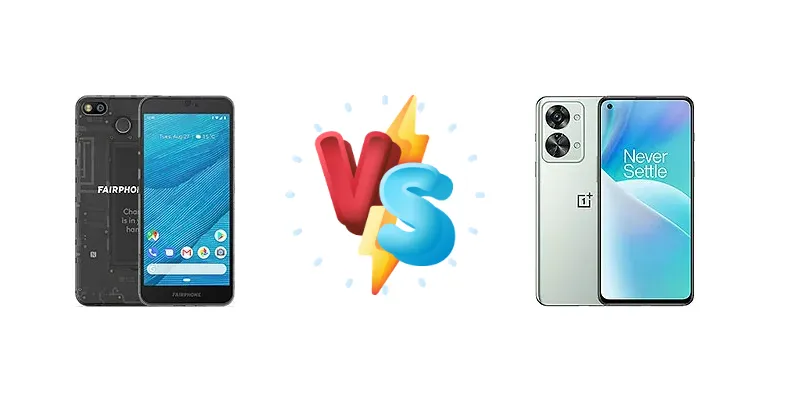
Fairphone 3 vs. OnePlus Nord 2T: A Deep Dive into Sustainability and Performance
| Phones Images | |||||
|---|---|---|---|---|---|
|
🏆 Quick Verdict
For the average user prioritizing speed and convenience, the OnePlus Nord 2T is the clear winner. Its Dimensity 1300 chipset and 80W charging offer a significantly smoother experience. However, the Fairphone 3 remains a compelling choice for those committed to reducing e-waste and maximizing device lifespan through self-repair.
| PHONES | ||
|---|---|---|
| Phone Names | Fairphone 3 | OnePlus Nord 2T |
| Network | ||
|---|---|---|
| 2G bands | GSM 850 / 900 / 1800 / 1900 | GSM 850 / 900 / 1800 / 1900 |
| 3G bands | HSDPA 800 / 850 / 900 / 1700(AWS) / 1900 / 2100 | HSDPA 800 / 850 / 900 / 1700(AWS) / 1800 / 1900 / 2100 |
| 4G bands | 1, 2, 3, 4, 5, 7, 8, 13, 20, 26 | 1, 2, 3, 4, 5, 7, 8, 12, 17, 18, 19, 20, 26, 28, 32, 34, 38, 39, 40, 41, 66 |
| 5G bands | - | 1, 3, 7, 8, 20, 28, 38, 41, 78 SA/NSA |
| Speed | HSPA 42.2/5.76 Mbps, LTE (2CA) Cat6 300/150 Mbps | HSPA 42.2/5.76 Mbps, LTE Cat18 1200/150 Mbps, 5G |
| Technology | GSM / HSPA / LTE | GSM / HSPA / LTE / 5G |
| Launch | ||
|---|---|---|
| Announced | 2019, August 27. Released 2019, September 03 | 2022, May 19 |
| Status | Discontinued | Available. Released 2022, May 21 |
| Body | ||
|---|---|---|
| Build | - | Glass front (Gorilla Glass 5), plastic frame |
| Dimensions | 158 x 71.8 x 9.9 mm (6.22 x 2.83 x 0.39 in) | 159.1 x 73.2 x 8.2 mm (6.26 x 2.88 x 0.32 in) |
| SIM | Nano-SIM + Nano-SIM | Nano-SIM + Nano-SIM |
| Weight | 189 g (6.67 oz) | 190 g (6.70 oz) |
| Display | ||
|---|---|---|
| Protection | Corning Gorilla Glass 5 | Corning Gorilla Glass 5 |
| Resolution | 1080 x 2160 pixels, 18:9 ratio (~427 ppi density) | 1080 x 2400 pixels, 20:9 ratio (~409 ppi density) |
| Size | 5.65 inches, 82.4 cm2 (~72.6% screen-to-body ratio) | 6.43 inches, 99.8 cm2 (~85.7% screen-to-body ratio) |
| Type | IPS LCD | AMOLED, 90Hz, HDR10+ |
| Platform | ||
|---|---|---|
| CPU | Octa-core (4x1.8 GHz Kryo 250 Gold & 4x1.8 GHz Kryo 250 Silver) | Octa-core (1x3.0 GHz Cortex-A78 & 3x2.6 GHz Cortex-A78 & 4x2.0 GHz Cortex-A55) |
| Chipset | Qualcomm SDM632 Snapdragon 632 (14 nm) | Mediatek Dimensity 1300 (6 nm) |
| GPU | Adreno 506 | Mali-G77 MC9 |
| OS | Android 9.0 (Pie), upgradable to Android 13 | Android 12, upgradable to Android 14, OxygenOS 14 |
| Memory | ||
|---|---|---|
| Card slot | microSDXC (dedicated slot) | No |
| Internal | 64GB 4GB RAM | 128GB 8GB RAM, 256GB 12GB RAM |
| eMMC 5.1 | UFS 3.1 | |
| Main Camera | ||
|---|---|---|
| Features | Dual-LED dual-tone flash, HDR, panorama | Dual-LED flash, HDR, panorama |
| Single | 12 MP, f/1.8, (wide), 1/2.55", 1.4µm, dual pixel PDAF | 32 MP, f/2.4, (wide), 1/2.8", 0.8µm |
| Triple | - | 50 MP, f/1.9, 24mm (wide), 1/1.56", 1.0µm, PDAF, OIS 8 MP, f/2.2, 120˚ (ultrawide) Auxiliary lens |
| Video | 4K@30fps, 1080p@30fps, gyro-EIS | 4K@30fps, 1080p@30/60/120/480fps, gyro-EIS |
| Selfie camera | ||
|---|---|---|
| Features | - | Auto HDR |
| Single | 8 MP, f/2.0, (wide), 1/4.0" | 32 MP, f/2.4, (wide), 1/2.8", 0.8µm |
| Video | 1080p@30fps, gyro-EIS | 1080p@30fps, gyro-EIS |
| Sound | ||
|---|---|---|
| 3.5mm jack | Yes | No |
| 35mm jack | Yes | No |
| Loudspeaker | Yes | Yes, with stereo speakers |
| Comms | ||
|---|---|---|
| Bluetooth | 5.0, A2DP, LE | 5.2, A2DP, LE, aptX HD |
| NFC | Yes | Yes |
| Positioning | GPS, GLONASS, GALILEO | GPS, GLONASS, GALILEO, BDS, NavIC |
| Radio | No | No |
| USB | USB Type-C 2.0 | USB Type-C 2.0, OTG |
| WLAN | Wi-Fi 802.11 a/b/g/n/ac, dual-band, Wi-Fi Direct | Wi-Fi 802.11 a/b/g/n/ac/6, dual-band, Wi-Fi Direct |
| Features | ||
|---|---|---|
| Sensors | Fingerprint (rear-mounted), accelerometer, gyro, proximity, compass | Fingerprint (under display, optical), accelerometer, gyro, proximity, compass |
| Battery | ||
|---|---|---|
| Charging | - | 80W wired, PD |
| Type | Li-Ion 3040 mAh, removable | Li-Po 4500 mAh |
| Misc | ||
|---|---|---|
| Colors | Black | Gray Shadow, Jade Fog |
| Models | - | CPH2399, CPH2401 |
| Price | About 400 EUR | € 144.39 / $ 169.99 / ₹ 31,490 |
| SAR EU | 0.39 W/kg (head) 1.41 W/kg (body) | - |
| Tests | ||
|---|---|---|
| Battery life | - | Endurance rating 100h |
| Camera | - | Photo / Video |
| Display | - | Contrast ratio: Infinite (nominal) |
| Loudspeaker | - | -25.6 LUFS (Very good) |
| Performance | - | AnTuTu: 490545 (v8) | 604467 (v9) GeekBench: 2790 (v5.1) GFXBench: 40fps (ES 3.1 onscreen) |
Fairphone 3
- Exceptional repairability and modular design
- Long-term software support commitment
- Ethical and sustainable manufacturing practices
- Significantly weaker processor performance
- Less impressive camera capabilities
- Slower charging speeds
OnePlus Nord 2T
- Powerful MediaTek Dimensity 1300 chipset
- 80W SuperVOOC charging for rapid replenishment
- Brighter and more vibrant display
- Limited repairability and shorter lifespan
- Less environmentally friendly manufacturing
- Software updates may be less frequent than Fairphone
Display Comparison
The OnePlus Nord 2T boasts a significantly brighter display, reaching 636 nits measured, compared to the Fairphone 3’s unspecified brightness. This translates to better visibility outdoors. While the Nord 2T’s contrast ratio is listed as ‘infinite’ (nominal), this is typical marketing; the Fairphone 3’s panel characteristics are less defined. Both phones likely utilize IPS LCD technology, but the Nord 2T’s higher peak brightness is a tangible advantage for everyday use.
Camera Comparison
Both phones offer photo and video capabilities, but details are limited. Without specific sensor sizes or aperture information, a direct comparison is difficult. However, the Nord 2T’s chipset includes a more advanced image signal processor (ISP), enabling better noise reduction and dynamic range. The Fairphone 3’s camera system is likely more focused on practicality than cutting-edge features. The absence of detailed camera specs on the Fairphone 3 suggests it’s not a primary selling point, while the Nord 2T aims for a more competitive camera experience.
Performance
The performance gap between these devices is substantial. The OnePlus Nord 2T’s MediaTek Dimensity 1300, built on a 6nm process, features a powerful octa-core configuration with a Cortex-A78 prime core clocked at 3.0 GHz. This contrasts sharply with the Fairphone 3’s Qualcomm Snapdragon 632 (14nm), which relies on Kryo 250 cores clocked at 1.8 GHz. The 6nm node of the Dimensity 1300 offers superior power efficiency and thermal performance, resulting in sustained performance during demanding tasks. The Nord 2T will handle gaming and multitasking with ease, while the Fairphone 3 will struggle with graphically intensive applications.
Battery Life
Both devices achieve an endurance rating of 100 hours, suggesting similar overall battery life despite differing internal capacities (not specified for the Fairphone 3). However, the Nord 2T’s 80W wired charging with Power Delivery (PD) is a game-changer. It can replenish the battery from 0-100% in a fraction of the time compared to the Fairphone 3’s slower charging speeds. This convenience factor is a significant advantage for users who prioritize minimizing downtime.
Buying Guide
Buy the Fairphone 3 if you value long-term ownership, the ability to repair your device yourself, and minimizing your environmental impact. You'll accept compromises in raw processing power and camera capabilities for this peace of mind. Buy the OnePlus Nord 2T if you prioritize a responsive user experience, fast charging, and a more conventional smartphone feature set, even if it means a shorter potential lifespan and limited repair options.