
Fairphone 3 vs. Nokia XR20: A Deep Dive into Repairability, Performance, and 5G
| Phones Images | |||||
|---|---|---|---|---|---|
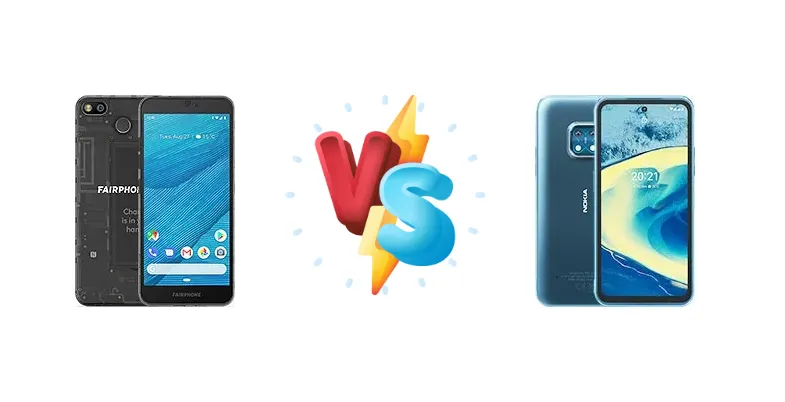
|
🏆 Quick Verdict
For the average user prioritizing future-proofing and faster data speeds, the Nokia XR20 is the better choice. Its Snapdragon 480 5G chipset offers a noticeable performance uplift and 5G connectivity. However, the Fairphone 3 remains compelling for those who value the ability to repair and upgrade their device independently.
| PHONES | ||
|---|---|---|
| Phone Names | Fairphone 3 | Nokia XR20 |
| Network | ||
|---|---|---|
| 2G bands | GSM 850 / 900 / 1800 / 1900 | GSM 850 / 900 / 1800 / 1900 |
| 3G bands | HSDPA 800 / 850 / 900 / 1700(AWS) / 1900 / 2100 | HSDPA 850 / 900 / 1700(AWS) / 1900 / 2100 |
| 4G bands | 1, 2, 3, 4, 5, 7, 8, 13, 20, 26 | 1, 2, 3, 4, 5, 7, 8, 12, 13, 14, 20, 25, 26, 28, 30, 38, 40, 41, 48, 66, 71 |
| 5G bands | - | 2, 5, 25, 38, 41, 48, 66, 77, 78 SA/NSA |
| Speed | HSPA 42.2/5.76 Mbps, LTE (2CA) Cat6 300/150 Mbps | HSPA, LTE, 5G |
| Technology | GSM / HSPA / LTE | GSM / CDMA / HSPA / EVDO / LTE / 5G |
| - | CDMA2000 1xEV-DO | |
| Launch | ||
|---|---|---|
| Announced | 2019, August 27. Released 2019, September 03 | 2021, July 27 |
| Status | Discontinued | Available. Released 2021, August 04 |
| Body | ||
|---|---|---|
| Dimensions | 158 x 71.8 x 9.9 mm (6.22 x 2.83 x 0.39 in) | 171.6 x 81.5 x 10.6 mm (6.76 x 3.21 x 0.42 in) |
| SIM | Nano-SIM + Nano-SIM | · Nano-SIM· Nano-SIM + Nano-SIM |
| Weight | 189 g (6.67 oz) | 248 g (8.75 oz) |
| - | IP68 dust/water resistant (up to 1.5m for 60 min) Drop-to-concrete resistance from up to 1.8m MIL-STD-810H compliant | |
| Display | ||
|---|---|---|
| Protection | Corning Gorilla Glass 5 | Corning Gorilla Glass Victus |
| Resolution | 1080 x 2160 pixels, 18:9 ratio (~427 ppi density) | 1080 x 2400 pixels, 20:9 ratio (~395 ppi density) |
| Size | 5.65 inches, 82.4 cm2 (~72.6% screen-to-body ratio) | 6.67 inches, 107.4 cm2 (~76.8% screen-to-body ratio) |
| Type | IPS LCD | IPS LCD, 550 nits |
| Platform | ||
|---|---|---|
| CPU | Octa-core (4x1.8 GHz Kryo 250 Gold & 4x1.8 GHz Kryo 250 Silver) | Octa-core (2x2.0 GHz Kryo 460 & 6x1.8 GHz Kryo 460) |
| Chipset | Qualcomm SDM632 Snapdragon 632 (14 nm) | Qualcomm SM4350 Snapdragon 480 5G (8 nm) |
| GPU | Adreno 506 | Adreno 619 |
| OS | Android 9.0 (Pie), upgradable to Android 13 | Android 11, upgradable to Android 13 |
| Memory | ||
|---|---|---|
| Card slot | microSDXC (dedicated slot) | microSDXC (uses shared SIM slot) |
| Internal | 64GB 4GB RAM | 64GB 4GB RAM, 128GB 6GB RAM |
| eMMC 5.1 | - | |
| Main Camera | ||
|---|---|---|
| Dual | - | 48 MP, f/1.8, (wide), 1/2.25", 0.8µm, PDAF 13 MP, f/2.4, 123˚ (ultrawide), 1/3.0", 1.12µm |
| Features | Dual-LED dual-tone flash, HDR, panorama | Zeiss optics, Dual-LED dual-tone flash, second LED flash, HDR, panorama |
| Single | 12 MP, f/1.8, (wide), 1/2.55", 1.4µm, dual pixel PDAF | 8 MP, f/2.0 (wide), 1/4.0", 1.12µm |
| Video | 4K@30fps, 1080p@30fps, gyro-EIS | 1080p@30fps |
| Selfie camera | ||
|---|---|---|
| Single | 8 MP, f/2.0, (wide), 1/4.0" | 8 MP, f/2.0 (wide), 1/4.0", 1.12µm |
| Video | 1080p@30fps, gyro-EIS | 1080p@30fps |
| Sound | ||
|---|---|---|
| 3.5mm jack | Yes | Yes |
| 35mm jack | Yes | Yes |
| Loudspeaker | Yes | Yes, with stereo speakers |
| Comms | ||
|---|---|---|
| Bluetooth | 5.0, A2DP, LE | 5.1, A2DP, LE, aptX Adaptive |
| NFC | Yes | Yes |
| Positioning | GPS, GLONASS, GALILEO | GPS (L1+L5), GLONASS, BDS, GALILEO, QZSS, NavIC |
| Radio | No | Unspecified |
| USB | USB Type-C 2.0 | USB Type-C 3.0 |
| WLAN | Wi-Fi 802.11 a/b/g/n/ac, dual-band, Wi-Fi Direct | Wi-Fi 802.11 a/b/g/n/ac/6, dual-band, Wi-Fi Direct |
| Features | ||
|---|---|---|
| Sensors | Fingerprint (rear-mounted), accelerometer, gyro, proximity, compass | Fingerprint (side-mounted), accelerometer, gyro, proximity, compass, barometer |
| Battery | ||
|---|---|---|
| Charging | - | 18W wired 15W wireless |
| Type | Li-Ion 3040 mAh, removable | Li-Po 4630 mAh |
| Misc | ||
|---|---|---|
| Colors | Black | Ultra Blue, Granite Gray |
| Models | - | TA-1368, TA-1362 |
| Price | About 400 EUR | About 270 EUR |
| SAR EU | 0.39 W/kg (head) 1.41 W/kg (body) | 1.13 W/kg (head) 1.43 W/kg (body) |
Fairphone 3
- Exceptional repairability and modularity
- Sustainable and ethical design
- Replaceable battery extends lifespan
- Older, less powerful processor
- Lacks 5G connectivity
- Camera performance likely inferior
Nokia XR20
- 5G connectivity for faster data speeds
- More powerful Snapdragon 480 processor
- Wireless charging convenience
- Less repairable than the Fairphone 3
- Not as environmentally focused
- Software update support may be limited
Display Comparison
Neither device boasts a cutting-edge display. While specific display specs (resolution, panel type) are not provided for the Fairphone 3, it's known to be a standard IPS LCD. The Nokia XR20 also utilizes an IPS LCD. The key difference lies in the processing power driving them. The XR20’s Snapdragon 480, being manufactured on an 8nm process, will likely deliver slightly smoother animations and faster response times compared to the Fairphone 3’s older Snapdragon 632 on a 14nm node. Both are adequate for everyday tasks, but neither will impress demanding users.
Camera Comparison
Detailed camera specs are limited, but the Nokia XR20 likely holds an advantage. While both phones likely feature multi-camera setups, the XR20 benefits from the newer image signal processor (ISP) within the Snapdragon 480. This ISP enables improved image processing, potentially resulting in better dynamic range and low-light performance. The Fairphone 3’s older ISP will struggle to match the XR20’s capabilities. We can assume both phones will have a primary camera, but the XR20’s processing will likely yield more detailed and vibrant images.
Performance
The Nokia XR20’s Qualcomm SM4350 Snapdragon 480 5G represents a significant architectural leap over the Fairphone 3’s Snapdragon 632. The 8nm fabrication process of the 480 results in improved power efficiency and thermal performance. While both are octa-core CPUs, the XR20 features a more modern CPU core configuration (2x2.0 GHz Kryo 460 & 6x1.8 GHz Kryo 460) compared to the Fairphone 3’s (4x1.8 GHz Kryo 250 Gold & 4x1.8 GHz Kryo 250 Silver). This translates to faster app loading times and a more responsive user experience on the XR20, especially when utilizing 5G networks. The Fairphone 3, while capable, will show its age in more demanding tasks.
Battery Life
The Fairphone 3’s battery capacity is not provided, but its modular design allows for easy battery replacement, a significant advantage for longevity. The Nokia XR20 offers 18W wired and 15W wireless charging, providing convenient charging options. The Snapdragon 480’s 8nm process contributes to better power efficiency, potentially offsetting any capacity difference between the two devices. The XR20’s faster charging will allow for quicker top-ups, while the Fairphone 3’s replaceable battery offers a unique long-term solution.
Buying Guide
Buy the Fairphone 3 if you need a phone you can easily repair yourself, upgrade components over time, and minimize electronic waste. It’s ideal for tech enthusiasts and environmentally conscious consumers. Buy the Nokia XR20 if you prefer a durable, 5G-enabled device with a more conventional smartphone experience and faster download speeds, particularly if you rely on mobile data.