
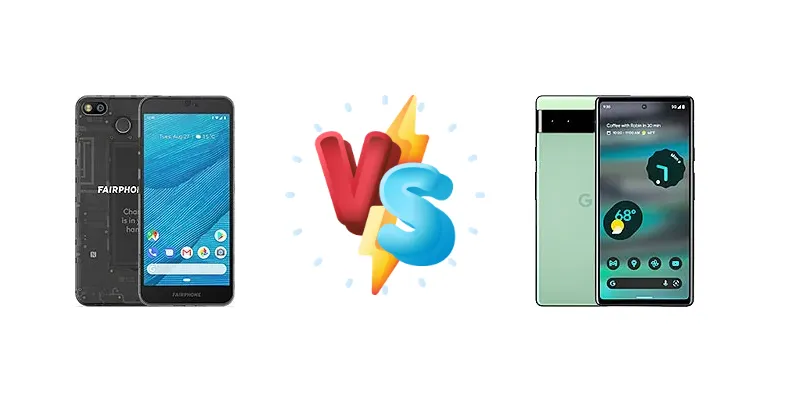
Fairphone 3 vs. Google Pixel 6a: A Deep Dive into Sustainability and Performance
| Phones Images | |||||
|---|---|---|---|---|---|
|
🏆 Quick Verdict
For the average user prioritizing performance and a smooth Android experience, the Google Pixel 6a is the clear winner. Its Tensor chip offers significantly faster processing and superior camera capabilities. However, the Fairphone 3 remains a compelling choice for those deeply committed to sustainability and long-term ownership through repairability.
| PHONES | ||
|---|---|---|
| Phone Names | Fairphone 3 | Google Pixel 6a |
| Network | ||
|---|---|---|
| 2G bands | GSM 850 / 900 / 1800 / 1900 | GSM 850 / 900 / 1800 / 1900 |
| 3G bands | HSDPA 800 / 850 / 900 / 1700(AWS) / 1900 / 2100 | HSDPA 800 / 850 / 900 / 1700(AWS) / 1900 / 2100 |
| 4G bands | 1, 2, 3, 4, 5, 7, 8, 13, 20, 26 | 1, 2, 3, 4, 5, 7, 8, 12, 13, 14, 17, 18, 19, 20, 25, 26, 28, 29, 30, 38, 39, 40, 41, 42, 48, 66, 71 - GX7AS, GB62Z (USA/Canada) |
| 5G bands | - | 1, 2, 3, 5, 7, 8, 12, 20, 25, 28, 30, 38, 40, 41, 48, 66, 71, 77, 78 SA/NSA/Sub6 - GX7AS (USA/Canada) |
| Speed | HSPA 42.2/5.76 Mbps, LTE (2CA) Cat6 300/150 Mbps | HSPA, LTE, 5G |
| Technology | GSM / HSPA / LTE | GSM / HSPA / LTE / 5G |
| - | 1, 2, 3, 5, 7, 8, 12, 20, 25, 28, 30, 40, 48, 66, 71, 77, 78 SA/NSA/Sub6 - G1AZG (International) | |
| Launch | ||
|---|---|---|
| Announced | 2019, August 27. Released 2019, September 03 | 2022, May 11 |
| Status | Discontinued | Available. Released 2022, July 21 |
| Body | ||
|---|---|---|
| Build | - | Glass front (Gorilla Glass 3), aluminum frame, plastic back |
| Dimensions | 158 x 71.8 x 9.9 mm (6.22 x 2.83 x 0.39 in) | 152.2 x 71.8 x 8.9 mm (5.99 x 2.83 x 0.35 in) |
| SIM | Nano-SIM + Nano-SIM | Nano-SIM + eSIM |
| Weight | 189 g (6.67 oz) | 178 g (6.28 oz) |
| - | IP67 dust/water resistant (up to 1m for 30 min) | |
| Display | ||
|---|---|---|
| Protection | Corning Gorilla Glass 5 | Corning Gorilla Glass 3 |
| Resolution | 1080 x 2160 pixels, 18:9 ratio (~427 ppi density) | 1080 x 2400 pixels, 20:9 ratio (~429 ppi density) |
| Size | 5.65 inches, 82.4 cm2 (~72.6% screen-to-body ratio) | 6.1 inches, 90.7 cm2 (~83.0% screen-to-body ratio) |
| Type | IPS LCD | OLED, HDR |
| - | Always-on display | |
| Platform | ||
|---|---|---|
| CPU | Octa-core (4x1.8 GHz Kryo 250 Gold & 4x1.8 GHz Kryo 250 Silver) | Octa-core (2x2.80 GHz Cortex-X1 & 2x2.25 GHz Cortex-A76 & 4x1.80 GHz Cortex-A55) |
| Chipset | Qualcomm SDM632 Snapdragon 632 (14 nm) | Google Tensor (5 nm) |
| GPU | Adreno 506 | Mali-G78 MP20 |
| OS | Android 9.0 (Pie), upgradable to Android 13 | Android 12, upgradable to Android 15, up to 5 major Android upgrades |
| Memory | ||
|---|---|---|
| Card slot | microSDXC (dedicated slot) | No |
| Internal | 64GB 4GB RAM | 128GB 6GB RAM |
| eMMC 5.1 | UFS 3.1 | |
| Main Camera | ||
|---|---|---|
| Dual | - | 12.2 MP, f/1.7, 27mm, (wide), 1/2.55", 1.4µm, dual pixel PDAF, OIS 12 MP, f/2.2, 17mm, 114˚ (ultrawide), 1.25µm |
| Features | Dual-LED dual-tone flash, HDR, panorama | Dual-LED flash, Pixel Shift, Auto-HDR, panorama |
| Single | 12 MP, f/1.8, (wide), 1/2.55", 1.4µm, dual pixel PDAF | 8 MP, f/2.0, 24mm (wide), 1.12µm |
| Video | 4K@30fps, 1080p@30fps, gyro-EIS | 4K@30/60fps, 1080p@30/60/120/240fps; gyro-EIS, OIS |
| Selfie camera | ||
|---|---|---|
| Features | - | HDR, panorama |
| Single | 8 MP, f/2.0, (wide), 1/4.0" | 8 MP, f/2.0, 24mm (wide), 1.12µm |
| Video | 1080p@30fps, gyro-EIS | 1080p@30fps |
| Sound | ||
|---|---|---|
| 3.5mm jack | Yes | No |
| 35mm jack | Yes | No |
| Loudspeaker | Yes | Yes, with stereo speakers |
| Comms | ||
|---|---|---|
| Bluetooth | 5.0, A2DP, LE | 5.2, A2DP, LE |
| NFC | Yes | Yes |
| Positioning | GPS, GLONASS, GALILEO | GPS, GLONASS, GALILEO, QZSS |
| Radio | No | No |
| USB | USB Type-C 2.0 | USB Type-C 3.1 |
| WLAN | Wi-Fi 802.11 a/b/g/n/ac, dual-band, Wi-Fi Direct | Wi-Fi 802.11 a/b/g/n/ac/6e, dual-band, Wi-Fi Direct |
| Features | ||
|---|---|---|
| Sensors | Fingerprint (rear-mounted), accelerometer, gyro, proximity, compass | Fingerprint (under display, optical), accelerometer, gyro, proximity, compass, barometer |
| Battery | ||
|---|---|---|
| Charging | - | 18W wired, PD3.0 |
| Type | Li-Ion 3040 mAh, removable | Li-Po 4410 mAh |
| Misc | ||
|---|---|---|
| Colors | Black | Chalk, Charcoal, Sage |
| Models | - | GX7AS, GB62Z, G1AZG, GB17L |
| Price | About 400 EUR | $ 138.99 / C$ 228.74 / ₹ 23,999 |
| SAR EU | 0.39 W/kg (head) 1.41 W/kg (body) | - |
| Tests | ||
|---|---|---|
| Battery life | - | Endurance rating 94h |
| Display | - | Contrast ratio: Infinite (nominal) |
Fairphone 3
- Exceptional repairability and modularity
- Sustainable and ethical design
- Long-term software support commitment
- Significantly lower performance
- Less impressive camera capabilities
- Higher initial cost for comparable specs
Google Pixel 6a
- Powerful Google Tensor chip
- Excellent camera quality and image processing
- Fast charging and good battery life
- Limited repairability
- Less sustainable design
- Shorter potential lifespan due to limited repair options
Display Comparison
The Pixel 6a boasts a significantly brighter display, reaching 876 nits measured, compared to the Fairphone 3’s unspecified brightness. This translates to better outdoor visibility for the Pixel 6a. While the Fairphone 3’s display details are limited, its focus is on practicality rather than visual extravagance. The Pixel 6a’s ‘infinite’ contrast ratio (nominal) suggests a superior OLED panel, offering deeper blacks and more vibrant colors, a benefit for media consumption. The Fairphone 3 likely utilizes an IPS LCD, which is generally less power-efficient and offers lower contrast.
Camera Comparison
While both phones offer capable cameras, the Pixel 6a is expected to deliver superior image quality thanks to Google’s computational photography prowess and the Tensor chip’s image signal processor (ISP). The Fairphone 3’s camera specifications are less detailed, but its modularity allows for potential camera module upgrades. However, the Pixel 6a’s ISP is optimized for features like Night Sight and Super Res Zoom, providing a more versatile and consistently high-quality camera experience. The Pixel 6a’s image processing algorithms are a key differentiator, offering superior dynamic range and detail in challenging lighting conditions.
Performance
The performance gap between these devices is substantial. The Google Pixel 6a’s Google Tensor chip, built on a 5nm process, features a tri-cluster CPU configuration with high-performance Cortex-X1 cores clocked at 2.80 GHz. This contrasts sharply with the Fairphone 3’s Qualcomm Snapdragon 632 (14nm), which relies on Kryo 250 cores clocked at 1.8 GHz. The 5nm fabrication process of the Tensor chip provides significantly better power efficiency and thermal management, allowing for sustained performance under load. The Pixel 6a will handle demanding tasks like gaming and video editing with ease, while the Fairphone 3 will struggle with more intensive applications. The Pixel 6a’s likely use of faster LPDDR5 RAM further enhances its performance advantage.
Battery Life
Both phones achieve an endurance rating of 94 hours, indicating comparable battery life despite differing battery capacities (not specified for Fairphone 3). However, the Pixel 6a’s 18W wired charging with PD3.0 support offers faster charging speeds than the Fairphone 3’s unspecified charging capabilities. This means the Pixel 6a can be topped up more quickly, minimizing downtime. The Tensor chip’s 5nm efficiency also contributes to the Pixel 6a’s strong battery performance, balancing power consumption with processing demands.
Buying Guide
Buy the Fairphone 3 if you need a phone you can easily repair yourself, value a modular design for upgrades, and prioritize environmental responsibility over cutting-edge performance. Buy the Google Pixel 6a if you prefer a fast, feature-rich Android experience, excellent camera quality, and don't anticipate needing to repair the phone yourself beyond standard warranty service.