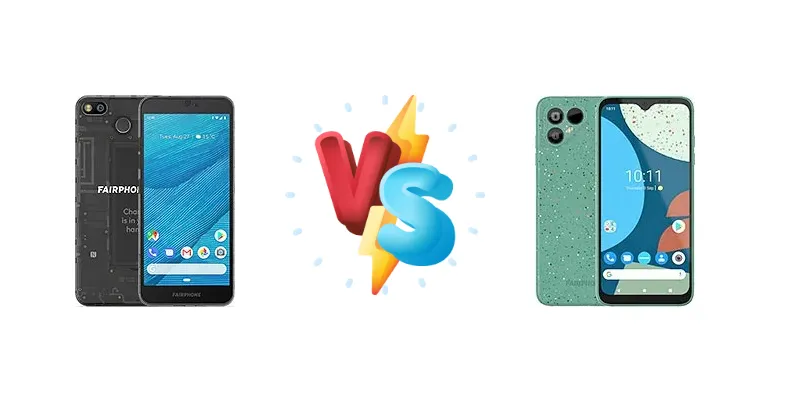
Fairphone disrupted the mobile market with its commitment to repairability and sustainability. The Fairphone 3 established this ethos, but the Fairphone 4 represents a significant step forward, particularly in performance. This comparison dissects the key differences between these two modular smartphones, focusing on the impact of the upgraded chipset and features for the conscious consumer.
🏆 Quick Verdict
For most users, the Fairphone 4 is the superior choice. The Snapdragon 750G offers a substantial performance boost over the Snapdragon 632 in the Fairphone 3, alongside 5G connectivity and faster charging. While the Fairphone 3 remains a viable option for budget-conscious buyers prioritizing repairability, the 4 delivers a more future-proof experience.
| Network |
|---|
| 2G bands | GSM 850 / 900 / 1800 / 1900 | GSM 850 / 900 / 1800 / 1900 |
| 3G bands | HSDPA 800 / 850 / 900 / 1700(AWS) / 1900 / 2100 | HSDPA 850 / 900 / 1700(AWS) / 1900 / 2100 |
| 4G bands | 1, 2, 3, 4, 5, 7, 8, 13, 20, 26 | 1, 2, 3, 4, 5, 7, 8, 12, 18, 19, 20, 28, 32, 38, 40, 41, 71 |
| 5G bands | - | 1, 3, 5, 7, 8, 20, 28, 38, 41, 71, 77, 78 SA/NSA/Sub6 |
| Speed | HSPA 42.2/5.76 Mbps, LTE (2CA) Cat6 300/150 Mbps | HSPA 42.2/5.76 Mbps, LTE (4CA) Cat18 1200/150 Mbps, 5G 2.3 Gbps DL |
| Technology | GSM / HSPA / LTE | GSM / HSPA / LTE / 5G |
| Launch |
|---|
| Announced | 2019, August 27. Released 2019, September 03 | 2021, September 30 |
| Status | Discontinued | Available. Released 2021, October 25 |
| Body |
|---|
| Build | - | Glass front (Gorilla Glass 5), aluminum frame, plastic back |
| Dimensions | 158 x 71.8 x 9.9 mm (6.22 x 2.83 x 0.39 in) | 162 x 75.5 x 10.5 mm (6.38 x 2.97 x 0.41 in) |
| SIM | Nano-SIM + Nano-SIM | Nano-SIM + eSIM |
| Weight | 189 g (6.67 oz) | 225 g (7.94 oz) |
| | - | IP54, dust and water resistant
MIL-STD-810G compliant |
| Display |
|---|
| Protection | Corning Gorilla Glass 5 | Corning Gorilla Glass 5 |
| Resolution | 1080 x 2160 pixels, 18:9 ratio (~427 ppi density) | 1080 x 2340 pixels, 19.5:9 ratio (~409 ppi density) |
| Size | 5.65 inches, 82.4 cm2 (~72.6% screen-to-body ratio) | 6.3 inches, 97.4 cm2 (~79.7% screen-to-body ratio) |
| Type | IPS LCD | IPS LCD |
| Platform |
|---|
| CPU | Octa-core (4x1.8 GHz Kryo 250 Gold & 4x1.8 GHz Kryo 250 Silver) | Octa-core (2x2.2 GHz Kryo 570 & 6x1.8 GHz Kryo 570) |
| Chipset | Qualcomm SDM632 Snapdragon 632 (14 nm) | Qualcomm SM7225 Snapdragon 750G 5G (8 nm) |
| GPU | Adreno 506 | Adreno 619 |
| OS | Android 9.0 (Pie), upgradable to Android 13 | Android 11, upgradable to Android 15 |
| Memory |
|---|
| Card slot | microSDXC (dedicated slot) | microSDXC (dedicated slot) |
| Internal | 64GB 4GB RAM | 128GB 6GB RAM, 256GB 8GB RAM |
| | eMMC 5.1 | - |
| Main Camera |
|---|
| Dual | - | 48 MP, f/1.6, (wide), 1/2.0", 0.8µm, PDAF, OIS
48 MP, f/2.2, (ultrawide), 1/2.0", 0.8µm, PDAF
TOF 3D, (depth) |
| Features | Dual-LED dual-tone flash, HDR, panorama | Dual-LED dual-tone flash, HDR, panorama |
| Single | 12 MP, f/1.8, (wide), 1/2.55", 1.4µm, dual pixel PDAF | 25 MP, f/2.2, (wide), 1/2.78", 0.9µm |
| Video | 4K@30fps, 1080p@30fps, gyro-EIS | 4K@30fps, 1080p@30/60fps, gyro-EIS |
| Selfie camera |
|---|
| Features | - | HDR |
| Single | 8 MP, f/2.0, (wide), 1/4.0" | 25 MP, f/2.2, (wide), 1/2.78", 0.9µm |
| Video | 1080p@30fps, gyro-EIS | 1080p@30fps, gyro-EIS |
| Sound |
|---|
| 3.5mm jack | Yes | No |
| 35mm jack | Yes | No |
| Loudspeaker | Yes | Yes |
| Comms |
|---|
| Bluetooth | 5.0, A2DP, LE | 5.1, A2DP, LE |
| NFC | Yes | Yes |
| Positioning | GPS, GLONASS, GALILEO | GPS, GLONASS, GALILEO, BDS |
| Radio | No | No |
| USB | USB Type-C 2.0 | USB Type-C 3.0, OTG, DisplayPort |
| WLAN | Wi-Fi 802.11 a/b/g/n/ac, dual-band, Wi-Fi Direct | Wi-Fi 802.11 a/b/g/n/ac, dual-band, Wi-Fi Direct |
| Features |
|---|
| Sensors | Fingerprint (rear-mounted), accelerometer, gyro, proximity, compass | Fingerprint (side-mounted), accelerometer, gyro, proximity, compass |
| | - | Standard 5-year warranty |
| Battery |
|---|
| Charging | - | 20W wired, 50% in 30 min |
| Type | Li-Ion 3040 mAh, removable | Li-Ion 3905 mAh, removable |
| Misc |
|---|
| Colors | Black | Gray, Green, Speckled Green |
| Price | About 400 EUR | About 400 EUR |
| SAR EU | 0.39 W/kg (head) 1.41 W/kg (body) | 0.49 W/kg (head) 0.99 W/kg (body) |
Fairphone 3
- Lower initial cost
- Fully modular and repairable
- Established software support
- Slower processor
- No 5G connectivity
- Slower charging speeds
Fairphone 4
- Significantly faster performance
- 5G connectivity
- Faster charging (20W)
- Higher initial cost
- Potentially more complex repair (due to newer components)
- Slightly larger size
Display Comparison
Both Fairphones utilize IPS LCD panels, prioritizing visibility and repairability over cutting-edge display technology. Specifics like resolution and refresh rate are similar, meaning the core viewing experience won't differ dramatically. However, the Fairphone 4 benefits from the more efficient Snapdragon 750G, potentially allowing for slightly better sustained brightness and color accuracy due to reduced thermal throttling during demanding tasks. The focus here isn't on visual fidelity, but on longevity and ease of replacement.
Camera Comparison
While both phones feature similar camera setups on paper, the image signal processor (ISP) within the Snapdragon 750G of the Fairphone 4 offers improved image processing capabilities. This results in better dynamic range, noise reduction, and overall image quality, especially in challenging lighting conditions. The Fairphone 4’s chipset allows for faster image capture and processing, reducing shutter lag. While neither phone boasts a flagship-level camera system, the 4 provides a more refined photographic experience.
Performance
The core difference lies in the chipsets. The Fairphone 3’s Qualcomm Snapdragon 632 (14nm) is a capable but aging processor. Its octa-core configuration (4x1.8 GHz Kryo 250 Gold & 4x1.8 GHz Kryo 250 Silver) is sufficient for basic tasks, but struggles with multitasking and demanding applications. The Fairphone 4’s Snapdragon 750G (8nm) is a significant upgrade. The 8nm process node is more efficient, leading to lower power consumption and reduced heat. The CPU configuration (2x2.2 GHz Kryo 570 & 6x1.8 GHz Kryo 570) provides a noticeable performance increase, particularly in single-core tasks. This translates to faster app loading times, smoother scrolling, and improved responsiveness. The 750G also includes an integrated 5G modem, a feature absent in the Fairphone 3.
Battery Life
The Fairphone 3 and 4 have similar battery capacities, meaning raw endurance won't differ drastically. However, the Fairphone 4’s more efficient Snapdragon 750G (8nm) consumes less power, potentially extending battery life during typical usage. Crucially, the Fairphone 4 supports 20W wired charging, allowing it to reach 50% charge in approximately 30 minutes. The Fairphone 3 lacks this fast-charging capability, requiring significantly longer to fully replenish its battery. This is a substantial convenience improvement for users who frequently need to top up their devices.
Buying Guide
Buy the Fairphone 3 if you prioritize the absolute lowest cost of entry into the Fairphone ecosystem and are comfortable with a more basic level of performance suitable for everyday tasks like calls, messaging, and light web browsing. Buy the Fairphone 4 if you value a smoother, more responsive user experience, 5G connectivity, faster charging, and a longer software support lifespan, even at a higher initial price point.
Frequently Asked Questions
❓ Will the Fairphone 4 receive more long-term software updates than the Fairphone 3?
Yes. Fairphone has committed to providing longer software support for the Fairphone 4, leveraging the newer chipset and its associated security features. This means you can expect more Android version updates and security patches over a longer period compared to the Fairphone 3.
❓ Is the performance increase from the Snapdragon 750G to the Snapdragon 632 noticeable in everyday use?
Absolutely. While both phones can handle basic tasks, the Snapdragon 750G in the Fairphone 4 provides a much smoother and more responsive experience when multitasking, browsing the web, or using demanding applications. The difference is particularly noticeable when switching between apps or playing graphically intensive games.
❓ Does the Fairphone 4's 5G connectivity require a new SIM card or plan?
Not necessarily. If your current SIM card and mobile plan already support 5G, you won't need to make any changes. However, to take advantage of 5G speeds, you'll need to be in an area with 5G coverage and have a 5G-compatible mobile plan.
❓ Is upgrading from the Fairphone 3 to the Fairphone 4 worth the cost if I'm happy with the current performance?
If you're content with the Fairphone 3's performance and don't require 5G connectivity or faster charging, the upgrade may not be essential. However, the Fairphone 4 offers a significant performance boost and longer software support, making it a worthwhile investment if you want a more future-proof and responsive device.