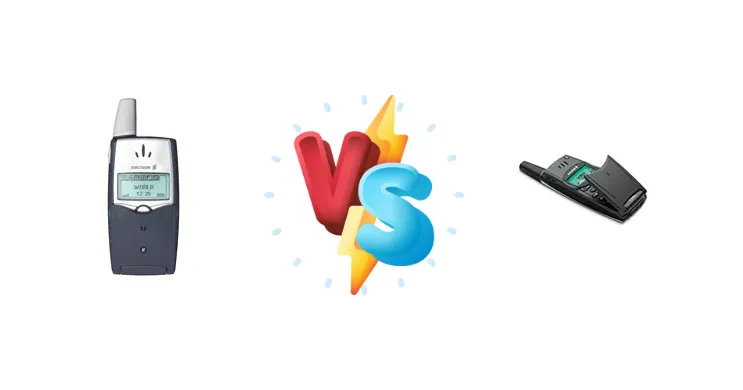
The late 90s and early 2000s were a golden age for mobile phones, and Ericsson was a major player. Today, we're pitting two of their classic devices, the T39 and the T28s, against each other. This isn't about cutting-edge tech; it's about appreciating the design and functionality of a bygone era.
🏆 Quick Verdict
Given the limited information, the T28s likely edges out the T39 due to its generally better reputation for build quality and slightly more refined design. Both offer a nostalgic experience, but the T28s probably provides a more polished retro mobile phone feel.
| Network |
|---|
| 2G bands | GSM 900 / 1800 / 1900 | GSM 900 / 1800 |
| EDGE | No | No |
| GPRS | Yes | No |
| Technology | GSM | GSM |
| Launch |
|---|
| Announced | 2001 | 1999 |
| Status | Discontinued | Discontinued |
| Body |
|---|
| Dimensions | 96 x 50 x 18 mm (3.78 x 1.97 x 0.71 in) | 97 x 50 x 15 mm (3.82 x 1.97 x 0.59 in) |
| SIM | Mini-SIM | Mini-SIM |
| Weight | 86 g (3.03 oz) | 83 g (2.93 oz) |
| Display |
|---|
| Resolution | 101 x 54 pixels, 4 lines, 17:9 ratio | 101 x 33 pixels, 3 x 12 chars |
| Type | Grayscale graphic | Monochrome graphic |
| | - | Fixed icons |
| Memory |
|---|
| Call records | 10 received, dialed and missed calls | - |
| Card slot | No | No |
| Phonebook | 510 | 250 |
| Sound |
|---|
| 3.5mm jack | No | No |
| 35mm jack | No | No |
| Alert types | Vibration; Downloadable monophonic ringtones, composer | Vibration; Monophonic ringtones, composer |
| Loudspeaker | No | No |
| Comms |
|---|
| Bluetooth | 1.0b | No |
| Infrared port | Yes | - |
| Positioning | No | No |
| Radio | No | No |
| WLAN | No | No |
| Features |
|---|
| Alarm | Yes | Yes |
| Browser | WAP 1.2.1 | - |
| Clock | Yes | Yes |
| Games | Yes | 2 - Tetris, Solitarie |
| Java | No | No |
| Languages | 37 | 37 |
| Messaging | SMS, Email | SMS |
| | Predictive text input
Organizer
Voice dialing
Voice answering
Profiles
Helptexts and shortcuts
Active flip | Voice dialing
Voice answering
Profiles
Helptexts and shortcuts
Active flip |
| Battery |
|---|
| Stand-by | up to 29 days | 65 h |
| Talk time | up to 25 h | 4 h 30 min |
| Type | Removable NiMH battery | Removable Li-Po 500 mAh battery |
| Misc |
|---|
| Colors | 3 - Classic Blue, Icecap Blue, Rose White | - |
Ericsson T39
- Potentially more rugged design
- Nostalgic appeal
- Simple and easy to use
- Likely limited features
- Unknown performance
- Battery degradation risk
- Difficult to find parts/support
Ericsson T28s
- Generally better build quality (reputation)
- Slightly more refined design
- Nostalgic appeal
- Simple and easy to use
- Likely limited features
- Unknown performance
- Battery degradation risk
- Difficult to find parts/support
Display Comparison
Both phones likely feature small, monochrome LCD screens typical of the era. The T28s might have a slightly higher resolution or better contrast, but differences would be minimal. Expect limited viewing angles and low brightness.
Camera Comparison
Neither phone likely had a camera, or if they did, it would be a very low-resolution, rudimentary model. Image quality would be extremely poor by today's standards.
Performance
Performance will be dictated by the processors and memory, which are unknown. Both will be slow by modern standards, suitable only for basic calling and texting. Expect limited multitasking capabilities.
Battery Life
Battery life was a strong point of these older phones. Expect several days of moderate use from either device, assuming a functional battery. Battery degradation is a significant concern with these older models.
Buying Guide
The Ericsson T39 and T28s are for collectors, nostalgia enthusiasts, and those seeking a simple, distraction-free communication device. The T39 might appeal to those seeking a slightly more rugged design, while the T28s is better for those prioritizing aesthetics and a more premium feel (within the context of early 2000s phones).
Frequently Asked Questions
❓ Are these phones easy to find?
Finding these phones in good working condition can be challenging. They are primarily available through online marketplaces and auction sites specializing in vintage electronics.
❓ Can I use these phones on a modern network?
No, these phones use older 2G network technologies (GSM) which are largely phased out. They are not compatible with modern 3G, 4G, or 5G networks.