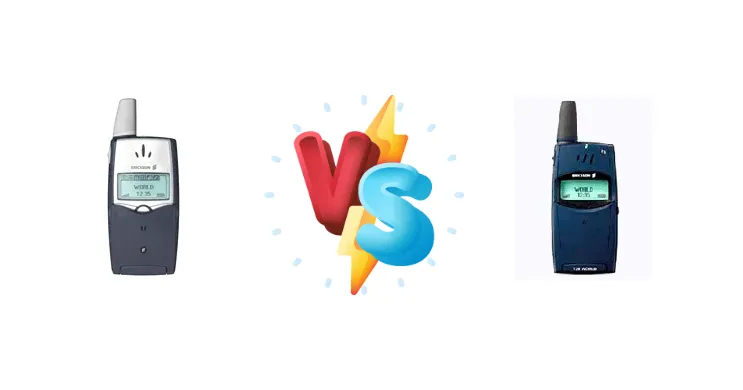
The 1990s were a golden age for mobile phones, with iconic designs and a unique charm. Today, we're pitting two of Ericsson's finest against each other: the T39 and the T28 World. Let's see which one holds up best in a modern context.
🏆 Quick Verdict
Both phones offer a nostalgic experience. The T28 World likely edges out the T39 due to its 'World' designation suggesting broader network compatibility and potentially slightly improved features, though both are limited by their era's technology. Ultimately, it's about the retro appeal.
| Network |
|---|
| 2G bands | GSM 900 / 1800 / 1900 | GSM 900 / 1900 |
| EDGE | No | No |
| GPRS | Yes | No |
| Technology | GSM | GSM |
| Launch |
|---|
| Announced | 2001 | 1999 |
| Status | Discontinued | Discontinued |
| Body |
|---|
| Dimensions | 96 x 50 x 18 mm (3.78 x 1.97 x 0.71 in) | 97 x 50 x 15 mm (3.82 x 1.97 x 0.59 in) |
| SIM | Mini-SIM | Mini-SIM |
| Weight | 86 g (3.03 oz) | 83 g (2.93 oz) |
| Display |
|---|
| Resolution | 101 x 54 pixels, 4 lines, 17:9 ratio | 101 x 33 pixels, 3 x 12 chars |
| Type | Grayscale graphic | Monochrome graphic |
| | - | Fixed icons |
| Memory |
|---|
| Call records | 10 received, dialed and missed calls | - |
| Card slot | No | No |
| Phonebook | 510 | 250 |
| Sound |
|---|
| 3.5mm jack | No | No |
| 35mm jack | No | No |
| Alert types | Vibration; Downloadable monophonic ringtones, composer | Vibration; Monophonic ringtones, composer |
| Loudspeaker | No | No |
| Comms |
|---|
| Bluetooth | 1.0b | No |
| Infrared port | Yes | - |
| Positioning | No | No |
| Radio | No | No |
| WLAN | No | No |
| Features |
|---|
| Alarm | Yes | Yes |
| Browser | WAP 1.2.1 | - |
| Clock | Yes | Yes |
| Games | Yes | 2 - Tetris, Solitarie |
| Java | No | No |
| Languages | 37 | 37 |
| Messaging | SMS, Email | SMS |
| | Predictive text input
Organizer
Voice dialing
Voice answering
Profiles
Helptexts and shortcuts
Active flip | Voice dialing
Voice answering
Profiles
Helptexts and shortcuts
Active flip |
| Battery |
|---|
| Stand-by | up to 29 days | 65 h |
| Talk time | up to 25 h | 4 h 30 min |
| Type | Removable NiMH battery | Removable Li-Po 500 mAh battery |
| Misc |
|---|
| Colors | 3 - Classic Blue, Icecap Blue, Rose White | - |
Ericsson T39
- Classic Ericsson design
- Simple and durable
- Nostalgic appeal
- Extremely limited functionality
- Small screen
- No camera (likely)
- Difficult to find accessories
Ericsson T28 World
- Classic Ericsson design
- Potentially wider network compatibility ('World' designation)
- Simple and durable
- Nostalgic appeal
- Extremely limited functionality
- Small screen
- No camera (likely)
- Difficult to find accessories
Display Comparison
Both phones likely feature small, monochrome LCD screens typical of the era. Expect low resolution and limited color capabilities. The T28 World *might* have a marginally larger screen, but this is unconfirmed.
Camera Comparison
Neither phone is likely to have a camera. Cameras were not standard on phones of this generation. If either does, it would be a very low-resolution, rudimentary affair.
Performance
Performance will be extremely limited on both devices. Expect slow processing speeds and basic functionality. Don't expect multitasking or modern app capabilities. They are designed for calls and SMS.
Battery Life
Battery life was generally good on these older phones, but expect to charge them regularly. The T28 World *might* have a slightly larger battery capacity, but this is speculative.
Buying Guide
The Ericsson T39 is for dedicated collectors and those seeking a very basic, minimalist phone experience. The Ericsson T28 World is ideal for those wanting a slightly more feature-rich retro phone, potentially with better international roaming capabilities (though this is speculative).
Frequently Asked Questions
❓ Are these phones easy to find?
Finding these phones in good condition can be challenging. They are primarily available through online marketplaces specializing in vintage electronics.
❓ Can I use these phones on modern networks?
Likely no. These phones use older network technologies (GSM) that are being phased out. You may need to find a specialized network or SIM card to use them.