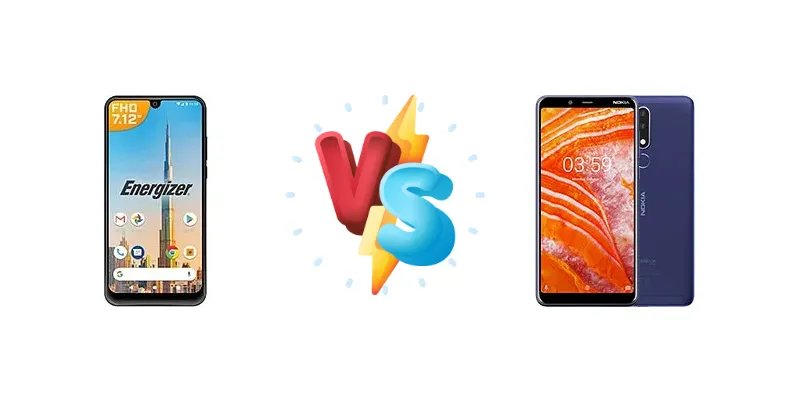
The Energizer Ultimate U710S and Nokia 3.1 Plus represent a segment of the market focused on affordability. However, beneath the similar price points lie crucial differences in their core hardware, specifically the chipset. The Nokia 3.1 Plus notably varies its chipset based on region, offering either the Mediatek Helio P22 globally or the Qualcomm Snapdragon 439 in the USA, creating a complex comparison against the consistently Mediatek Helio P23-powered Energizer U710S.
🏆 Quick Verdict
For the average user prioritizing consistent performance, the Nokia 3.1 Plus (Snapdragon 439 variant) offers a slight edge due to Qualcomm’s generally optimized software and the more efficient 12nm process. However, the Energizer U710S remains a viable option, particularly where the Nokia’s regional chipset variation is a concern.
| Network |
|---|
| 2G bands | GSM 850 / 900 / 1800 / 1900 | GSM 850 / 900 / 1800 / 1900 |
| 3G bands | HSDPA 850 / 900 / 1900 / 2100 | HSDPA 850 / 900 / 1900 / 2100 |
| 4G bands | 1, 3, 7, 8, 20, 28, 38, 40 | 2, 4, 5, 12, 14, 29, 30 - USA |
| Speed | HSPA, LTE | HSPA 42.2/5.76 Mbps, LTE Cat4 150/50 Mbps |
| Technology | GSM / HSPA / LTE | GSM / HSPA / LTE |
| | - | HSDPA 850 / 1700(AWS) / 1900 - USA |
| Launch |
|---|
| Announced | 2020, February 17 | 2018, October. Released 2018, October |
| Status | Cancelled | Discontinued |
| Body |
|---|
| Build | - | Glass front, aluminum back, aluminum frame |
| Dimensions | 180.3 x 86.8 x 9.2 mm (7.10 x 3.42 x 0.36 in) | 156.9 x 76.4 x 8.2 mm (6.18 x 3.01 x 0.32 in) |
| SIM | Nano-SIM + Nano-SIM | Nano-SIM + Nano-SIM |
| Weight | - | 180 g (6.35 oz) |
| Display |
|---|
| Protection | AGC glass | - |
| Resolution | 1080 x 2244 pixels, 18.7:9 ratio (~350 ppi density) | 720 x 1440 pixels, 18:9 ratio (~268 ppi density) |
| Size | 7.12 inches, 127.8 cm2 (~81.7% screen-to-body ratio) | 6.0 inches, 92.9 cm2 (~77.5% screen-to-body ratio) |
| Type | IPS LCD | IPS LCD |
| Platform |
|---|
| CPU | Octa-core (4x2.0 GHz Cortex-A53 & 4x1.5 GHz Cortex-A53) | Octa-core 2.0 GHz Cortex-A53 - GlobalOcta-core (4x1.95 GHz Cortex-A53 & 4x1.45 GHz Cortex A53) - USA |
| Chipset | Mediatek MT6763 Helio P23 (16 nm) | Mediatek MT6762 Helio P22 (12 nm) - GlobalQualcomm SDM439 Snapdragon 439 (12 nm) - USA |
| GPU | Mali-G71 MP2 | PowerVR GE8320 - GlobalAdreno 505 - USA |
| OS | Android 9.0 (Pie) | Android 8.1 (Oreo), upgradable to Android 10, Android One |
| Memory |
|---|
| Card slot | microSDXC | microSDXC (dedicated slot) |
| Internal | 32GB 3GB RAM | 16GB 2GB RAM, 32GB 2GB RAM, 32GB 3GB RAM |
| | eMMC 5.1 | eMMC 5.1 |
| Main Camera |
|---|
| Dual | 13 MP, PDAF
VGA | 13 MP, f/2.0, AF
Auxiliary lens |
| Features | LED flash, HDR, panorama | LED flash, HDR, panorama |
| Video | 1080p@30fps | 1080p@30fps |
| Selfie camera |
|---|
| Features | - | LED flash, HDR |
| Single | 5 MP | 8 MP, f/2.2 |
| Video | - | 720p@30fps |
| Sound |
|---|
| 3.5mm jack | Yes | Yes |
| 35mm jack | Yes | Yes |
| Loudspeaker | Yes, with stereo speakers | Yes |
| Comms |
|---|
| Bluetooth | 4.2, A2DP, LE | 4.1, A2DP, LE |
| NFC | No | Yes (USA, APAC & EMEA) |
| Positioning | GPS, GLONASS | GPS, GLONASS, BDS, GALILEO |
| Radio | FM radio | FM radio |
| USB | USB Type-C 2.0 | microUSB 2.0, OTG |
| WLAN | Wi-Fi 802.11 b/g/n, Wi-Fi Direct | Wi-Fi 802.11 b/g/n, Wi-Fi Direct |
| Features |
|---|
| Sensors | Fingerprint (rear-mounted), accelerometer, proximity | Fingerprint (rear-mounted), accelerometer, gyro, proximity, compass |
| Battery |
|---|
| Charging | 10W wired | 10W wired |
| Type | Li-Po 6000 mAh | Li-Ion 3500 mAh, non-removable |
| Misc |
|---|
| Colors | Gray | Blue, White, Gray |
| Models | - | TA-1118, TA-1125, TA-1113, TA-1117, TA-1124, TA-1125 |
| Price | - | About 120 EUR |
| SAR EU | - | 0.41 W/kg (head) 1.58 W/kg (body) |
Energizer Ultimate U710S
- Consistent chipset across all regions.
- Potentially lower cost due to Mediatek chipset.
- Reliable performance for basic tasks.
- Less efficient 16nm process.
- Mediatek chipset may have less software optimization.
- Potentially lower resale value.
Nokia 3.1 Plus
- More efficient 12nm process (P22/SDM439).
- Qualcomm Snapdragon 439 offers optimized performance (USA variant).
- Potentially better software support (especially USA variant).
- Chipset varies by region, creating inconsistency.
- May be slightly more expensive.
- Global variant (P22) may not offer a significant advantage over the P23.
Display Comparison
Neither device boasts a standout display. Both are likely to feature 720p+ panels, typical for this price bracket. However, the display quality will be heavily influenced by panel sourcing and calibration, data not provided. The focus here is on the chipset's ability to drive the display efficiently, and the differences are minimal given the resolution.
Camera Comparison
Camera performance is unlikely to be a differentiating factor. Both devices likely feature basic camera setups. Without sensor size or aperture information, it’s difficult to assess image quality. The inclusion of a 2MP macro lens on either device is largely a marketing tactic and won’t significantly impact image quality. The image signal processor (ISP) within the chipset plays a larger role, and Qualcomm’s ISP in the Snapdragon 439 variant may offer slightly better image processing capabilities.
Performance
The core of the comparison lies in the chipsets. The Energizer U710S utilizes the Mediatek MT6763 Helio P23, built on a 16nm process, featuring an octa-core CPU split into 4x2.0 GHz Cortex-A53 and 4x1.5 GHz Cortex-A53 cores. The Nokia 3.1 Plus presents a regional split: the Helio P22 (12nm) globally and the Snapdragon 439 (12nm) in the USA. The 12nm process of both Nokia variants offers a theoretical efficiency advantage over the 16nm P23, potentially leading to slightly cooler operation and better sustained performance. The Snapdragon 439, while also using Cortex-A53 cores, benefits from Qualcomm’s optimizations and often delivers smoother performance in real-world usage compared to Mediatek’s equivalent. The CPU configuration on the USA Nokia 3.1 Plus is slightly different (4x1.95 GHz & 4x1.45 GHz) which may offer a marginal performance boost.
Battery Life
Both devices support 10W wired charging, indicating a similar charging experience. Battery capacity is not specified, but given the target market, both are likely in the 3000-4000 mAh range. The more efficient 12nm process of the Nokia 3.1 Plus chipsets (P22/SDM439) could translate to slightly longer battery life, especially during sustained use, offsetting any potential capacity differences.
Buying Guide
Buy the Energizer Ultimate U710S if you need a reliably spec'd device regardless of location, and are comfortable with Mediatek's software ecosystem. Buy the Nokia 3.1 Plus if you are in the USA and value Qualcomm's optimized software and potentially better long-term software support, or if you prioritize a slightly more power-efficient chipset in the global variant.
Frequently Asked Questions
❓ Will the Energizer U710S struggle with multitasking compared to the Nokia 3.1 Plus?
The Nokia 3.1 Plus, particularly the Snapdragon 439 variant, is likely to handle multitasking slightly more smoothly due to Qualcomm’s optimizations. However, for basic multitasking (e.g., switching between messaging and web browsing), the Energizer U710S should be adequate.
❓ Does the regional chipset difference in the Nokia 3.1 Plus significantly impact performance?
Yes, the Snapdragon 439 (USA) offers a noticeable performance advantage over the Helio P22 (Global). The Snapdragon 439 benefits from Qualcomm’s software optimizations and a more efficient architecture, resulting in a smoother user experience.
❓ Is the 10W charging speed on either device sufficient for daily use?
10W charging is relatively slow by modern standards. Expect a full charge to take around 2-3 hours. Neither device prioritizes fast charging, focusing instead on affordability.
❓ Which phone is better for playing casual mobile games?
Both phones can handle casual games adequately. The Snapdragon 439 in the USA Nokia 3.1 Plus will provide a slightly more consistent frame rate and smoother experience in more demanding casual titles.