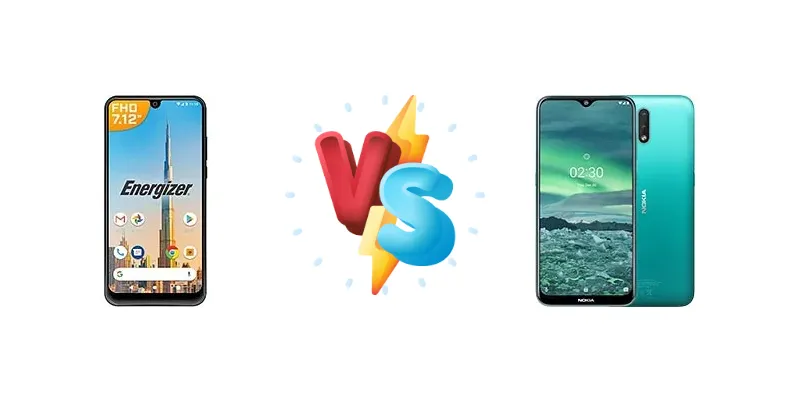
The Energizer Ultimate U710S and Nokia 2.3 represent the extreme end of the budget smartphone market. Both aim to deliver essential smartphone functionality at a minimal cost, but they take different approaches to achieving this. The U710S prioritizes a more powerful, albeit older, chipset, while the Nokia 2.3 opts for a newer, more power-efficient design. This comparison will dissect the key differences to determine which device offers the best value.
🏆 Quick Verdict
For the average user, the Energizer Ultimate U710S is the better choice. Its Mediatek Helio P23 chipset, despite being built on a larger 16nm process, offers significantly more processing power than the Nokia 2.3’s Helio A22. This translates to a smoother experience with multitasking and more demanding applications, making it a more future-proof option.
| Network |
|---|
| 2G bands | GSM 850 / 900 / 1800 / 1900 | GSM 850 / 900 / 1800 / 1900 |
| 3G bands | HSDPA 850 / 900 / 1900 / 2100 | HSDPA 850 / 900 / 2100 - Global |
| 4G bands | 1, 3, 7, 8, 20, 28, 38, 40 | 1, 3, 5, 7, 8, 20, 28, 38, 40, 41 - Global |
| Speed | HSPA, LTE | HSPA 42.2/5.76 Mbps, LTE Cat4 150/50 Mbps |
| Technology | GSM / HSPA / LTE | GSM / HSPA / LTE |
| | - | 1, 3, 5, 8, 40, 41 - India |
| Launch |
|---|
| Announced | 2020, February 17 | 2019, December 05. Released 2019, December 19 |
| Status | Cancelled | Discontinued |
| Body |
|---|
| Build | - | Glass front, plastic back, plastic frame |
| Dimensions | 180.3 x 86.8 x 9.2 mm (7.10 x 3.42 x 0.36 in) | 157.7 x 75.4 x 8.7 mm (6.21 x 2.97 x 0.34 in) |
| SIM | Nano-SIM + Nano-SIM | · Nano-SIM· Nano-SIM + Nano-SIM |
| Weight | - | 183 g (6.46 oz) |
| Display |
|---|
| Protection | AGC glass | - |
| Resolution | 1080 x 2244 pixels, 18.7:9 ratio (~350 ppi density) | 720 x 1520 pixels, 19:9 ratio (~271 ppi density) |
| Size | 7.12 inches, 127.8 cm2 (~81.7% screen-to-body ratio) | 6.2 inches, 95.9 cm2 (~80.7% screen-to-body ratio) |
| Type | IPS LCD | IPS LCD |
| | - | Always-on display |
| Platform |
|---|
| CPU | Octa-core (4x2.0 GHz Cortex-A53 & 4x1.5 GHz Cortex-A53) | Quad-core 2.0 GHz Cortex-A53 |
| Chipset | Mediatek MT6763 Helio P23 (16 nm) | Mediatek MT6761 Helio A22 (12 nm) |
| GPU | Mali-G71 MP2 | PowerVR GE8320 |
| OS | Android 9.0 (Pie) | Android 9.0 (Pie), upgradable to Android 11, Android One |
| Memory |
|---|
| Card slot | microSDXC | microSDXC (uses shared SIM slot) |
| Internal | 32GB 3GB RAM | 32GB 2GB RAM |
| | eMMC 5.1 | eMMC 5.1 |
| Main Camera |
|---|
| Dual | 13 MP, PDAF
VGA | - |
| Features | LED flash, HDR, panorama | LED flash, HDR, panorama |
| Single | - | 13 MP, f/2.2, 1/3.1", 1.12µm, AF
Auxiliary lens |
| Video | 1080p@30fps | 1080p@30fps |
| Selfie camera |
|---|
| Single | 5 MP | 5 MP, f/2.4 |
| Sound |
|---|
| 3.5mm jack | Yes | Yes |
| 35mm jack | Yes | Yes |
| Loudspeaker | Yes, with stereo speakers | Yes |
| Comms |
|---|
| Bluetooth | 4.2, A2DP, LE | 5.0, A2DP, LE |
| NFC | No | No |
| Positioning | GPS, GLONASS | GPS, GLONASS, BDS |
| Radio | FM radio | FM radio |
| USB | USB Type-C 2.0 | microUSB 2.0, OTG |
| WLAN | Wi-Fi 802.11 b/g/n, Wi-Fi Direct | Wi-Fi 802.11 b/g/n |
| Features |
|---|
| Sensors | Fingerprint (rear-mounted), accelerometer, proximity | Accelerometer, proximity |
| Battery |
|---|
| Charging | 10W wired | - |
| Type | Li-Po 6000 mAh | Li-Po 4000 mAh, non-removable |
| Misc |
|---|
| Colors | Gray | Cyan Green, Sand, Charcoal |
| Models | - | TA-1211, TA-1214, TA-1206, TA-1209 |
| Price | - | About 120 EUR |
| SAR | - | 0.81 W/kg (head) 0.86 W/kg (body) |
| SAR EU | - | 0.41 W/kg (head) 1.40 W/kg (body) |
Energizer Ultimate U710S
- More powerful processor for smoother multitasking
- Octa-core CPU offers better performance in demanding apps
- Potentially better image processing capabilities
- Less power-efficient chipset
- Larger manufacturing process (16nm) may lead to more heat
Nokia 2.3
- More power-efficient chipset for potentially longer battery life
- Smaller manufacturing process (12nm)
- Likely cleaner Android experience (Nokia's strength)
- Significantly less powerful processor
- Quad-core CPU may struggle with multitasking
Display Comparison
Neither device boasts a standout display. Specifics regarding panel type, resolution, and brightness are unavailable, but given the price point, both likely utilize LCD panels. The Nokia 2.3’s Helio A22 chipset may have limited display output capabilities, potentially resulting in a less vibrant or responsive screen compared to the U710S, which benefits from the P23’s greater processing headroom. Bezels are expected to be substantial on both devices, reflecting their budget nature.
Camera Comparison
Camera performance is likely to be similar on both devices, with both likely featuring basic camera setups. Without specific sensor details, it’s difficult to make a definitive judgment. However, the U710S’s more powerful processor could enable slightly better image processing, potentially resulting in more detailed and less noisy photos. The presence of a 2MP macro lens on either device is largely a marketing gimmick and shouldn’t be a deciding factor.
Performance
The core difference lies in the chipsets. The Energizer U710S’s Mediatek MT6763 Helio P23 is an octa-core processor with a heterogeneous architecture – four cores clocked at 2.0 GHz (Cortex-A53) and four at 1.5 GHz (Cortex-A53). This contrasts sharply with the Nokia 2.3’s Mediatek MT6761 Helio A22, a quad-core 2.0 GHz Cortex-A53 processor. While both use the same core architecture, the U710S’s eight cores provide a significant advantage in multi-threaded tasks. The P23’s 16nm manufacturing process is less efficient than the A22’s 12nm process, potentially leading to higher power consumption, but the performance gains are likely worth the trade-off for most users. The A22 is designed for basic functionality, while the P23 offers a more fluid experience.
Battery Life
Battery capacity is not specified for either device. However, the Nokia 2.3’s Helio A22, built on a 12nm process, is inherently more power-efficient than the U710S’s Helio P23 (16nm). This suggests the Nokia 2.3 could offer longer battery life under similar usage conditions. However, the U710S’s 10W wired charging is the only charging information available, and it's likely the Nokia 2.3 has similar charging capabilities. The efficiency gain of the A22 may be offset by a smaller battery capacity in the Nokia 2.3.
Buying Guide
Buy the Energizer Ultimate U710S if you need a phone capable of handling more than basic tasks, such as moderate gaming or running multiple apps simultaneously. Its stronger processor will provide a more responsive user experience. Buy the Nokia 2.3 if your primary needs are simple communication – calls, texts, and light social media – and you prioritize potentially longer battery life due to the more efficient chipset, and a cleaner Android experience.
Frequently Asked Questions
❓ Will the Energizer U710S struggle with popular games like PUBG Mobile?
While the Helio P23 isn't a gaming powerhouse, it should be able to run PUBG Mobile at lower settings. Expect frame rate drops during intense scenes. The Nokia 2.3’s Helio A22 will likely struggle significantly with PUBG, making it a less suitable choice for gamers.
❓ Is the Nokia 2.3 a good option for someone who primarily uses WhatsApp and makes calls?
Yes, the Nokia 2.3 is well-suited for basic communication tasks. The Helio A22 is sufficient for running apps like WhatsApp and handling phone calls without issue. Its power efficiency will also contribute to longer battery life for these use cases.
❓ Does the Energizer U710S support fast charging?
No, the Energizer U710S only supports 10W wired charging. This is a relatively slow charging speed compared to modern smartphones, so expect a longer charging time from 0 to 100%.
❓ Which phone is likely to receive more software updates?
Nokia has a better track record for providing software updates, even for its budget devices. While neither phone is guaranteed to receive extensive updates, the Nokia 2.3 is more likely to receive at least some security patches and potentially a version upgrade.