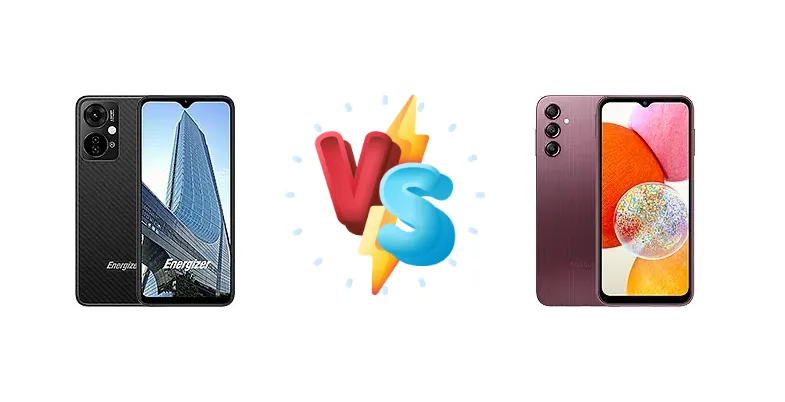
The Energizer Ultimate U652S and Samsung Galaxy A14 represent opposite ends of the budget smartphone spectrum. The U652S is an older, ultra-affordable device, while the A14 aims to deliver a more modern experience at a slightly higher price point. This comparison dissects their key differences to determine which offers the best value for your money.
🏆 Quick Verdict
For most users, the Samsung Galaxy A14 is the superior choice. Its newer Mediatek Helio G80 (or Exynos 850) chipset provides significantly improved performance and future-proofing compared to the aging Mediatek MT6739WW in the Energizer U652S. While the U652S is cheaper, the A14’s performance gains justify the price difference.
| Network |
|---|
| 2G bands | GSM 850 / 900 / 1800 / 1900 | GSM 850 / 900 / 1800 / 1900 |
| 3G bands | HSDPA 850 / 900 / 2100 | HSDPA 850 / 900 / 2100 |
| 4G bands | 1, 2, 3, 4, 5, 7, 8, 12, 13, 17, 20, 26, 28, 38, 40, 41, 66 | 1, 3, 5, 7, 8, 20, 28, 38, 40, 41 |
| Speed | HSPA, LTE | HSPA, LTE |
| Technology | GSM / HSPA / LTE | GSM / HSPA / LTE |
| Launch |
|---|
| Announced | 2024, February | 2023, February 28 |
| Status | Available. Released 2024, July | Available. Released 2023, March 27 |
| Body |
|---|
| Build | - | Glass front, plastic back, plastic frame |
| Dimensions | 164.3 x 76.1 x 9.1 mm (6.47 x 3.00 x 0.36 in) | 167.7 x 78 x 9.1 mm (6.60 x 3.07 x 0.36 in) |
| SIM | Nano-SIM + Nano-SIM | · Nano-SIM· Nano-SIM + Nano-SIM |
| Weight | 190 g (6.70 oz) | 201 g (7.09 oz) |
| Display |
|---|
| Resolution | 720 x 1600 pixels, 20:9 ratio (~270 ppi density) | 1080 x 2408 pixels, 20:9 ratio (~400 ppi density) |
| Size | 6.51 inches, 102.3 cm2 (~81.8% screen-to-body ratio) | 6.6 inches, 104.9 cm2 (~80.2% screen-to-body ratio) |
| Type | IPS LCD | PLS LCD |
| Platform |
|---|
| CPU | Quad-core 1.5 GHz | Octa-core (2x2.0 GHz Cortex-A75 & 6x1.8 GHz Cortex-A55) - Version AOcta-core (4x2.0 GHz Cortex-A55 & 4x2.0 GHz Cortex-A55) - Version B |
| Chipset | Mediatek MT6739WW (28 nm) | Mediatek MT6769 Helio G80 (12 nm) - Version AExynos 850 (8 nm) - Version B |
| GPU | IMG 8XE1PPC | Mali-G52 MC2 |
| OS | Android 13 (Go edition) | Android 13, upgradable to Android 15, One UI 7 |
| Memory |
|---|
| Card slot | microSDXC | microSDXC (dedicated slot) |
| Internal | 64GB 2GB RAM | 64GB 4GB RAM, 128GB 4GB RAM, 128GB 6GB RAM |
| Main Camera |
|---|
| Features | LED flash | LED flash, panorama, HDR |
| Single | - | 13 MP, f/2.0, (wide) |
| Triple | 18 MP (wide), AF
Auxiliary lenses | 50 MP, f/1.8, 26mm (wide), 1/2.75", 0.64µm, PDAF
5 MP, f/2.2, 17mm (ultrawide), 1/5.0", 1.12µm
2 MP (macro) |
| Video | 1080p@30fps | 1080p@30fps |
| Selfie camera |
|---|
| Single | 13 MP, (wide) | 13 MP, f/2.0, 26mm (wide), 1/3.1", 1.12µm |
| Video | Yes | 1080p@30fps |
| Sound |
|---|
| 3.5mm jack | - | Yes |
| 35mm jack | Yes | Yes |
| Loudspeaker | Yes | Yes |
| Comms |
|---|
| Bluetooth | 4.2, A2DP | 5.1 or 5.3, A2DP, LE |
| NFC | No | Yes (market/region dependent) |
| Positioning | GPS | GPS, GALILEO, GLONASS, BDS, QZSS |
| Radio | FM radio | Unspecified |
| USB | USB Type-C 2.0 | USB Type-C 2.0 |
| WLAN | Wi-Fi 802.11 a/b/g/n | Wi-Fi 802.11 a/b/g/n/ac, dual-band, Wi-Fi Direct |
| Features |
|---|
| Sensors | Fingerprint (side-mounted), accelerometer, proximity, compass | Fingerprint (side-mounted), accelerometer, proximity, compass |
| Battery |
|---|
| Charging | - | 15W wired |
| Type | Li-Ion 4000 mAh | Li-Po 5000 mAh |
| Misc |
|---|
| Colors | Black | Black, Dark Red, Silver, Green |
| Models | - | SM-A145F, SM-A145F/DSN, SM-A145M, SM-A145M/DS, SM-A145P, SM-A145R |
| Price | About 70 EUR | € 85.76 / $ 147.60 / £ 79.95 |
| SAR EU | - | 0.46 W/kg (head) 1.37 W/kg (body) |
Energizer Ultimate U652S
- Lowest possible price point
- Potentially longer battery life due to less powerful processor
- Simple and straightforward user experience
- Outdated processor struggles with modern apps
- Likely poor camera performance
- Slow charging speeds
Samsung Galaxy A14
- Significantly faster processor for smoother performance
- More efficient chipset for better battery management
- Faster 15W wired charging
- Higher price than the Energizer U652S
- Camera quality is still limited by the budget segment
- May not be the best choice for extreme battery life needs
Display Comparison
Neither device boasts a standout display. The Energizer U652S’s display specifications are unavailable, but given its price point, it likely features a lower resolution and less accurate color reproduction than the Galaxy A14. The A14’s display, while not specified in terms of nits, benefits from Samsung’s display expertise, offering a more vibrant and viewable experience. The A14’s larger screen size also provides more immersive content consumption. We can assume the U652S uses a basic IPS panel, while the A14 likely uses a PLS LCD, offering wider viewing angles.
Camera Comparison
Camera performance is likely to be a weak point on both devices, but the A14 has a slight edge. While both likely feature a primary camera, the A14’s sensor size and image processing capabilities are expected to be superior. The U652S’s camera specs are unknown, but its lower price suggests a basic sensor. The A14 benefits from Samsung’s image processing algorithms, potentially delivering more detailed and vibrant photos, especially in good lighting conditions. The inclusion of a 2MP macro camera on the A14 is largely a marketing gimmick and offers limited practical benefit.
Performance
The performance gap is the most significant differentiator. The Energizer U652S relies on the Mediatek MT6739WW, a quad-core processor built on a 28nm process. This older architecture struggles with demanding tasks. In contrast, the Samsung Galaxy A14 offers two chipset options: the Mediatek Helio G80 (12nm) and the Exynos 850 (8nm). Both are octa-core processors, with the Helio G80 featuring a more powerful CPU configuration (2x2.0 GHz Cortex-A75 & 6x1.8 GHz Cortex-A55) geared towards gaming. The Exynos 850 prioritizes efficiency. The move to a 12nm or 8nm process node in the A14 translates to significantly improved power efficiency and thermal management, reducing throttling during sustained workloads. The A14 will offer a noticeably smoother experience in everyday tasks and handle more complex apps without lag.
Battery Life
Battery life is a complex equation. The Energizer U652S’s battery capacity is unknown, but its less powerful chipset and older manufacturing process may result in comparable or even better battery life than the A14’s. However, the A14’s 15W wired charging is a significant advantage. The U652S likely charges at a slower rate, meaning longer times to reach a full charge. While the A14’s battery capacity isn’t massive, the more efficient chipset and faster charging provide a more convenient user experience.
Buying Guide
Buy the Energizer Ultimate U652S if you absolutely need the lowest possible price and only require basic smartphone functionality like calls, texts, and light web browsing. Buy the Samsung Galaxy A14 if you prioritize smoother multitasking, occasional gaming, and a more responsive user experience, even if it means spending a bit more.
Frequently Asked Questions
❓ Does the Samsung Galaxy A14’s Exynos 850 chip overheat during prolonged gaming sessions?
The Exynos 850 is designed for efficiency, and while it's not a flagship gaming chip, it's unlikely to overheat significantly during typical gaming sessions. The 8nm process helps dissipate heat effectively, minimizing throttling. However, demanding titles at maximum settings may still cause some performance reduction after extended play.
❓ Is the 2MP macro camera on the Samsung Galaxy A14 worth using?
Generally, no. 2MP macro cameras on budget phones often produce low-quality images with limited detail. They are primarily a marketing feature and rarely deliver satisfying results. The main camera on the A14 will provide far superior image quality for most close-up shots.
❓ Can the Samsung Galaxy A14 run PUBG Mobile at 60fps?
The Samsung Galaxy A14, particularly the Helio G80 variant, can likely run PUBG Mobile at 60fps with medium graphics settings. However, achieving a consistently smooth 60fps experience may require lowering the graphics settings further, depending on the specific device configuration and game updates.
❓ How much faster is the Samsung Galaxy A14 compared to the Energizer U652S in real-world use?
The A14 is significantly faster. Expect app launch times to be nearly twice as quick, smoother multitasking, and a more responsive user interface. The U652S will exhibit noticeable lag when switching between apps or running demanding applications, a problem the A14 largely avoids.