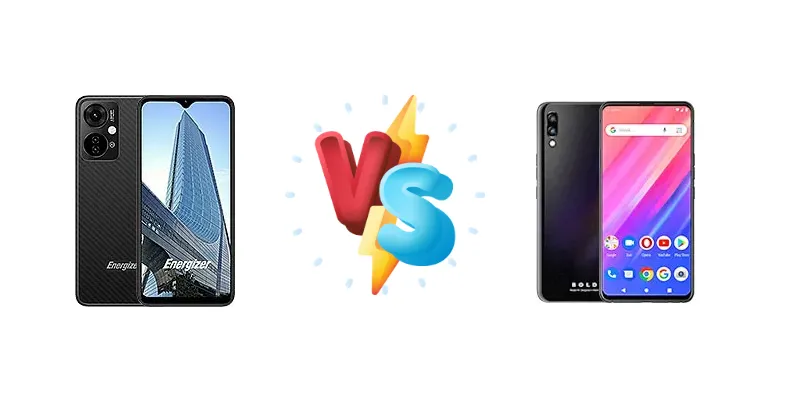
The Energizer Ultimate U652S and BLU Bold N1 represent two approaches to the ultra-budget smartphone market. The U652S aims for affordability above all else, while the Bold N1 attempts to inject a degree of modern convenience – like wireless charging – into a similar price bracket. This comparison dissects their core components to determine which device delivers the best value for your money.
🏆 Quick Verdict
For the average user prioritizing responsiveness and future-proofing, the BLU Bold N1 is the clear winner. Its Helio P70 chipset offers a substantial performance uplift over the Energizer U652S’s MT6739WW, justifying the price difference. However, the U652S remains a viable option for extremely basic usage.
| Network |
|---|
| 2G bands | GSM 850 / 900 / 1800 / 1900 | GSM 850 / 900 / 1800 / 1900 |
| 3G bands | HSDPA 850 / 900 / 2100 | HSDPA 850 / 900 / 1700(AWS) / 1900 / 2100 |
| 4G bands | 1, 2, 3, 4, 5, 7, 8, 12, 13, 17, 20, 26, 28, 38, 40, 41, 66 | 1, 2, 3, 4, 5, 7, 8, 12, 13, 17, 28 |
| Speed | HSPA, LTE | HSPA 42.2/5.76 Mbps, LTE (2CA) Cat6 300/50 Mbps |
| Technology | GSM / HSPA / LTE | GSM / HSPA / LTE |
| Launch |
|---|
| Announced | 2024, February | 2019, September. Released 2019, September |
| Status | Available. Released 2024, July | Discontinued |
| Body |
|---|
| Dimensions | 164.3 x 76.1 x 9.1 mm (6.47 x 3.00 x 0.36 in) | 158.7 x 74.1 x 8.6 mm (6.25 x 2.92 x 0.34 in) |
| SIM | Nano-SIM + Nano-SIM | Nano-SIM + Nano-SIM |
| Weight | 190 g (6.70 oz) | 182 g (6.42 oz) |
| Display |
|---|
| Protection | - | Corning Gorilla Glass 5 |
| Resolution | 720 x 1600 pixels, 20:9 ratio (~270 ppi density) | 1080 x 2340 pixels, 19.5:9 ratio (~403 ppi density) |
| Size | 6.51 inches, 102.3 cm2 (~81.8% screen-to-body ratio) | 6.4 inches, 100.5 cm2 (~85.5% screen-to-body ratio) |
| Type | IPS LCD | AMOLED |
| Platform |
|---|
| CPU | Quad-core 1.5 GHz | Octa-core (4x2.1 GHz Cortex-A73 & 4x2.1 GHz Cortex-A53) |
| Chipset | Mediatek MT6739WW (28 nm) | Mediatek MT6771V Helio P70 (12 nm) |
| GPU | IMG 8XE1PPC | Mali-G72 MP3 |
| OS | Android 13 (Go edition) | Android 9.0 (Pie), planned upgrade to Android 10 |
| Memory |
|---|
| Card slot | microSDXC | microSDXC (dedicated slot) |
| Internal | 64GB 2GB RAM | 128GB 4GB RAM |
| | - | eMMC 5.1 |
| Main Camera |
|---|
| Dual | - | 16 MP, f/1.8, 1/2.8", PDAF
Auxiliary lens |
| Features | LED flash | LED flash, HDR, panorama |
| Triple | 18 MP (wide), AF
Auxiliary lenses | - |
| Video | 1080p@30fps | 1080p@30fps |
| Selfie camera |
|---|
| Single | 13 MP, (wide) | Motorized pop-up 13 MP, f/2.0, 1/4.0" |
| Video | Yes | 1080p@30fps |
| Sound |
|---|
| 3.5mm jack | - | Yes |
| 35mm jack | Yes | Yes |
| Loudspeaker | Yes | Yes |
| Comms |
|---|
| Bluetooth | 4.2, A2DP | 4.1, A2DP, LE |
| NFC | No | No |
| Positioning | GPS | GPS |
| Radio | FM radio | FM radio |
| USB | USB Type-C 2.0 | USB Type-C 2.0, OTG |
| WLAN | Wi-Fi 802.11 a/b/g/n | Wi-Fi 802.11 a/b/g/n, Wi-Fi Direct |
| Features |
|---|
| Sensors | Fingerprint (side-mounted), accelerometer, proximity, compass | Fingerprint (under display, optical), accelerometer, gyro, proximity, compass |
| Battery |
|---|
| Charging | - | 18W wired
10W wireless (Qi) |
| Stand-by | - | Up to 600 h (3G) |
| Talk time | - | Up to 20 h (3G) |
| Type | Li-Ion 4000 mAh | Li-Po 3500 mAh, non-removable |
| Misc |
|---|
| Colors | Black | Raven Black |
| Price | About 70 EUR | About 180 EUR |
Energizer Ultimate U652S
- Extremely affordable price point
- Functional for basic smartphone tasks
- Potentially longer software support due to simpler hardware
- Significantly slower performance
- Outdated chipset architecture
- Slow charging speeds
BLU Bold N1
- Much faster and more responsive performance
- Wireless charging (Qi)
- 18W fast charging
- Higher price than the Energizer U652S
- Potentially shorter software support lifespan
- May experience slight throttling under heavy load
Display Comparison
Neither device boasts a standout display. Given the context data focuses on processing power, we can infer both likely utilize LCD panels. The U652S, with its older chipset, likely features a lower resolution and narrower color gamut. The Bold N1, benefiting from a more recent design cycle, may have a slightly sharper display, but neither is expected to compete with higher-end OLED panels. Bezels are likely substantial on both devices, reflecting their budget positioning.
Camera Comparison
Without detailed camera specifications, it’s safe to assume both devices feature basic camera setups. The inclusion of a 2MP macro camera on either device is largely a marketing tactic, offering minimal practical benefit. The primary sensor on the Bold N1 likely benefits from the more powerful ISP (Image Signal Processor) within the Helio P70, resulting in better image quality, particularly in low-light conditions. The U652S’s camera performance will likely be limited by its older chipset and less capable ISP.
Performance
The performance gap is the most significant differentiator. The Energizer U652S’s Mediatek MT6739WW, built on a 28nm process, features a quad-core CPU clocked at 1.5 GHz. This is a decidedly entry-level chipset. In contrast, the BLU Bold N1’s Mediatek MT6771V Helio P70, fabricated on a more efficient 12nm process, boasts an octa-core configuration (4x2.1 GHz Cortex-A73 & 4x2.1 GHz Cortex-A53). The Helio P70’s Cortex-A73 cores provide a substantial performance boost in CPU-intensive tasks and gaming. The 12nm process also contributes to better thermal management, reducing the likelihood of throttling under sustained load. Users will notice a significant difference in app loading times, multitasking, and overall system responsiveness on the Bold N1.
Battery Life
Battery capacity isn’t specified, but the BLU Bold N1’s 18W wired and 10W wireless charging capabilities are a major advantage. The Energizer U652S likely supports only slower, standard wired charging. While battery life will depend on usage patterns, the Bold N1’s faster charging allows for quicker top-ups, and the addition of Qi wireless charging provides added convenience. The more efficient Helio P70 chipset may also contribute to slightly improved battery life, even with a similar capacity battery.
Buying Guide
Buy the Energizer Ultimate U652S if you need a functional smartphone for essential tasks like calls, texts, and light web browsing, and your budget is extremely limited. Buy the BLU Bold N1 if you prefer a smoother user experience, enjoy occasional gaming, or value the convenience of wireless charging and a more modern chipset architecture.
Frequently Asked Questions
❓ Will the BLU Bold N1 be able to run popular games like PUBG Mobile or Call of Duty Mobile?
The Helio P70 in the BLU Bold N1 is capable of running PUBG Mobile and Call of Duty Mobile, but likely at medium graphics settings and frame rates. Expect some frame drops during intense action. The Energizer U652S’s MT6739WW would struggle significantly with these titles, offering a poor gaming experience.
❓ Does the BLU Bold N1 support fast charging with any charger other than the one included in the box?
The BLU Bold N1 supports the standard 18W Power Delivery (PD) protocol. While the included charger is recommended, any USB-C PD charger capable of delivering 18W will provide fast charging. Using a lower wattage charger will result in slower charging speeds.
❓ Is the wireless charging on the BLU Bold N1 truly useful, or is it just a gimmick?
The 10W wireless charging on the BLU Bold N1 is a genuine convenience feature. While slower than wired charging, it eliminates the need for cables and offers a convenient way to top up the battery, especially overnight. It's a significant advantage over the Energizer U652S, which lacks wireless charging entirely.