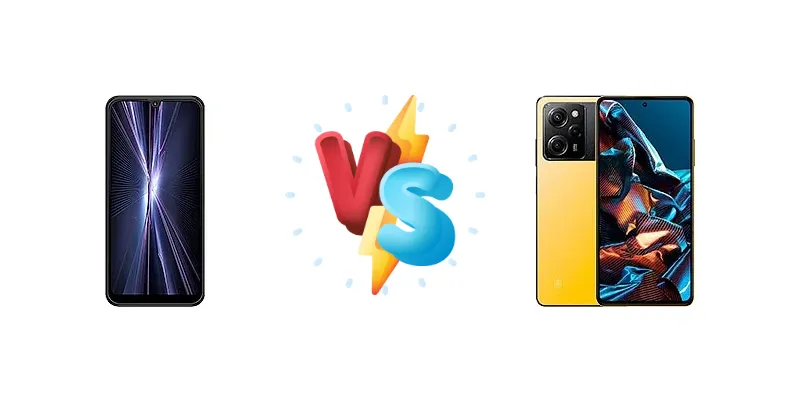
The budget smartphone market is fiercely competitive, offering incredible value for your money. Today, we're pitting two contenders against each other: the rugged Energizer Ultimate U608s and the feature-packed Xiaomi Poco X5 Pro. Which phone offers the best overall experience?
🏆 Quick Verdict
The Xiaomi Poco X5 Pro is the clear winner. While the Energizer U608s boasts impressive battery life and ruggedness, the Poco X5 Pro's superior chipset, display, camera, and charging speed make it a more compelling choice for most users.
| Network |
|---|
| 2G bands | GSM 850 / 900 / 1800 / 1900 | GSM 850 / 900 / 1800 / 1900 |
| 3G bands | HSDPA 850 / 900 / 2100 | HSDPA 800 / 850 / 900 / 1700(AWS) / 1900 / 2100 - International |
| 4G bands | LTE | 1, 2, 3, 4, 5, 7, 8, 20, 28, 38, 40, 41, 66 - International |
| 5G bands | - | 1, 3, 5, 7, 8, 20, 28, 38, 40, 41, 77, 78 SA/NSA/Sub6 - International |
| Speed | HSPA, LTE | HSPA, LTE, 5G |
| Technology | GSM / HSPA / LTE | GSM / HSPA / LTE / 5G |
| | - | 1, 3, 5, 8, 28, 40, 78 SA/NSA - India |
| Launch |
|---|
| Announced | 2022, June | 2023, February 06 |
| Status | Available. Released 2022, July | Available. Released 2023, February 07 |
| Body |
|---|
| Build | - | Glass front (Gorilla Glass 5), plastic back, plastic frame |
| Dimensions | 155.4 x 73.3 x 9.8 mm (6.12 x 2.89 x 0.39 in) | 162.9 x 76 x 7.9 mm (6.41 x 2.99 x 0.31 in) |
| SIM | Nano-SIM + Nano-SIM | Nano-SIM + Nano-SIM |
| Weight | 156.8 g (5.54 oz) | 181 g (6.38 oz) |
| | - | IP53, dust and splash resistant |
| Display |
|---|
| Protection | - | Corning Gorilla Glass 5 |
| Resolution | 720 x 1520 pixels, 19:9 ratio (~277 ppi density) | 1080 x 2400 pixels, 20:9 ratio (~395 ppi density) |
| Size | 6.08 inches, 92.3 cm2 (~81.0% screen-to-body ratio) | 6.67 inches, 107.4 cm2 (~86.8% screen-to-body ratio) |
| Type | LCD | AMOLED, 1B colors, 120Hz, Dolby Vision, HDR10+, 500 nits (typ), 900 nits (HBM) |
| Platform |
|---|
| CPU | Quad-core 2.0 GHz Cortex-A53 | Octa-core (1x2.4 GHz Cortex-A78 & 3x2.2 GHz Cortex-A78 & 4x1.9 GHz Cortex-A55) |
| Chipset | Mediatek MT6761 Helio A22 (12 nm) | Qualcomm SM7325 Snapdragon 778G 5G (6 nm) |
| GPU | PowerVR GE8320 | Adreno 642L |
| OS | Android 12 (Go edition) | Android 12, upgradable to Android 13, MIUI 14 for POCO |
| Memory |
|---|
| Card slot | microSDXC | No |
| Internal | 32GB 2GB RAM | 128GB 6GB RAM, 256GB 8GB RAM |
| | eMMC 5.1 | UFS 2.2 |
| Main Camera |
|---|
| Features | LED flash | LED flash, HDR, panorama |
| Single | 5 MP | - |
| Triple | - | 108 MP, f/1.9, (wide), 1/1.52", 0.7µm, PDAF
8 MP, f/2.2, 120˚ (ultrawide), 1/4.0", 1.12µm
2 MP (macro) |
| Video | 1080p@30/60fps | 4K@30fps, 1080p@30/60/120fps, gyro-EIS |
| Selfie camera |
|---|
| Features | - | HDR, panorama |
| Single | 5 MP | 16 MP, f/2.4, (wide), 1/3.06" 1.0µm |
| Video | 720p | 1080p@30/60fps |
| Sound |
|---|
| 3.5mm jack | Yes | Yes |
| 35mm jack | Yes | Yes |
| Loudspeaker | Yes | Yes, with stereo speakers |
| | - | 24-bit/192kHz audio |
| Comms |
|---|
| Bluetooth | 4.2, A2DP | 5.2 (Intl), 5.1 (India), A2DP, LE |
| Infrared port | - | Yes |
| NFC | No | Yes (market/region dependent) |
| Positioning | GPS | GPS, GLONASS, BDS, GALILEO |
| Radio | FM radio | No |
| USB | microUSB | USB Type-C 2.0, OTG |
| WLAN | Wi-Fi 802.11 b/g/n | Wi-Fi 802.11 a/b/g/n/ac/6, dual-band, Wi-Fi DirectWi-Fi 802.11 a/b/g/n/ac, dual-band - India |
| Features |
|---|
| Sensors | - | Fingerprint (side-mounted), accelerometer, gyro, proximity, compass |
| Battery |
|---|
| Charging | - | 67W wired, PD3.0, QC4, 100% in 45 min
5W reverse wired |
| Type | Li-Ion 3000 mAh | Li-Po 5000 mAh |
| Misc |
|---|
| Colors | Black | Astral Black, Horizon Blue, Poco Yellow |
| Models | - | 22101320G, 22101320I |
| Price | About 90 EUR | € 156.00 / $ 221.33 / ₹ 22,490 |
| Tests |
|---|
| Battery life | - |
Endurance rating 113h
|
| Camera | - |
Photo / Video |
| Display | - |
Contrast ratio: Infinite (nominal) |
| Loudspeaker | - |
-24.9 LUFS (Very good)
|
| Performance | - |
AnTuTu: 531398 (v9)
GeekBench: 2930 (v5.1)
GFXBench: 28fps (ES 3.1 onscreen) |
Energizer Ultimate U608s
- Exceptional battery life
- Rugged and durable design
- Affordable price
- Weak performance
- Basic display
- Limited camera capabilities
Xiaomi Poco X5 Pro
- Powerful Snapdragon 778G 5G chipset
- Excellent display with high brightness
- Fast 67W charging
- Capable camera system
- Less rugged than the U608s
- May lack some of the U608s' durability features
Display Comparison
The Poco X5 Pro's 912 nits peak brightness and infinite contrast ratio provide a significantly better viewing experience than the U608s. Colors are more vibrant, and visibility in sunlight is excellent. The U608s likely has a more basic LCD panel.
Camera Comparison
While both phones offer photo and video capabilities, the Poco X5 Pro is expected to deliver superior image quality thanks to its more advanced hardware and image processing. Expect better low-light performance and more detail in photos from the Poco X5 Pro.
Performance
The Poco X5 Pro's Snapdragon 778G 5G chipset blows the U608s' Helio A22 out of the water. Expect smoother multitasking, faster app loading times, and better gaming performance on the Poco X5 Pro. The Poco X5 Pro's octa-core CPU is significantly more powerful than the U608s' quad-core.
Battery Life
Both phones boast an endurance rating of 113h, suggesting excellent battery life. However, the Poco X5 Pro's 67W charging allows for significantly faster top-ups, a major advantage.
Buying Guide
The Energizer Ultimate U608s is ideal for users prioritizing extreme battery life and durability in a rugged design. The Xiaomi Poco X5 Pro is perfect for those seeking a well-rounded smartphone with a great display, fast performance, and a capable camera, all at an affordable price.
Frequently Asked Questions
❓ Is the Energizer U608s waterproof?
The Energizer U608s is advertised as rugged, but specific waterproofing ratings (like IP68) are often not provided. It likely offers some splash resistance but shouldn't be submerged.
❓ Can the Poco X5 Pro handle demanding games?
Yes, the Snapdragon 778G 5G is a capable chipset that can handle most mobile games at medium to high settings. However, very demanding titles might require some graphical adjustments.