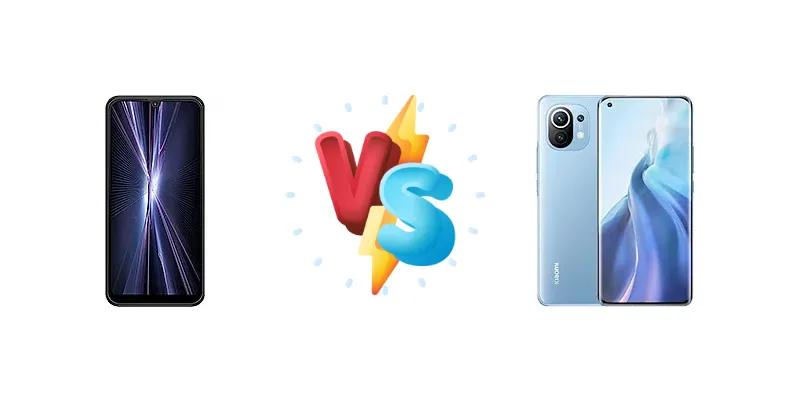
The smartphone market offers a dizzying array of choices, from ultra-budget options to premium flagships. Today, we're pitting two very different contenders against each other: the Energizer Ultimate U608s, known for its massive battery, and the Xiaomi Mi 11, a former flagship powerhouse. Let's see which one comes out on top.
🏆 Quick Verdict
The Xiaomi Mi 11 is the clear winner overall. Its Snapdragon 888 chipset, superior display, and faster charging capabilities far outweigh the Energizer U608s' impressive battery life. The U608s is a budget-friendly option for those prioritizing longevity above all else.
| Network |
|---|
| 2G bands | GSM 850 / 900 / 1800 / 1900 | GSM 850 / 900 / 1800 / 1900 |
| 3G bands | HSDPA 850 / 900 / 2100 | HSDPA 850 / 900 / 1700(AWS) / 1900 / 2100 |
| 4G bands | LTE | 1, 2, 3, 4, 5, 7, 8, 12, 17, 20, 28, 32, 38, 40, 41, 42, 66 - International |
| 5G bands | - | 1, 3, 5, 7, 8, 20, 28, 38, 41, 77, 78, 79 SA/NSA - International |
| Speed | HSPA, LTE | HSPA, LTE, 5G |
| Technology | GSM / HSPA / LTE | GSM / CDMA / HSPA / EVDO / LTE / 5G |
| | - | 1, 3, 28, 41, 77, 78, 79 SA/NSA - China |
| Launch |
|---|
| Announced | 2022, June | 2020, December 28. Released 2021, January 01 |
| Status | Available. Released 2022, July | Discontinued |
| Body |
|---|
| Build | - | Glass front (Gorilla Glass Victus), glass back (Gorilla Glass 5) or eco leather back, aluminum frame |
| Dimensions | 155.4 x 73.3 x 9.8 mm (6.12 x 2.89 x 0.39 in) | 164.3 x 74.6 x 8.1 mm (Glass) / 8.6 mm (Leather) |
| SIM | Nano-SIM + Nano-SIM | Nano-SIM + Nano-SIM |
| Weight | 156.8 g (5.54 oz) | 196 g (Glass) / 194 g (Leather) (6.84 oz) |
| Display |
|---|
| Protection | - | Corning Gorilla Glass Victus |
| Resolution | 720 x 1520 pixels, 19:9 ratio (~277 ppi density) | 1440 x 3200 pixels, 20:9 ratio (~515 ppi density) |
| Size | 6.08 inches, 92.3 cm2 (~81.0% screen-to-body ratio) | 6.81 inches, 112.0 cm2 (~91.4% screen-to-body ratio) |
| Type | LCD | AMOLED, 1B colors, 120Hz, HDR10+, 1500 nits (peak) |
| Platform |
|---|
| CPU | Quad-core 2.0 GHz Cortex-A53 | Octa-core (1x2.84 GHz Cortex-X1 & 3x2.42 GHz Cortex-A78 & 4x1.80 GHz Cortex-A55 |
| Chipset | Mediatek MT6761 Helio A22 (12 nm) | Qualcomm SM8350 Snapdragon 888 5G (5 nm) |
| GPU | PowerVR GE8320 | Adreno 660 |
| OS | Android 12 (Go edition) | Android 11, upgradable to Android 14, HyperOS |
| Memory |
|---|
| Card slot | microSDXC | No |
| Internal | 32GB 2GB RAM | 128GB 6GB RAM, 128GB 8GB RAM, 256GB 8GB RAM, 256GB 12GB RAM |
| | eMMC 5.1 | UFS 3.1 |
| Main Camera |
|---|
| Features | LED flash | Dual-LED dual-tone flash, HDR, panorama |
| Single | 5 MP | - |
| Triple | - | 108 MP, f/1.9, 26mm (wide), 1/1.33", 0.8µm, PDAF, OIS
13 MP, f/2.4, 123˚ (ultrawide), 1/3.06", 1.12µm
5 MP (macro) |
| Video | 1080p@30/60fps | 8K@24/30fps, 4K@30/60fps, 1080p@30/60/120/240fps; gyro-EIS, HDR10+ |
| Selfie camera |
|---|
| Features | - | HDR |
| Single | 5 MP | 20 MP, f/2.2, 27mm (wide), 1/3.4", 0.8µm |
| Video | 720p | 1080p@30/60fps, 720p@120fps |
| Sound |
|---|
| 3.5mm jack | Yes | No |
| 35mm jack | Yes | No |
| Loudspeaker | Yes | Yes, with stereo speakers |
| | - | 24-bit/192kHz audio |
| Comms |
|---|
| Bluetooth | 4.2, A2DP | 5.2, A2DP, LE, aptX HD, aptX Adaptive |
| Infrared port | - | Yes |
| NFC | No | Yes |
| Positioning | GPS | GPS (L1+L5), GLONASS (G1), BDS (B1I+B1c+B2a), GALILEO (E1+E5a), QZSS (L1+L5), NavIC (L5) |
| Radio | FM radio | No |
| USB | microUSB | USB Type-C 2.0, OTG |
| WLAN | Wi-Fi 802.11 b/g/n | Wi-Fi 802.11 a/b/g/n/ac/6, dual-band, Wi-Fi Direct |
| Features |
|---|
| Sensors | - | Fingerprint (under display, optical), accelerometer, gyro, compass |
| | - | Virtual proximity sensing |
| Battery |
|---|
| Charging | - | 55W wired, PD3.0, QC4, 100% in 45 min
50W wireless, 100% in 53 min
10W reverse wireless |
| Type | Li-Ion 3000 mAh | Li-Po 4600 mAh |
| Misc |
|---|
| Colors | Black | Horizon Blue, Cloud White, Midnight Gray, Special Edition Blue, Gold, Violet |
| Models | - | M2011K2C, M2011K2G |
| Price | About 90 EUR | About 330 EUR |
| SAR | - | 0.95 W/kg (head) 0.65 W/kg (body) |
| SAR EU | - | 0.56 W/kg (head) 0.98 W/kg (body) |
| Tests |
|---|
| Battery life | - |
Endurance rating 89h
|
| Camera | - |
Photo / Video |
| Display | - |
Contrast ratio: Infinite (nominal) |
| Loudspeaker | - |
-24.2 LUFS (Very good)
|
| Performance | - |
AnTuTu: 668722 (v8)
GeekBench: 3489 (v5.1)
GFXBench: 33fps (ES 3.1 onscreen) |
Energizer Ultimate U608s
- Exceptional battery life
- Affordable price
- Durable build (likely)
- Large display
- Weak performance
- Basic camera
- Outdated chipset
- Lower screen quality
Xiaomi Mi 11
- Flagship performance
- Stunning display
- Excellent camera
- Fast charging
- Premium design
- Higher price
- Battery life not as exceptional as U608s
- Older model (may lack latest software updates)
Display Comparison
The Xiaomi Mi 11 boasts a significantly superior display. While both are reported to have an 'infinite' contrast ratio (likely a marketing term), the Mi 11's AMOLED panel offers vibrant colors, deep blacks, and a higher resolution, resulting in a much more immersive viewing experience. The U608s likely uses a standard LCD panel, which will be noticeably less impressive.
Camera Comparison
The Xiaomi Mi 11's camera system is considerably more advanced. It features a high-resolution main sensor, offering excellent image quality, dynamic range, and low-light performance. The U608s' camera is likely a more basic setup, suitable for casual snapshots but lacking the detail and features of the Mi 11.
Performance
Performance is where the Mi 11 truly shines. The Snapdragon 888 is a flagship-level chipset, providing blazing-fast speeds for gaming, multitasking, and demanding applications. The U608s' Helio A22 is a budget chipset, adequate for basic tasks but struggling with more intensive workloads. Expect noticeable lag and slower app loading times on the U608s.
Battery Life
The Energizer U608s' standout feature is its massive battery, promising exceptional endurance. While the Mi 11 also has good battery life (89h endurance rating), the U608s is likely to last significantly longer on a single charge, especially with moderate usage. However, the Mi 11's incredibly fast charging (55W wired, 50W wireless) makes up for any battery life deficit.
Buying Guide
The Energizer Ultimate U608s is ideal for users who prioritize extreme battery life and affordability. It's a great choice for those who travel frequently or spend extended periods away from power outlets. The Xiaomi Mi 11 is perfect for users who demand top-tier performance, a stunning display, and a versatile camera system, and are willing to pay a premium.
Frequently Asked Questions
❓ Is the Energizer U608s good for gaming?
No, the U608s' chipset is not powerful enough for demanding games. It can handle basic games, but expect low frame rates and lag.
❓ How does the Xiaomi Mi 11's camera compare to newer phones?
While the Mi 11's camera was excellent for its time, newer phones have surpassed it in terms of features and image processing. However, it still delivers very good image quality.