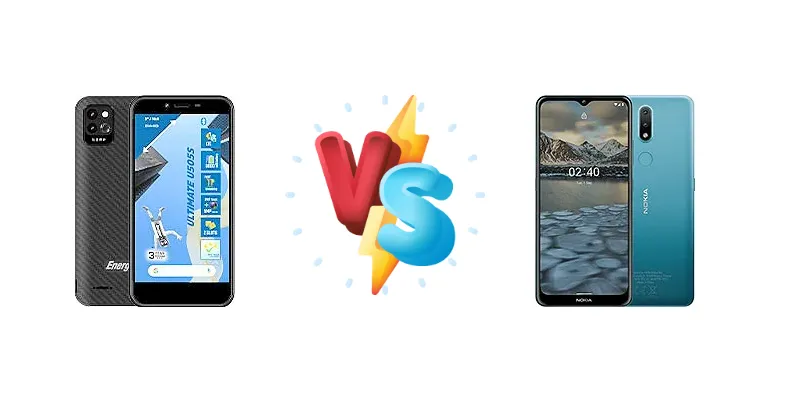
The Energizer Ultimate U505s and Nokia 2.4 represent the lower end of the smartphone market, targeting users prioritizing affordability. However, despite similar price points, significant differences in chipset architecture and processing power exist, impacting everyday usability and long-term performance. This comparison dissects these differences to determine which device offers the best value.
🏆 Quick Verdict
For the average user, the Nokia 2.4 is the superior choice. Its Mediatek Helio P22 chipset, built on a more efficient 12nm process and featuring an octa-core CPU, delivers noticeably smoother performance than the Energizer U505s’ older, quad-core MT6739. While both phones are budget-focused, the Nokia 2.4 provides a more future-proof experience.
| Network |
|---|
| 2G bands | GSM 850 / 900 / 1800 / 1900 | GSM 850 / 900 / 1800 / 1900 |
| 3G bands | HSDPA 850 / 900 / 2100 | HSDPA 850 / 900 / 1900 / 2100 |
| 4G bands | 1, 3, 7, 8, 20, 28, 38, 40, 41 | LTE |
| Speed | HSPA, LTE | HSPA 42.2/5.76 Mbps, LTE Cat4 150/50 Mbps |
| Technology | GSM / HSPA / LTE | GSM / HSPA / LTE |
| Launch |
|---|
| Announced | 2022, March | 2020, September 22. Released 2020, September 30 |
| Status | Available. Released 2022, March | Discontinued |
| Body |
|---|
| Dimensions | 138.5 x 73.5 x 10.6 mm (5.45 x 2.89 x 0.42 in) | 165.9 x 76.3 x 8.7 mm (6.53 x 3.00 x 0.34 in) |
| SIM | Nano-SIM + Nano-SIM | Nano-SIM + Nano-SIM |
| Weight | - | 195 g (6.88 oz) |
| Display |
|---|
| Resolution | 480 x 854 pixels, 16:9 ratio (~196 ppi density) | 720 x 1600 pixels, 20:9 ratio (~270 ppi density) |
| Size | 5.0 inches, 68.9 cm2 (~67.7% screen-to-body ratio) | 6.5 inches, 102.0 cm2 (~80.6% screen-to-body ratio) |
| Type | TFT LCD | IPS LCD |
| Platform |
|---|
| CPU | Quad-core 1.5 GHz | Octa-core 2.0 GHz Cortex-A53 |
| Chipset | Mediatek MT6739 | Mediatek MT6762 Helio P22 (12 nm) |
| GPU | - | PowerVR GE8320 |
| OS | Android 11 (Go edition) | Android 10, upgradable to Android 11 |
| Memory |
|---|
| Card slot | microSDHC | microSDXC (dedicated slot) |
| Internal | 16GB 1GB RAM | 32GB 2GB RAM, 64GB 3GB RAM |
| | eMMC 5.1 | eMMC 5.1 |
| Main Camera |
|---|
| Dual | 5 MP
VGA | 13 MP, AF
Auxiliary lens |
| Features | LED flash | LED flash, HDR, panorama |
| Video | 1080p@30fps | 1080p@30fps |
| Selfie camera |
|---|
| Single | 2 MP | 5 MP, f/2.4 |
| Video | 720p | - |
| Sound |
|---|
| 3.5mm jack | Yes | Yes |
| 35mm jack | Yes | Yes |
| Loudspeaker | Yes | Yes |
| Comms |
|---|
| Bluetooth | 4.0, A2DP | 5.0, A2DP, LE |
| NFC | No | No |
| Positioning | GPS | GPS, GLONASS, BDS |
| Radio | FM radio | FM radio |
| USB | microUSB 2.0 | microUSB 2.0, OTG |
| WLAN | Yes | Wi-Fi 802.11 b/g/n |
| Features |
|---|
| Sensors | Accelerometer, proximity | Fingerprint (rear-mounted), accelerometer, proximity |
| Battery |
|---|
| Charging | - | 10W wired |
| Type | Li-Po 3000 mAh, removable | Li-Po 4500 mAh |
| Misc |
|---|
| Colors | Black | Fjord, Dusk, Charcoal |
| Models | - | TA-1277, TA-1275, TA-1274, TA-1270 |
| Price | About 80 EUR | About 240 EUR |
| SAR | - | 0.77 W/kg (head) 1.32 W/kg (body) |
| SAR EU | - | 0.27 W/kg (head) 1.54 W/kg (body) |
Energizer Ultimate U505s
- Potentially lower price point
- Simple, straightforward user experience
- Unique Energizer licensing model for software updates
- Significantly weaker processor
- Less efficient chipset
- Likely slower app loading times
Nokia 2.4
- Faster and more efficient processor
- Octa-core CPU for better multitasking
- 12nm manufacturing process for improved battery life
- Slow 10W charging
- Basic camera performance
- Limited RAM (likely 2GB or 3GB)
Display Comparison
Neither device boasts a standout display. Specifications are unavailable for the U505s, but given its market segment, it likely features a 720p LCD panel. The Nokia 2.4 also utilizes a 720p LCD, but its focus is on efficiency. Neither phone is expected to deliver vibrant colors or high brightness levels, making them best suited for indoor use. Bezels are likely substantial on both, reflecting their budget nature.
Camera Comparison
Camera performance on both devices will be limited. Details are scarce for the U505s, but budget phones often prioritize megapixel count over sensor quality. The Nokia 2.4’s camera setup is similarly modest. While it may include a higher megapixel main sensor, image processing will be basic. Expect acceptable results in good lighting conditions, but struggles in low light. The presence of a 2MP macro camera on the Nokia 2.4 is largely a marketing gimmick, offering minimal practical benefit due to its low resolution and lack of autofocus.
Performance
The core difference lies in the chipsets. The Energizer U505s’ Mediatek MT6739 is a quad-core processor, while the Nokia 2.4’s Mediatek Helio P22 (MT6762) is an octa-core unit. This difference is compounded by the manufacturing process: 12nm on the P22 versus an older, less efficient process for the MT6739. The P22’s Cortex-A53 cores, while not high-end, offer significantly better multi-tasking and app loading speeds. The Nokia 2.4’s 2.0 GHz clock speed further enhances its performance advantage. This translates to a smoother experience when switching between apps and a more responsive UI.
Battery Life
Battery capacity is not specified for the U505s, but it's likely around 4000-5000mAh, typical for this segment. The Nokia 2.4 features a 4000mAh battery and supports 10W wired charging. While 10W is slow by modern standards, the Helio P22’s improved efficiency should result in comparable or slightly better battery life on the Nokia 2.4 despite the similar capacity. The U505s may have a slightly larger battery, but the less efficient chipset will likely negate any advantage.
Buying Guide
Buy the Energizer Ultimate U505s if you absolutely need the lowest possible upfront cost and primarily use your phone for basic tasks like calls and messaging. Its simplicity and potentially longer software support (Energizer's licensing model is unique) might appeal to minimalists. Buy the Nokia 2.4 if you value a more responsive user experience, occasional multitasking, and a slightly more modern chipset that will handle app updates and Android version upgrades with greater ease.
Frequently Asked Questions
❓ Will the Nokia 2.4 struggle with popular apps like Facebook or WhatsApp?
While the Nokia 2.4 won't deliver a flagship-level experience, its Helio P22 chipset is capable of running apps like Facebook and WhatsApp smoothly. However, running multiple apps simultaneously or using more demanding applications may result in some slowdown. The Energizer U505s will likely struggle more with these tasks.
❓ Is the 10W charging on the Nokia 2.4 painfully slow?
Yes, 10W charging is relatively slow compared to modern standards. Expect a full charge to take several hours. However, the Nokia 2.4’s efficient chipset and battery management can help mitigate this by extending battery life, reducing the frequency of charging.
❓ Can the Energizer U505s handle basic mobile gaming?
The Energizer U505s can handle very basic 2D games, but it will struggle with more demanding 3D titles. Frame rates will likely be low and inconsistent. The Nokia 2.4 offers a slightly better gaming experience, but it's still not ideal for serious mobile gamers.
❓ What Android version do these phones ship with, and will they receive updates?
The Nokia 2.4 launched with Android 10 (Go Edition) and is guaranteed at least two years of security updates. The Energizer U505s likely ships with Android Go Edition as well, but Energizer's update policy is less clear, relying on a unique licensing model that may prioritize stability over frequent version upgrades.