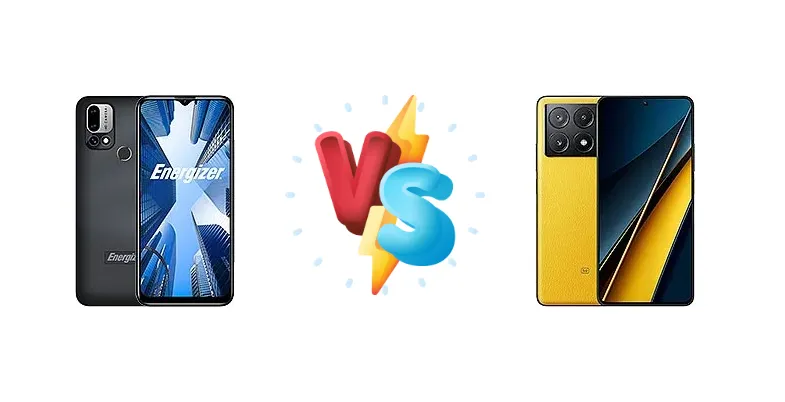
The smartphone landscape is crowded with options, but the Poco X6 Pro and Energizer Ultimate 65G represent distinct approaches to the mid-range market. The Poco X6 Pro aims for near-flagship performance with its Dimensity 8300 Ultra, while the Energizer Ultimate 65G focuses on providing a functional experience at a more accessible price point. This comparison dissects their key differences to determine which device delivers the best value.
🏆 Quick Verdict
For most users, the Xiaomi Poco X6 Pro is the clear winner. Its significantly more powerful Dimensity 8300 Ultra chipset, coupled with 67W fast charging and a brighter display, justifies the price premium. The Energizer Ultimate 65G remains a viable option for those on a very tight budget prioritizing basic functionality.
| Network |
|---|
| 2G bands | GSM 850 / 900 / 1800 / 1900 | GSM 850 / 900 / 1800 / 1900 |
| 3G bands | HSDPA 850 / 900 / 1900 / 2100 | HSDPA 850 / 900 / 1700(AWS) / 1900 / 2100 |
| 4G bands | 1, 3, 5, 7, 8, 28, 34, 38, 39, 40, 41 | 1, 2, 3, 4, 5, 7, 8, 18, 19, 20, 28, 38, 40, 41, 48, 66 |
| 5G bands | 1, 3, 5, 8, 28, 41, 77, 78 SA/NSA | 1, 2, 3, 5, 7, 8, 20, 28, 38, 40, 41, 48, 77, 78 SA/NSA/Sub6 |
| Speed | HSPA, LTE, 5G | HSPA, LTE, 5G |
| Technology | GSM / HSPA / LTE / 5G | GSM / HSPA / LTE / 5G |
| Launch |
|---|
| Announced | 2024, February | 2024, January 11 |
| Status | Available. Released 2024, Q3 | Available. Released 2024, January 12 |
| Body |
|---|
| Build | - | Glass front (Gorilla Glass 5), plastic frame, plastic back or silicone polymer back (eco leather) |
| Dimensions | 164.4 x 76.4 x 9.2 mm (6.47 x 3.01 x 0.36 in) | 160.5 x 74.3 x 8.3 mm (6.32 x 2.93 x 0.33 in) |
| SIM | Nano-SIM + Nano-SIM | Nano-SIM + Nano-SIM |
| Weight | 190 g (6.70 oz) | 186 g or 190 g (6.56 oz) |
| Display |
|---|
| Protection | - | Corning Gorilla Glass 5 |
| Resolution | 720 x 1600 pixels, 20:9 ratio (~270 ppi density) | 1220 x 2712 pixels, 20:9 ratio (~446 ppi density) |
| Size | 6.51 inches, 102.3 cm2 (~81.5% screen-to-body ratio) | 6.67 inches, 107.4 cm2 (~90.1% screen-to-body ratio) |
| Type | IPS LCD | AMOLED, 68B colors, 120Hz, 1920Hz PWM, HDR10+, Dolby Vision, 500 nits (typ), 1200 nits (HBM), 1800 nits (peak) |
| Platform |
|---|
| CPU | Octa-core (2x2.2 GHz Cortex-A76 & 6x2.0 GHz Cortex-A55) | Octa-core (1x3.35 GHz Cortex-A715 & 3x3.20 GHz Cortex-A715 & 4x2.20 GHz Cortex-A510) |
| Chipset | Mediatek Dimensity 700 (7 nm) | Mediatek Dimensity 8300 Ultra (4 nm) |
| GPU | Mali-G57 MC2 | Mali G615-MC6 |
| OS | Android 13 | Android 14, up to 3 major Android upgrades, HyperOS |
| Memory |
|---|
| Card slot | microSDXC | No |
| Internal | 64GB 4GB RAM | 256GB 8GB RAM, 256GB 12GB RAM, 512GB 12GB RAM |
| Main Camera |
|---|
| Features | LED flash | LED flash, HDR, panorama |
| Triple | 13 MP, f/1.8, (wide)
2 MP (macro)
Auxiliary lens | 64 MP, f/1.7, 25mm (wide), 1/2.0", 0.7µm, PDAF, OIS
8 MP, f/2.2, 120˚ (ultrawide), 1/4.0", 1.12µm
2 MP (macro) |
| Video | 1080p@30fps | 4K@24/30fps, 1080p@30/60fps, gyro-EIS |
| Selfie camera |
|---|
| Features | - | HDR, panorama |
| Single | 8 MP, (wide) | 16 MP, f/2.4, (wide), 1/3.06", 1.0µm |
| Video | 1080p@30fps | 1080p@30/60fps |
| Sound |
|---|
| 35mm jack | Yes | No |
| Loudspeaker | Yes | Yes, with dual speakers |
| Comms |
|---|
| Bluetooth | 5.1, A2DP, LE | 5.4, A2DP, LE, aptX HD |
| Infrared port | - | Yes |
| NFC | No | Yes (market/region dependent) |
| Positioning | GPS | GPS, GALILEO, GLONASS, QZSS, BDS (B1I+B1c) |
| Radio | FM radio | No |
| USB | USB Type-C 2.0 | USB Type-C 2.0, OTG |
| WLAN | Wi-Fi 802.11 a/b/g/n/ac, dual-band | Wi-Fi 802.11 a/b/g/n/ac/6, dual-band, Wi-Fi Direct |
| Features |
|---|
| Sensors | Fingerprint (rear-mounted), accelerometer, proximity | Fingerprint (under display, optical), accelerometer, gyro, compass |
| Battery |
|---|
| Charging | 20W wired | 67W wired, QC2.0, PD3.0, 100% in 45 min |
| Type | Li-Ion 4000 mAh | 5000 mAh |
| Misc |
|---|
| Colors | Black | Black, Yellow, Gray |
| Models | - | 2311DRK48G, 2311DRK48I |
| Price | About 140 EUR | € 195.30 / $ 209.79 / £ 274.99 / ₹ 21,999 |
| SAR EU | - | 0.99 W/kg (head) 1.00 W/kg (body) |
Energizer Ultimate 65G
- Very affordable price point
- Functional and reliable for basic tasks
- Decent battery life for light usage
- Outdated Dimensity 700 chipset
- Slow 20W charging
- Likely a lower-quality display
Xiaomi Poco X6 Pro
- Powerful Dimensity 8300 Ultra processor
- Fast 67W charging with QC/PD support
- Bright and vibrant display (1148 nits)
- Higher price compared to the Energizer
- May experience some thermal throttling under heavy load
- Camera details are limited
Display Comparison
The Poco X6 Pro boasts a significantly brighter display, reaching a measured 1148 nits, making it easily viewable outdoors. The Energizer Ultimate 65G’s display specifications are not provided, suggesting a lower peak brightness and potentially less vibrant colors. While the Energizer likely uses an IPS LCD panel to keep costs down, the Poco X6 Pro’s panel technology is not specified, but its brightness suggests AMOLED or a high-end IPS. This difference impacts usability in direct sunlight and overall visual fidelity.
Camera Comparison
The Poco X6 Pro’s camera system is described as offering both photo and video capabilities, but specific sensor details are missing. However, given the phone’s positioning, it’s reasonable to expect a more sophisticated camera setup than the Energizer Ultimate 65G. The Energizer’s camera specifications are not provided, suggesting a basic camera system focused on casual snapshots. Without detailed sensor information, it’s difficult to make a precise comparison, but the Poco X6 Pro is likely to offer better image quality, especially in low-light conditions, and more advanced features.
Performance
The core difference lies in the chipsets. The Poco X6 Pro’s Mediatek Dimensity 8300 Ultra (4nm) is a substantial upgrade over the Energizer Ultimate 65G’s Dimensity 700 (7nm). The 8300 Ultra features a more modern CPU architecture – a 1x3.35 GHz Cortex-A715 prime core alongside 3x3.20 GHz Cortex-A715 cores and 4x2.20 GHz Cortex-A510 cores – compared to the Energizer’s 2x2.2 GHz Cortex-A76 and 6x2.0 GHz Cortex-A55 configuration. The 4nm process node of the 8300 Ultra also translates to better power efficiency and reduced thermal throttling during sustained workloads like gaming. This means the Poco X6 Pro will deliver a smoother, faster experience, especially in demanding applications.
Battery Life
The Poco X6 Pro achieves a commendable 11:46h of active use, demonstrating good battery life despite its powerful processor. It also features 67W wired charging with support for QC2.0 and PD3.0, enabling a full charge in just 45 minutes. The Energizer Ultimate 65G, with its 20W wired charging, will take considerably longer to charge. While the Energizer’s battery capacity isn’t specified, the faster charging and longer active use time of the Poco X6 Pro provide a significant convenience advantage.
Buying Guide
Buy the Energizer Ultimate 65G if you need a reliable, basic smartphone for essential tasks like calls, texts, and light browsing, and your budget is extremely limited. Buy the Xiaomi Poco X6 Pro if you prioritize gaming, demanding apps, fast charging, and a vibrant display, and are willing to spend more for a significantly improved user experience.
Frequently Asked Questions
❓ Will the Poco X6 Pro’s Dimensity 8300 Ultra handle demanding games like Genshin Impact at high settings?
Yes, the Dimensity 8300 Ultra is a very capable chipset and should handle Genshin Impact and other graphically intensive games at high settings with smooth frame rates. However, prolonged gaming sessions may lead to some thermal throttling, potentially requiring slight graphics adjustments to maintain optimal performance.
❓ How does the 67W charging on the Poco X6 Pro compare to standard charging speeds?
67W charging is significantly faster than standard charging (typically 15-25W). The Poco X6 Pro can charge from 0 to 100% in approximately 45 minutes, whereas the Energizer Ultimate 65G’s 20W charging will take considerably longer, potentially exceeding two hours.
❓ Is the Energizer Ultimate 65G a good choice for seniors or those who primarily use their phone for calls and texts?
Yes, the Energizer Ultimate 65G is a suitable option for users with basic needs. Its affordability and functional design make it a practical choice for those who prioritize simplicity and reliability over advanced features.