
Xiaomi 13 Lite vs. Energizer Ultimate 65G: Which Mid-Range Phone Reigns Supreme?
| Phones Images | |||||
|---|---|---|---|---|---|
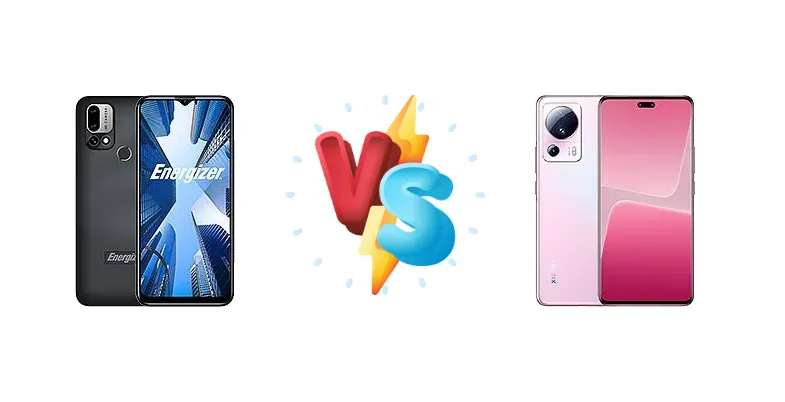
|
🏆 Quick Verdict
For most users, the Xiaomi 13 Lite is the superior choice. Its Snapdragon 7 Gen 1 chipset, coupled with 67W fast charging and a significantly brighter 938 nit display, offers a smoother and more enjoyable experience than the Energizer Ultimate 65G's Dimensity 700 and 20W charging.
| PHONES | ||
|---|---|---|
| Phone Names | Energizer Ultimate 65G | Xiaomi 13 Lite |
| Network | ||
|---|---|---|
| 2G bands | GSM 850 / 900 / 1800 / 1900 | GSM 850 / 900 / 1800 / 1900 |
| 3G bands | HSDPA 850 / 900 / 1900 / 2100 | HSDPA 800 / 850 / 900 / 1700(AWS) / 1900 / 2100 |
| 4G bands | 1, 3, 5, 7, 8, 28, 34, 38, 39, 40, 41 | 1, 2, 3, 4, 5, 7, 8, 12, 13, 17, 18, 19, 20, 26, 28, 32, 38, 40, 41, 42, 66 |
| 5G bands | 1, 3, 5, 8, 28, 41, 77, 78 SA/NSA | 1, 3, 5, 7, 8, 20, 28, 38, 40, 41, 66, 77, 78 SA/NSA |
| Speed | HSPA, LTE, 5G | HSPA, LTE, 5G |
| Technology | GSM / HSPA / LTE / 5G | GSM / HSPA / LTE / 5G |
| Launch | ||
|---|---|---|
| Announced | 2024, February | 2023, February 26 |
| Status | Available. Released 2024, Q3 | Available. Released 2023, March 08 |
| Body | ||
|---|---|---|
| Build | - | Glass front (Gorilla Glass 5), glass back, plastic frame |
| Dimensions | 164.4 x 76.4 x 9.2 mm (6.47 x 3.01 x 0.36 in) | 159.2 x 72.7 x 7.2 mm (6.27 x 2.86 x 0.28 in) |
| SIM | Nano-SIM + Nano-SIM | · Nano-SIM + eSIM· Nano-SIM + Nano-SIM |
| Weight | 190 g (6.70 oz) | 171 g (6.03 oz) |
| - | IP53, dust and splash resistant | |
| Display | ||
|---|---|---|
| Protection | - | Corning Gorilla Glass 5 |
| Resolution | 720 x 1600 pixels, 20:9 ratio (~270 ppi density) | 1080 x 2400 pixels, 20:9 ratio (~402 ppi density) |
| Size | 6.51 inches, 102.3 cm2 (~81.5% screen-to-body ratio) | 6.55 inches, 103.6 cm2 (~89.5% screen-to-body ratio) |
| Type | IPS LCD | AMOLED, 68B colors, Dolby Vision, HDR10+, 120Hz, 500 nits (typ), 1000 nits (peak) |
| Platform | ||
|---|---|---|
| CPU | Octa-core (2x2.2 GHz Cortex-A76 & 6x2.0 GHz Cortex-A55) | Octa-core (1x2.4 GHz Cortex-A710 & 3x2.36 GHz Cortex-A710 & 4x1.8 GHz Cortex-A510) |
| Chipset | Mediatek Dimensity 700 (7 nm) | Qualcomm SM7450-AB Snapdragon 7 Gen 1 (4 nm) |
| GPU | Mali-G57 MC2 | Adreno 644 |
| OS | Android 13 | Android 12, MIUI 14 |
| Memory | ||
|---|---|---|
| Card slot | microSDXC | No |
| Internal | 64GB 4GB RAM | 64GB 8GB RAM, 128GB 8GB RAM, 256GB 8GB RAM |
| - | UFS 2.2 | |
| Main Camera | ||
|---|---|---|
| Features | LED flash | Dual-LED dual-tone flash, HDR, panorama |
| Triple | 13 MP, f/1.8, (wide) 2 MP (macro) Auxiliary lens | 50 MP, f/1.8, 23mm (wide), 1/1.56", 1.0µm, PDAF 8 MP, f/2.2, 119˚ (ultrawide), 1/4.0", 1.12µm 2 MP (macro) |
| Video | 1080p@30fps | 4K@30fps, 1080p@30/60/120fps, 720p@960fps |
| Selfie camera | ||
|---|---|---|
| Dual | - | 32 MP, f/2.4, 100˚ (ultrawide), 1/2.74", 0.8µm 8 MP, f/2.3, (depth) |
| Features | - | Dual-LED flash, HDR |
| Single | 8 MP, (wide) | - |
| Video | 1080p@30fps | 1080p@30/60fps |
| Sound | ||
|---|---|---|
| 3.5mm jack | - | No |
| 35mm jack | Yes | No |
| Loudspeaker | Yes | Yes |
| - | 24-bit/192kHz audio | |
| Comms | ||
|---|---|---|
| Bluetooth | 5.1, A2DP, LE | 5.2, A2DP, LE |
| Infrared port | - | Yes |
| NFC | No | Yes (market/region dependent) |
| Positioning | GPS | GPS (L1), GLONASS (G1), BDS (B1I+B1c), GALILEO (E1), QZSS (L1) |
| Radio | FM radio | No |
| USB | USB Type-C 2.0 | USB Type-C 2.0, OTG |
| WLAN | Wi-Fi 802.11 a/b/g/n/ac, dual-band | Wi-Fi 802.11 a/b/g/n/ac/6, dual-band |
| Features | ||
|---|---|---|
| Sensors | Fingerprint (rear-mounted), accelerometer, proximity | Fingerprint (under display, optical), accelerometer, gyro, proximity, compass |
| Battery | ||
|---|---|---|
| Charging | 20W wired | 67W wired, 100% in 40 min |
| Type | Li-Ion 4000 mAh | Li-Po 4500 mAh |
| Misc | ||
|---|---|---|
| Colors | Black | Black, Lite Blue, Lite Pink |
| Price | About 140 EUR | About 180 EUR |
| Tests | ||
|---|---|---|
| Battery life | - | Endurance rating 93h |
| Camera | - | Photo / Video |
| Display | - | Contrast ratio: Infinite (nominal) |
| Loudspeaker | - | -28.5 LUFS (Average) |
| Performance | - | AnTuTu: 534143 (v9) GeekBench: 2936 (v5.1), 2434 (v6) GFXBench: 33fps (ES 3.1 onscreen) |
Energizer Ultimate 65G
- Lower price point makes it accessible.
- Decent battery endurance (93h).
- Functional for basic smartphone tasks.
- Older and less efficient Dimensity 700 chipset.
- Slow 20W charging.
- Likely a less impressive display.
Xiaomi 13 Lite
- Faster and more efficient Snapdragon 7 Gen 1.
- Significantly faster 67W charging (40 min full charge).
- Brighter and likely higher-quality display (938 nits).
- Better overall performance for gaming and multitasking.
- Generally more expensive than the Energizer Ultimate 65G.
- May not offer expandable storage.
Display Comparison
The Xiaomi 13 Lite boasts a significantly brighter display, reaching a measured 938 nits, compared to the Energizer Ultimate 65G’s unspecified brightness. This difference translates to far better visibility outdoors under direct sunlight. While both displays have an 'infinite' contrast ratio (nominal), the higher peak brightness of the Xiaomi 13 Lite is a tangible advantage. The lack of information regarding the panel technology (AMOLED vs. IPS) and refresh rate on the Energizer Ultimate 65G suggests a more basic display experience.
Camera Comparison
Both devices are listed as having 'Photo / Video' capabilities, but lack specific details. However, the Xiaomi 13 Lite’s positioning suggests a more refined camera system. The Energizer Ultimate 65G, targeting a lower price bracket, likely features a simpler camera setup. Without sensor size or aperture information, it’s difficult to make a definitive judgment, but the Xiaomi 13 Lite’s brand reputation and market segment indicate a greater emphasis on image quality and features.
Performance
The Xiaomi 13 Lite’s Qualcomm Snapdragon 7 Gen 1 (4nm) represents a substantial leap in processing power and efficiency over the Energizer Ultimate 65G’s Mediatek Dimensity 700 (7nm). The Snapdragon 7 Gen 1 utilizes a more modern CPU architecture – Cortex-A710 cores versus the A76 in the Dimensity 700 – resulting in faster application loading and smoother multitasking. The 4nm fabrication process of the Snapdragon also contributes to better thermal management, potentially reducing throttling during sustained workloads. While both are octa-core CPUs, the architectural differences and process node give the Xiaomi 13 Lite a clear performance edge.
Battery Life
Both phones achieve an endurance rating of 93 hours, suggesting comparable battery life despite the Energizer Ultimate 65G’s unspecified battery capacity. However, the Xiaomi 13 Lite’s 67W wired charging, capable of a full charge in just 40 minutes, is a significant advantage over the Energizer Ultimate 65G’s slower 20W charging. This faster charging speed minimizes downtime and provides a more convenient user experience. The equal endurance rating suggests the more efficient Snapdragon 7 Gen 1 offsets any potential capacity difference.
Buying Guide
Buy the Energizer Ultimate 65G if you need a functional smartphone on a very tight budget and prioritize basic connectivity over performance or premium features. Buy the Xiaomi 13 Lite if you value a vibrant display, faster charging speeds, and a more responsive user experience for everyday tasks and light gaming.