
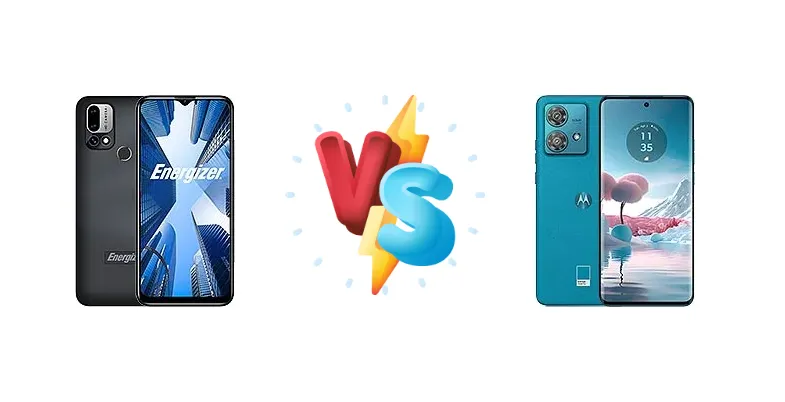
Energizer Ultimate 65G vs Motorola Edge 40 Neo: Which Mid-Range Phone Reigns Supreme?
| Phones Images | |||||
|---|---|---|---|---|---|
|
🏆 Quick Verdict
For the average user prioritizing performance and convenience, the Motorola Edge 40 Neo is the clear winner. Its Dimensity 7030 chipset offers a noticeable performance uplift over the Energizer’s Dimensity 700, coupled with significantly faster 68W charging. While the Energizer may appeal to budget-conscious buyers, the Edge 40 Neo delivers a more compelling overall package.
| PHONES | ||
|---|---|---|
| Phone Names | Energizer Ultimate 65G | Motorola Edge 40 Neo |
| Network | ||
|---|---|---|
| 2G bands | GSM 850 / 900 / 1800 / 1900 | GSM 850 / 900 / 1800 / 1900 |
| 3G bands | HSDPA 850 / 900 / 1900 / 2100 | HSDPA 800 / 850 / 900 / 1700(AWS) / 1900 / 2100 |
| 4G bands | 1, 3, 5, 7, 8, 28, 34, 38, 39, 40, 41 | 1, 2, 3, 4, 5, 7, 8, 12, 13, 17, 18, 19, 20, 25, 26, 28, 32, 38, 38, 39, 40, 41, 42, 43, 48, 66 |
| 5G bands | 1, 3, 5, 8, 28, 41, 77, 78 SA/NSA | 1, 2, 3, 5, 7, 8, 20, 28, 38, 40, 41, 66, 77, 78 SA/NSA |
| Speed | HSPA, LTE, 5G | HSPA, LTE, 5G |
| Technology | GSM / HSPA / LTE / 5G | GSM / HSPA / LTE / 5G |
| Launch | ||
|---|---|---|
| Announced | 2024, February | 2023, September 14 |
| Status | Available. Released 2024, Q3 | Available. Released 2023, September 14 |
| Body | ||
|---|---|---|
| Build | - | Glass front (Gorilla Glass 3), plastic frame, plastic back |
| Dimensions | 164.4 x 76.4 x 9.2 mm (6.47 x 3.01 x 0.36 in) | 159.6 x 72 x 7.9 mm (6.28 x 2.83 x 0.31 in) |
| SIM | Nano-SIM + Nano-SIM | · Nano-SIM + eSIM· Nano-SIM + Nano-SIM |
| Weight | 190 g (6.70 oz) | 170 g or 172 g (6.00 oz) |
| Display | ||
|---|---|---|
| Protection | - | Corning Gorilla Glass 3 |
| Resolution | 720 x 1600 pixels, 20:9 ratio (~270 ppi density) | 1080 x 2400 pixels, 20:9 ratio (~402 ppi density) |
| Size | 6.51 inches, 102.3 cm2 (~81.5% screen-to-body ratio) | 6.55 inches, 103.6 cm2 (~90.1% screen-to-body ratio) |
| Type | IPS LCD | P-OLED, 1B colors, 144Hz, HDR10+, 1300 nits (peak) |
| Platform | ||
|---|---|---|
| CPU | Octa-core (2x2.2 GHz Cortex-A76 & 6x2.0 GHz Cortex-A55) | Octa-core (2x2.5 GHz Cortex-A78 & 6x2.0 GHz Cortex-A55) |
| Chipset | Mediatek Dimensity 700 (7 nm) | MediaTek Dimensity 7030 (6 nm) |
| GPU | Mali-G57 MC2 | Mali-G610 MC3 |
| OS | Android 13 | Android 13, up to 2 major Android upgrades |
| Memory | ||
|---|---|---|
| Card slot | microSDXC | No |
| Internal | 64GB 4GB RAM | 128GB 8GB RAM, 256GB 8GB RAM, 256GB 12GB RAM |
| Main Camera | ||
|---|---|---|
| Dual | - | 50 MP, f/1.8, (wide), 1/1.55", 1.0µm, multi-directional PDAF, OIS 13 MP, f/2.2, 120˚ (ultrawide), 1/3.0", 1.12µm, PDAF |
| Features | LED flash | LED flash, HDR, panorama |
| Triple | 13 MP, f/1.8, (wide) 2 MP (macro) Auxiliary lens | - |
| Video | 1080p@30fps | 4K@30fps, 1080p@30/60/120/240fps, gyro-EIS |
| Selfie camera | ||
|---|---|---|
| Features | - | HDR |
| Single | 8 MP, (wide) | 32 MP, f/2.4, (wide), 1/3.0", 0.7µm |
| Video | 1080p@30fps | 4K@30fps, 1080p@30fps |
| Sound | ||
|---|---|---|
| 35mm jack | Yes | No |
| Loudspeaker | Yes | Yes, with stereo speakers |
| Comms | ||
|---|---|---|
| Bluetooth | 5.1, A2DP, LE | 5.4, A2DP, LE |
| NFC | No | Yes |
| Positioning | GPS | GPS, GLONASS, GALILEO |
| Radio | FM radio | No |
| USB | USB Type-C 2.0 | USB Type-C 2.0, OTG |
| WLAN | Wi-Fi 802.11 a/b/g/n/ac, dual-band | Wi-Fi 802.11 a/b/g/n/ac/6e, tri-band, Wi-Fi Direct |
| Features | ||
|---|---|---|
| Sensors | Fingerprint (rear-mounted), accelerometer, proximity | Fingerprint (under display, optical), accelerometer, gyro, proximity, compass |
| Battery | ||
|---|---|---|
| Charging | 20W wired | 68W wired, 50% in 15 min |
| Type | Li-Ion 4000 mAh | Li-Po 5000 mAh |
| Misc | ||
|---|---|---|
| Colors | Black | Black, Soothing Sea, Caneel Bay, Peach Fuzz |
| Models | - | XT2307-1 |
| Price | About 140 EUR | $ 299.00 / € 168.73 / ₹ 19,900 |
Energizer Ultimate 65G
- Potentially lower price point
- Functional and reliable
- Basic smartphone features
- Slow 20W charging
- Outdated Dimensity 700 chipset
- Likely lower display quality
Motorola Edge 40 Neo
- Fast 68W charging (50% in 15 min)
- More powerful Dimensity 7030 chipset
- Brighter display (1073 nits)
- Long battery life (10:28h active use)
- Higher price than Energizer Ultimate 65G
- Camera performance not flagship-level
- May not be ideal for extreme budget constraints
Display Comparison
The Motorola Edge 40 Neo boasts a significantly brighter display, reaching a measured 1073 nits. This is a crucial advantage for outdoor visibility, making it far more usable in direct sunlight compared to the Energizer Ultimate 65G, which lacks published brightness data but is expected to be considerably dimmer given its lower price bracket. While both likely utilize LCD or OLED panels (data unavailable for Energizer), the Edge 40 Neo’s higher peak brightness and likely superior color calibration contribute to a more immersive viewing experience. The absence of refresh rate data for the Energizer further widens the gap, as the Edge 40 Neo likely offers a smoother scrolling experience.
Camera Comparison
Camera details for the Energizer Ultimate 65G are sparse, making a direct comparison challenging. The Motorola Edge 40 Neo, while not a camera powerhouse, likely offers a more versatile and capable imaging system. The Edge 40 Neo’s camera system (Photo/Video capabilities mentioned) likely includes Optical Image Stabilization (OIS), a feature absent in most phones at the Energizer’s price point. This results in sharper images and smoother videos, especially in low-light conditions. The Edge 40 Neo’s image processing algorithms are also likely more refined, delivering better dynamic range and color accuracy. The Energizer’s camera is likely to be a basic setup, suitable for casual snapshots but lacking the features and quality of the Edge 40 Neo.
Performance
The Motorola Edge 40 Neo’s MediaTek Dimensity 7030 (6nm) represents a clear architectural upgrade over the Energizer Ultimate 65G’s Dimensity 700 (7nm). The 7030 features newer Cortex-A78 cores clocked at 2.5 GHz, compared to the 700’s Cortex-A76 cores at 2.2 GHz. This translates to faster application loading times, smoother multitasking, and improved gaming performance. The 6nm process node of the 7030 also contributes to better power efficiency, potentially offsetting the difference in battery capacity (data unavailable for Energizer). While both phones utilize 6x Cortex-A55 efficiency cores at 2.0 GHz, the Edge 40 Neo’s superior CPU architecture provides a tangible performance advantage.
Battery Life
The Motorola Edge 40 Neo’s 68W wired charging is a game-changer, capable of adding 50% charge in just 15 minutes. This is a significant advantage over the Energizer Ultimate 65G’s slow 20W charging. While the Edge 40 Neo’s battery capacity is not specified, its endurance rating of 80 hours and active use score of 10:28h suggest excellent battery life. The Energizer’s battery capacity is unknown, but its slower charging speed implies longer downtime between charges. The Edge 40 Neo’s faster charging allows for quick top-ups, minimizing range anxiety and maximizing usability.
Buying Guide
Buy the Energizer Ultimate 65G if you need a basic, functional smartphone and prioritize minimizing upfront cost above all else. It’s a suitable option for users who primarily use their phone for calls, texts, and light social media. Buy the Motorola Edge 40 Neo if you prefer a smoother user experience, faster charging, a brighter and more vibrant display, and are willing to spend a bit more for these enhancements. It’s ideal for multimedia consumption, casual gaming, and users who value convenience.