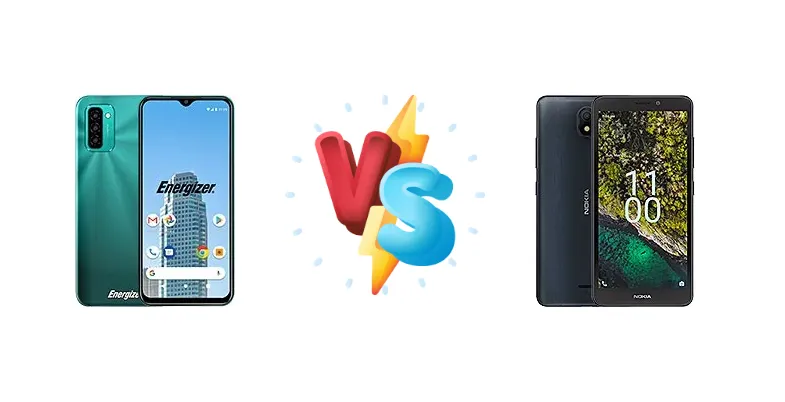
The Energizer U680S and Nokia C100 represent the extreme end of the budget smartphone market. Both aim to deliver basic smartphone functionality at the lowest possible price point, but they take different approaches to achieving this. The U680S leverages a newer, though still entry-level, Unisoc chipset, while the Nokia C100 relies on Mediatek’s Helio A22. This comparison will dissect the core differences to determine which device offers the best value for users prioritizing performance and efficiency.
🏆 Quick Verdict
For the average user seeking a slightly more responsive experience, the Energizer U680S is the better choice. Its Unisoc SC9863A, built on a 28nm process, offers an octa-core configuration that, despite the older node, provides a performance advantage over the Nokia C100’s quad-core Helio A22. While neither phone is a powerhouse, the U680S offers a smoother experience for everyday tasks.
| Network |
|---|
| 2G bands | GSM 850 / 900 / 1800 / 1900 | GSM 850 / 900 / 1800 / 1900 |
| 3G bands | HSDPA 850 / 900 / 1900 / 2100 | HSDPA 850 / 1700(AWS) / 1900 |
| 4G bands | 1, 2, 3, 5, 7, 8, 20, 28, 40, 41 | 2, 4, 5, 12, 13, 41, 66, 71 |
| Speed | HSPA, LTE | HSPA, LTE |
| Technology | GSM / HSPA / LTE | GSM / HSPA / LTE |
| Launch |
|---|
| Announced | 2021, June 29. Released 2021, Q3 | 2022, January 05 |
| Status | Discontinued | Available. Released 2022, Q2 |
| Body |
|---|
| Dimensions | - | 149.6 x 71.9 x 9.7 mm (5.89 x 2.83 x 0.38 in) |
| SIM | Nano-SIM + Micro-SIM | Nano-SIM |
| Weight | - | - |
| | - | Splash protection |
| Display |
|---|
| Resolution | 720 x 1640 pixels (~263 ppi density) | 720 x 1440 pixels, 18:9 ratio (~295 ppi density) |
| Size | 6.8 inches, 109.8 cm2 | 5.45 inches, 76.7 cm2 (~71.3% screen-to-body ratio) |
| Type | IPS LCD | IPS LCD |
| Platform |
|---|
| CPU | Octa-core (4x1.6 GHz Cortex-A55 & 4x1.2 GHz Cortex-A55) | Quad-core 2.0 GHz Cortex-A53 |
| Chipset | Unisoc SC9863A (28 nm) | Mediatek MT6761 Helio A22 (12 nm) |
| GPU | IMG8322 | PowerVR GE8320 |
| OS | Android 11 | Android 12 |
| Memory |
|---|
| Card slot | microSDHC | microSDXC (dedicated slot) |
| Internal | 32GB 2GB RAM | 32GB 3GB RAM |
| | eMMC 5.1 | eMMC 5.1 |
| Main Camera |
|---|
| Features | LED flash | LED flash |
| Single | - | 8 MP, AF |
| Triple | 13 MP, AF
2 MP
VGA | - |
| Video | 1080p@30fps | 1080p@30fps |
| Selfie camera |
|---|
| Single | 5 MP | 5 MP |
| Video | - | 720p |
| Sound |
|---|
| 3.5mm jack | Yes | Yes |
| 35mm jack | Yes | Yes |
| Loudspeaker | Yes | Yes |
| Comms |
|---|
| Bluetooth | 4.0 | 5.0, A2DP, LE |
| NFC | No | No |
| Positioning | GPS | GPS |
| Radio | FM radio | No |
| USB | USB Type-C 2.0 | USB Type-C 2.0 |
| WLAN | Wi-Fi 802.11 b/g/n | Wi-Fi 802.11 b/g/n/ac |
| Features |
|---|
| Sensors | Accelerometer, proximity | Accelerometer, proximity, barometer |
| Battery |
|---|
| Type | Li-Po 7000 mAh | Li-Ion 3000 mAh, removable |
| Misc |
|---|
| Colors | Green, Black | Blue |
| Models | - | TA-1484, TA-1520, N152DL |
| Price | About 120 EUR | About 50 EUR |
| SAR | - | 1.03 W/kg (head) 1.35 W/kg (body) |
Energizer U680S
- Octa-core processor offers better multitasking.
- More modern CPU architecture (Cortex-A55).
- Potentially smoother user experience.
- 28nm process is less power-efficient.
- Limited RAM likely a bottleneck.
Nokia C100
- 12nm process offers better power efficiency.
- Simpler user experience for basic tasks.
- Potentially longer battery life.
- Quad-core processor limits multitasking.
- Older CPU architecture (Cortex-A53).
Display Comparison
Neither device’s display specifications are available, so a direct comparison is limited. However, given their price points, both likely utilize LCD panels with 720p+ resolutions. The Nokia C100, being a slightly older model, may have wider bezels. Color accuracy is expected to be basic on both, prioritizing visibility over fidelity. The absence of high refresh rates or advanced panel technologies like LTPO is standard for this segment.
Camera Comparison
Camera details are sparse for both devices. It’s safe to assume both feature basic camera setups, likely with a single main sensor and potentially a secondary depth or macro sensor. Given the market segment, image quality will be adequate for casual snapshots but will struggle in low-light conditions. The absence of Optical Image Stabilization (OIS) is expected on both. Focusing on megapixel counts alone is misleading; sensor size and image processing algorithms are far more critical, and details on these are unavailable.
Performance
The core difference lies in the chipsets. The Energizer U680S’s Unisoc SC9863A features an octa-core CPU comprised of four Cortex-A55 cores clocked at 1.6 GHz and four at 1.2 GHz. This contrasts sharply with the Nokia C100’s Mediatek Helio A22, a quad-core processor utilizing Cortex-A53 cores clocked at 2.0 GHz. While the A53 cores have a higher clock speed, the A55 architecture is more efficient and generally offers better performance per clock cycle. The octa-core configuration of the U680S also allows for better multitasking. The Helio A22’s 12nm process is more efficient than the SC9863A’s 28nm, but the architectural improvements in the Unisoc chip largely offset this advantage. RAM configurations are unknown, but limited RAM will be a bottleneck on both devices.
Battery Life
Battery capacity is unknown for both devices. However, the Mediatek Helio A22’s 12nm process generally consumes less power than the Unisoc SC9863A’s 28nm. This suggests the Nokia C100 *could* offer slightly longer battery life under similar usage conditions. Charging wattage is also unknown, but both are likely to support slow charging speeds, meaning a full charge will take several hours. The efficiency gains of the Helio A22 may be negated by a smaller battery capacity in the Nokia C100.
Buying Guide
Buy the Energizer U680S if you need a phone capable of handling multiple apps simultaneously without significant slowdown, or if you occasionally play less demanding mobile games. The octa-core processor and more modern architecture provide a noticeable boost in responsiveness. Buy the Nokia C100 if your primary needs are basic communication – calls, texts, and light web browsing – and you prioritize simplicity and potentially longer battery life due to the less power-hungry chipset, even if it comes at the cost of performance.
Frequently Asked Questions
❓ Will the Unisoc SC9863A in the Energizer U680S struggle with popular apps like Facebook or WhatsApp?
While the SC9863A isn't a high-end processor, it should handle basic apps like Facebook and WhatsApp without significant issues. However, expect some slowdown when multitasking or using more demanding features within those apps. The octa-core configuration helps mitigate this compared to the Nokia C100.
❓ Is the Mediatek Helio A22 in the Nokia C100 sufficient for casual gaming?
The Helio A22 can handle very basic 2D games, but it will struggle with most modern 3D titles. Frame rates will likely be low, and you may experience significant lag. It's best suited for simple games like Candy Crush or older, less demanding titles.
❓ Given the 28nm process of the Unisoc chip, will the Energizer U680S get noticeably warm during extended use?
The 28nm process is less efficient, meaning the U680S may generate more heat than the Nokia C100 during prolonged use. However, given the low power draw of the chipset, it's unlikely to become uncomfortably hot. Expect some warmth during extended gaming or video playback.