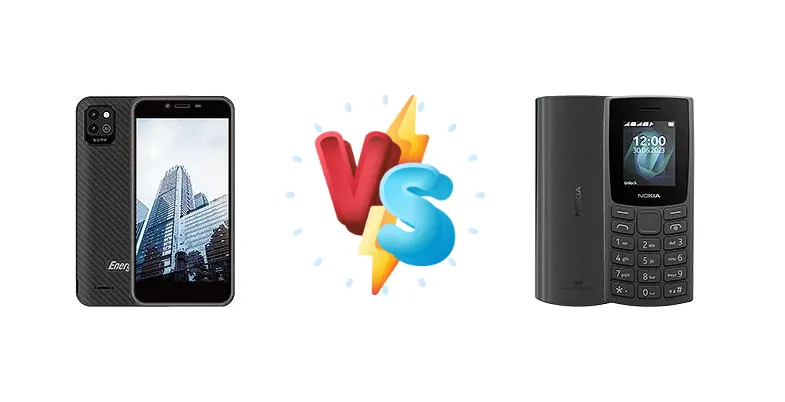
The smartphone landscape is diverse, ranging from flagship powerhouses to ultra-affordable devices. We're pitting the Energizer U506S, a basic smartphone, against the Nokia 105 4G 2nd Edition, a 4G feature phone, to determine which offers the best value for users prioritizing essential connectivity and simplicity. This comparison isn't about raw power, but about usability and functionality within a limited budget.
🏆 Quick Verdict
For users needing basic smartphone capabilities like app usage and web browsing, the Energizer U506S is the clear winner. Its quad-core 1.5 GHz processor provides a significantly more versatile experience than the Nokia 105 4G 2nd Edition, which is primarily a voice and text-focused device with limited app support.
| Network |
|---|
| 2G bands | GSM 850 / 900 / 1800 / 1900 | GSM 900 / 1800 |
| 3G bands | HSDPA 850 / 900 / 2100 | HSDPA 850 / 900 / 1700(AWS) / 1900 / 2100 |
| 4G bands | 1, 3, 4, 7, 8, 20, 28, 38, 40, 41 | LTE |
| Speed | HSPA, LTE | HSPA, LTE |
| Technology | GSM / HSPA / LTE | GSM / HSPA / LTE |
| Launch |
|---|
| Announced | 2023, November | 2024, December |
| Status | Available. Released 2023, November | Available. Released 2024, December |
| Body |
|---|
| Dimensions | 144.8 x 72.4 x 11.6 mm (5.70 x 2.85 x 0.46 in) | 121.5 x 50 x 14.4 mm (4.78 x 1.97 x 0.57 in) |
| SIM | Nano-SIM + Nano-SIM | · Nano-SIM· Nano-SIM + Nano-SIM |
| Weight | 178 g (6.28 oz) | 93 g (3.28 oz) |
| Display |
|---|
| Resolution | 480 x 854 pixels, 16:9 ratio (~196 ppi density) | 120 x 160 pixels, 4:3 ratio (~111 ppi density) |
| Size | 5.0 inches, 68.9 cm2 (~65.7% screen-to-body ratio) | 1.8 inches, 10.0 cm2 (~16.5% screen-to-body ratio) |
| Type | IPS LCD | IPS LCD |
| Platform |
|---|
| CPU | Quad-core 1.5 GHz | - |
| OS | Android 13 (Go edition) | - |
| Memory |
|---|
| Call records | - | Yes |
| Card slot | microSDHC | microSDHC |
| Internal | 32GB 2GB RAM | 48MB 128MB RAM |
| Phonebook | - | Yes |
| Main Camera |
|---|
| Dual | 5 MP
Auxiliary lens | - |
| Features | LED flash | - |
| Video | 1080p@30fps | - |
| Selfie camera |
|---|
| Single | 2 MP | - |
| Video | 1080p@30fps | - |
| Sound |
|---|
| 35mm jack | Yes | Yes |
| Loudspeaker | Yes | Yes |
| Comms |
|---|
| Bluetooth | 4.0, A2DP | 5.0, A2DP |
| NFC | No | No |
| Positioning | GPS | No |
| Radio | FM radio | Wireless FM radio |
| USB | microUSB | USB Type-C |
| WLAN | Wi-Fi 802.11 a/b/g/n | No |
| Features |
|---|
| Games | - | Yes |
| Java | - | No |
| Messaging | - | SMS |
| Sensors | Accelerometer, proximity | - |
| Battery |
|---|
| Type | Li-Ion 3000 mAh battery, removable | Li-Ion 1450 mAh, removable |
| Misc |
|---|
| Colors | Black | Charcoal |
| Price | About 60 EUR | About 50 EUR |
Energizer U506S
- Smartphone functionality with app support
- Larger, higher-resolution display
- Quad-core processor for smoother performance
- Likely shorter battery life than Nokia 105 4G
- Potentially lower build quality compared to Nokia
Nokia 105 4G 2nd Edition
- Exceptional battery life
- Simple and intuitive user interface
- Affordable price point
- Limited functionality – primarily calls and texts
- Basic display quality
Display Comparison
Given the lack of display specifications for the Nokia 105 4G 2nd Edition, we can assume it features a basic color display typical of feature phones. The Energizer U506S, being a smartphone, will offer a larger, higher-resolution display, enabling a more comfortable experience for viewing photos, browsing the web, and using apps. The difference in display technology will be substantial, with the U506S likely utilizing an IPS panel for wider viewing angles and better color reproduction.
Camera Comparison
Without camera specifications for the Nokia 105 4G 2nd Edition, it's safe to assume it has a very basic camera primarily for capturing simple snapshots. The Energizer U506S, while likely not boasting a high-end camera system, will offer a more capable camera for capturing photos and videos, allowing for more flexibility and better image quality. The U506S's camera will be useful for quick documentation or sharing photos with family and friends.
Performance
The Energizer U506S's quad-core 1.5 GHz processor represents a significant performance advantage over the Nokia 105 4G 2nd Edition. While the Nokia 105 4G 2nd Edition is designed for basic call and text functions, the U506S can handle light multitasking, web browsing, and app usage. The processor in the U506S allows for a smoother user experience when navigating the operating system and launching applications. The Nokia 105 4G 2nd Edition's chipset is optimized for power efficiency, not processing speed.
Battery Life
The Nokia 105 4G 2nd Edition is likely to excel in battery life due to its limited functionality and low-power chipset. However, the Energizer U506S, while having a smaller battery capacity (spec not provided), benefits from optimized software and power management features. The U506S's battery life will be sufficient for a full day of moderate use, while the Nokia 105 4G 2nd Edition could potentially last for several days on a single charge.
Buying Guide
Buy the Energizer U506S if you need access to smartphone apps, even for basic tasks like WhatsApp or Facebook, and require a color display for improved readability. Buy the Nokia 105 4G 2nd Edition if you prioritize exceptional battery life, a simple user interface, and primarily need a device for making calls and sending texts, with 4G connectivity as a bonus.
Frequently Asked Questions
❓ Can the Energizer U506S run popular social media apps like WhatsApp and Facebook?
Yes, the Energizer U506S's quad-core processor and smartphone operating system allow it to run popular social media apps like WhatsApp and Facebook, although performance may be limited compared to higher-end devices. It's suitable for basic usage of these apps.
❓ Is the Nokia 105 4G 2nd Edition a good choice for someone who is not tech-savvy?
Absolutely. The Nokia 105 4G 2nd Edition is designed for simplicity. Its user interface is straightforward and easy to navigate, making it an excellent choice for individuals who are not comfortable with complex smartphone features.
❓ Does the Energizer U506S support 4G connectivity?
While the specific 4G bands supported aren't listed, as a modern smartphone, the Energizer U506S is expected to support 4G connectivity, allowing for faster data speeds and improved browsing experience compared to 2G or 3G networks.