
Energizer Hardcase H620S vs. Ulefone Armor 10 5G: A Rugged Performance Showdown
| Phones Images | |||||
|---|---|---|---|---|---|
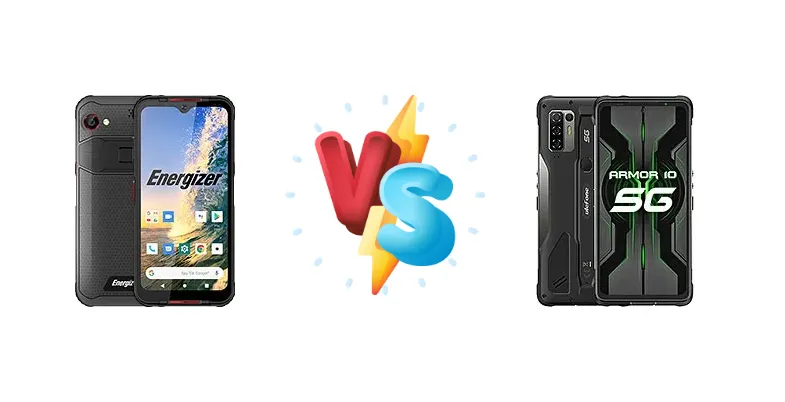
|
🏆 Quick Verdict
For the average user prioritizing responsiveness and future-proofing, the Ulefone Armor 10 5G is the clear winner. Its Mediatek Dimensity 800 chipset delivers significantly superior performance compared to the Energizer H620S’ Helio P22, making it better suited for multitasking, demanding apps, and 5G connectivity. However, the H620S remains a viable option for basic use cases where budget is paramount.
| PHONES | ||
|---|---|---|
| Phone Names | Energizer Hardcase H620S | Ulefone Armor 10 5G |
| Network | ||
|---|---|---|
| 2G bands | GSM 850 / 900 / 1800 / 1900 | GSM 850 / 900 / 1800 / 1900 |
| 3G bands | HSDPA 850 / 900 / 1900 / 2100 | HSDPA 850 / 900 / 1700(AWS) / 1900 / 2100 |
| 4G bands | 1, 3, 5, 7, 8, 20, 28, 34, 38, 39, 40, 41 | 1, 2, 3, 4, 5, 7, 8, 12, 13, 17, 18, 19, 20, 25, 26, 28, 34, 38, 39, 40, 41, 66 |
| 5G bands | - | 1, 3, 41, 77, 78, 79 SA/NSA |
| Speed | HSPA, LTE | HSPA, LTE, 5G |
| Technology | GSM / HSPA / LTE | GSM / CDMA / HSPA / EVDO / LTE / 5G |
| - | CDMA2000 1xEV-DO | |
| Launch | ||
|---|---|---|
| Announced | 2020, December. Released 2021, February 09 | 2020, November 17. Released 2020, December 07 |
| Status | Discontinued | Discontinued |
| Body | ||
|---|---|---|
| Build | - | Front glass, aluminum back with rubber, aluminum frame |
| Dimensions | 163 x 78.2 x 12 mm (6.42 x 3.08 x 0.47 in) | 176.5 x 82.8 x 14.6 mm (6.95 x 3.26 x 0.57 in) |
| SIM | Nano-SIM + Nano-SIM | Nano-SIM + Nano-SIM |
| Weight | 250 g (8.82 oz) | 328 g (11.57 oz) |
| IP69 dust/water resistant (up to 1.2m for 30 min) Drop-to-concrete resistance from up to 1.2m | IP68 dust/water resistant (up to 1.5m for 30 min) Drop-to-concrete resistance from up to 1.2m MIL-STD-810G compliant | |
| Display | ||
|---|---|---|
| Protection | - | Scratch-resistant glass, oleophobic coating |
| Resolution | 720 x 1440 pixels, 18:9 ratio (~260 ppi density) | 1080 x 2400 pixels, 20:9 ratio (~395 ppi density) |
| Size | 6.2 inches, 99.2 cm2 (~77.8% screen-to-body ratio) | 6.67 inches, 107.4 cm2 (~73.5% screen-to-body ratio) |
| Type | IPS LCD | IPS LCD |
| Platform | ||
|---|---|---|
| CPU | Octa-core 2.0 GHz Cortex-A53 | Octa-core (4x2.0 GHz Cortex-A76 & 4x2.0 GHz Cortex-A55) |
| Chipset | Mediatek MT6762 Helio P22 (12 nm) | Mediatek Dimensity 800 (7 nm) |
| GPU | PowerVR GE8320 | Mali-G57 MP4 |
| OS | Android 10 | Android 10, planned upgrade to Android 11 |
| Memory | ||
|---|---|---|
| Card slot | microSDHC (uses shared SIM slot) | microSDXC (uses shared SIM slot) |
| Internal | 64GB 4GB RAM | 128GB 8GB RAM |
| eMMC 5.1 | - | |
| Main Camera | ||
|---|---|---|
| Features | Dual-LED flash | LED flash, Panorama, HDR |
| Quad | - | 64 MP, f/1.9, 26mm (wide), 1/1.72", 0.8µm, PDAF 8 MP, f/2.2, 119˚ (ultrawide) 5 MP (macro) Auxiliary lens |
| Single | 48 MP, PDAF | - |
| Video | 1080p@30fps | 4K@30fps, 1080p@30fps |
| Selfie camera | ||
|---|---|---|
| Single | 8 MP | 16 MP, f/2.2 |
| Video | 1080p@30fps | 1080p@30fps |
| Sound | ||
|---|---|---|
| 3.5mm jack | Yes | Yes |
| 35mm jack | Yes | Yes |
| Loudspeaker | Yes | Yes |
| Comms | ||
|---|---|---|
| Bluetooth | 5.0, A2DP, LE | 5.2, A2DP, LE |
| NFC | Yes | Yes |
| Positioning | GPS | GPS, GLONASS, GALILEO, BDS |
| Radio | FM radio | FM radio, RDS, recording |
| USB | USB Type-C 2.0 | USB Type-C 2.0, OTG |
| WLAN | Wi-Fi 802.11 b/g/n, Wi-Fi Direct | Wi-Fi 802.11 a/b/g/n/ac, Wi-Fi Direct |
| Features | ||
|---|---|---|
| Sensors | Fingerprint (rear-mounted), accelerometer, proximity | Fingerprint (side-mounted), accelerometer, gyro, proximity, compass, baroceptor, coulombmeter |
| Battery | ||
|---|---|---|
| Charging | - | 15W wired 15W wireless |
| Type | Li-Ion 5000 mAh | Li-Po 5800 mAh |
| Misc | ||
|---|---|---|
| Colors | Black | Black |
| Price | About 300 EUR | About 420 EUR |
Energizer Hardcase H620S
- Extremely affordable price point
- Rugged design for durability
- Simple and easy-to-use interface
- Weak performance with the Helio P22 chipset
- Limited multitasking capabilities
- Likely outdated software support
Ulefone Armor 10 5G
- Significantly faster performance with the Dimensity 800
- 5G connectivity for future-proofing
- Wireless charging convenience
- Higher price compared to the H620S
- 15W charging is relatively slow
- Rugged design adds bulk
Display Comparison
Neither device boasts a cutting-edge display. While specific display specs (resolution, brightness) are absent for the H620S, its price point suggests a basic LCD panel. The Ulefone Armor 10 5G also likely features an LCD, but the focus here isn’t display quality; it’s ruggedness. Both will prioritize durability over vibrant colors or high refresh rates. The Armor 10 5G’s larger size may offer a slightly more immersive viewing experience, but neither phone is designed for media consumption.
Camera Comparison
Detailed camera specifications are limited, but both phones likely feature multiple rear cameras to offer versatility. However, the quality will heavily depend on sensor size and image processing. Given the price difference, the Ulefone Armor 10 5G likely benefits from a more sophisticated image signal processor (ISP) within the Dimensity 800 chipset, resulting in better image quality, especially in low-light conditions. The presence of a 5G modem in the Armor 10 5G suggests a more modern overall component selection, potentially extending to the camera module.
Performance
This is where the chasm between these two phones becomes apparent. The Energizer H620S utilizes the Mediatek MT6762 Helio P22, a 12nm chipset with an octa-core Cortex-A53 CPU clocked at 2.0 GHz. This is an entry-level processor designed for basic tasks. Conversely, the Ulefone Armor 10 5G is powered by the Mediatek Dimensity 800, a 7nm chip featuring a more powerful combination of Cortex-A76 and A55 cores, also clocked at 2.0 GHz. The 7nm process node and superior core architecture of the Dimensity 800 translate to significantly improved performance and power efficiency. The Armor 10 5G will handle multitasking, gaming, and demanding applications with far greater ease, while the H620S will struggle with anything beyond basic operations.
Battery Life
Battery capacity is not specified for the H620S, but rugged phones typically prioritize large batteries. The Ulefone Armor 10 5G supports both 15W wired and 15W wireless charging, offering convenient charging options. While 15W isn’t fast charging by modern standards, the Dimensity 800’s superior power efficiency means the Armor 10 5G will likely deliver longer battery life despite potentially having a similar capacity to the H620S. The wireless charging capability is a unique advantage for the Armor 10 5G, catering to users who prefer cable-free charging.
Buying Guide
Buy the Energizer Hardcase H620S if you need a supremely affordable, extremely durable phone for basic communication – calls, texts, and light app usage – and aren’t concerned with demanding performance or 5G. Buy the Ulefone Armor 10 5G if you prioritize a smoother user experience, faster app loading times, 5G connectivity for future network compatibility, and the ability to handle more intensive tasks like video editing or gaming, even if it means a higher initial investment.