
Energizer Hardcase H620S vs. Asus ROG Phone 6 Pro: A Clash of Titans
| Phones Images | |||||
|---|---|---|---|---|---|
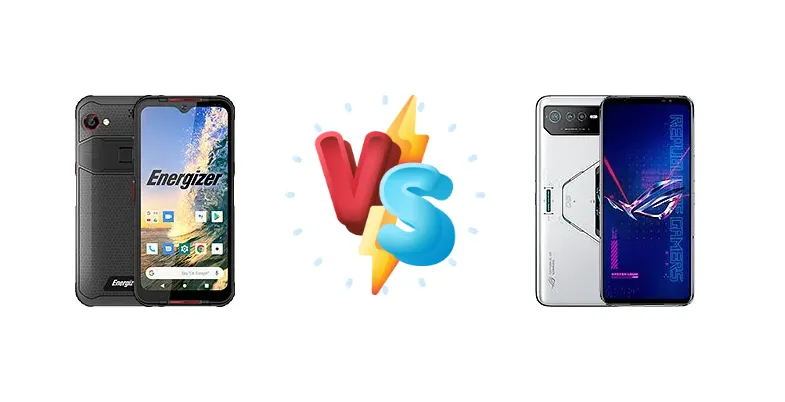
|
🏆 Quick Verdict
The Asus ROG Phone 6 Pro is the clear winner. Its Snapdragon 8+ Gen 1 chipset, stunning display, and rapid charging far outpace the Energizer H620S. While the Energizer offers ruggedness and a lower price, the ROG Phone 6 Pro provides a vastly superior overall experience, especially for gamers.
| PHONES | ||
|---|---|---|
| Phone Names | Energizer Hardcase H620S | Asus ROG Phone 6 Pro |
| Network | ||
|---|---|---|
| 2G bands | GSM 850 / 900 / 1800 / 1900 | GSM 850 / 900 / 1800 / 1900 |
| 3G bands | HSDPA 850 / 900 / 1900 / 2100 | HSDPA 800 / 850 / 900 / 1700(AWS) / 1900 / 2100 |
| 4G bands | 1, 3, 5, 7, 8, 20, 28, 34, 38, 39, 40, 41 | 1, 2, 3, 4, 5, 7, 8, 12, 13, 17, 18, 19, 20, 25, 26, 28, 29, 30, 32, 34, 38, 39, 40, 41, 42, 43, 48, 66, 71 - Version A |
| 5G bands | - | 1, 2, 3, 5, 7, 8, 12, 13, 18, 20, 25, 26, 28, 38, 40, 41, 48, 66, 71, 77, 78, 79 SA/NSA/Sub6 - Version A |
| Speed | HSPA, LTE | HSPA 42.2/5.76 Mbps, LTE (6CA) Cat20 2024/210 Mbps, 5G |
| Technology | GSM / HSPA / LTE | GSM / CDMA / HSPA / LTE / 5G |
| - | 1, 3, 5, 8, 28, 41, 77, 78, 79 - Version B | |
| Launch | ||
|---|---|---|
| Announced | 2020, December. Released 2021, February 09 | 2022, July 05 |
| Status | Discontinued | Available. Released 2022, July 13 |
| Body | ||
|---|---|---|
| Build | - | Glass front (Gorilla Glass Victus), glass back (Gorilla Glass 3), aluminum frame |
| Dimensions | 163 x 78.2 x 12 mm (6.42 x 3.08 x 0.47 in) | 173 x 77 x 10.3 mm (6.81 x 3.03 x 0.41 in) |
| SIM | Nano-SIM + Nano-SIM | Nano-SIM + Nano-SIM |
| Weight | 250 g (8.82 oz) | 239 g (8.43 oz) |
| IP69 dust/water resistant (up to 1.2m for 30 min) Drop-to-concrete resistance from up to 1.2m | IPX4 water resistant 2" OLED display (on the back) Pressure sensitive zones (Gaming triggers) | |
| Display | ||
|---|---|---|
| Protection | - | Corning Gorilla Glass Victus |
| Resolution | 720 x 1440 pixels, 18:9 ratio (~260 ppi density) | 1080 x 2448 pixels (~395 ppi density) |
| Size | 6.2 inches, 99.2 cm2 (~77.8% screen-to-body ratio) | 6.78 inches, 109.5 cm2 (~82.2% screen-to-body ratio) |
| Type | IPS LCD | AMOLED, 1B colors, 165Hz, HDR10+, 800 nits (typ), 1200 nits (peak) |
| Platform | ||
|---|---|---|
| CPU | Octa-core 2.0 GHz Cortex-A53 | Octa-core (1x3.19 GHz Cortex-X2 & 3x2.75 GHz Cortex-A710 & 4x1.80 GHz Cortex-A510) |
| Chipset | Mediatek MT6762 Helio P22 (12 nm) | Qualcomm SM8475 Snapdragon 8+ Gen 1 (4 nm) |
| GPU | PowerVR GE8320 | Adreno 730 |
| OS | Android 10 | Android 12, upgradable to Android 13 |
| Memory | ||
|---|---|---|
| Card slot | microSDHC (uses shared SIM slot) | No |
| Internal | 64GB 4GB RAM | 512GB 18GB RAM |
| eMMC 5.1 | UFS 3.1 NTFS support for external storage | |
| Main Camera | ||
|---|---|---|
| Features | Dual-LED flash | LED flash, HDR, panorama |
| Single | 48 MP, PDAF | - |
| Triple | - | 50 MP, f/1.9, (wide), 1/1.56", 1.0µm, PDAF 13 MP, f/2.2, (ultrawide) 5 MP (macro) |
| Video | 1080p@30fps | 8K@24fps, 4K@30/60/120fps, 1080p@30/60/120/240fps, 720p@480fps; gyro-EIS |
| Selfie camera | ||
|---|---|---|
| Features | - | Panorama, HDR |
| Single | 8 MP | 12 MP, 28mm (wide) |
| Video | 1080p@30fps | 1080p@30fps |
| Sound | ||
|---|---|---|
| 3.5mm jack | Yes | Yes |
| 35mm jack | Yes | Yes |
| Loudspeaker | Yes | Yes, with stereo speakers (2 amplifiers) |
| - | 32-bit/384kHz audio | |
| Comms | ||
|---|---|---|
| Bluetooth | 5.0, A2DP, LE | 5.2, A2DP, LE, aptX HD, aptX Adaptive, aptX Lossless |
| NFC | Yes | Yes |
| Positioning | GPS | GPS (L1+L5), GLONASS (L1), BDS (B1I+B1c+B2a), GALILEO (E1+E5a), QZSS (L1+L5), NavIC (L5) |
| Radio | FM radio | No |
| USB | USB Type-C 2.0 | USB Type-C 3.1 (side), USB Type-C 2.0 (bottom), OTG, accessory connector |
| WLAN | Wi-Fi 802.11 b/g/n, Wi-Fi Direct | Wi-Fi 802.11 a/b/g/n/ac/6e, tri-band, Wi-Fi Direct |
| Features | ||
|---|---|---|
| Sensors | Fingerprint (rear-mounted), accelerometer, proximity | Fingerprint (under display, optical), accelerometer, gyro, proximity, compass |
| Battery | ||
|---|---|---|
| Charging | - | 65W wired, PD3.0, QC5, 100% in 42 min 10W reverse wired |
| Type | Li-Ion 5000 mAh | Li-Po 6000 mAh |
| Misc | ||
|---|---|---|
| Colors | Black | Storm White |
| Models | - | AI2201_D |
| Price | About 300 EUR | About 800 EUR |
| Tests | ||
|---|---|---|
| Battery life | - | Endurance rating 119h |
| Camera | - | Photo / Video |
| Display | - | Contrast ratio: Infinite (nominal) |
| Loudspeaker | - | -24.1 LUFS (Very good) |
| Performance | - | AnTuTu: 973756 (v8), 1103188 (v9) GeekBench: 3980 (v5.1) GFXBench: 79fps (ES 3.1 onscreen) |
Energizer Hardcase H620S
- Rugged design
- Affordable price
- Long battery life (claimed)
- Outdated chipset
- Lower display quality
- Likely inferior camera
- Slower charging
Asus ROG Phone 6 Pro
- Exceptional performance
- Stunning display
- Fast charging (65W)
- Excellent camera
- Gaming-focused features
- High price
- Larger size and weight
Display Comparison
The ROG Phone 6 Pro boasts a significantly brighter (829 nits vs. likely around 350-400 nits for the Energizer) and higher-quality AMOLED display with an infinite contrast ratio. The Energizer likely uses an IPS LCD, offering decent color accuracy but lacking the vibrancy and deep blacks of the ROG Phone 6 Pro's panel. The ROG Phone's refresh rate is also likely higher, providing smoother visuals.
Camera Comparison
While specific camera specs are missing for the Energizer, it's safe to assume the ROG Phone 6 Pro has a superior camera system. The ROG Phone 6 Pro likely features multiple lenses with higher resolution sensors and advanced image processing capabilities, resulting in better photo and video quality, especially in low light.
Performance
The Snapdragon 8+ Gen 1 in the ROG Phone 6 Pro is in a different league compared to the Helio P22 in the Energizer. Expect drastically faster app loading, smoother multitasking, and significantly better gaming performance on the ROG Phone. The ROG Phone's CPU architecture is also far more advanced, offering superior efficiency and power.
Battery Life
Both phones claim impressive endurance ratings (119h). However, the ROG Phone 6 Pro's 65W fast charging provides a significant advantage, allowing for much quicker top-ups compared to the Energizer's likely slower charging speeds. The ROG Phone's power efficiency, thanks to its advanced chipset, also contributes to its excellent battery life.
Buying Guide
The Energizer Hardcase H620S is ideal for users prioritizing durability and budget-friendliness, who don't demand high-end performance. The Asus ROG Phone 6 Pro is perfect for serious mobile gamers and power users who want the best possible performance, display, and features, and are willing to pay a premium.