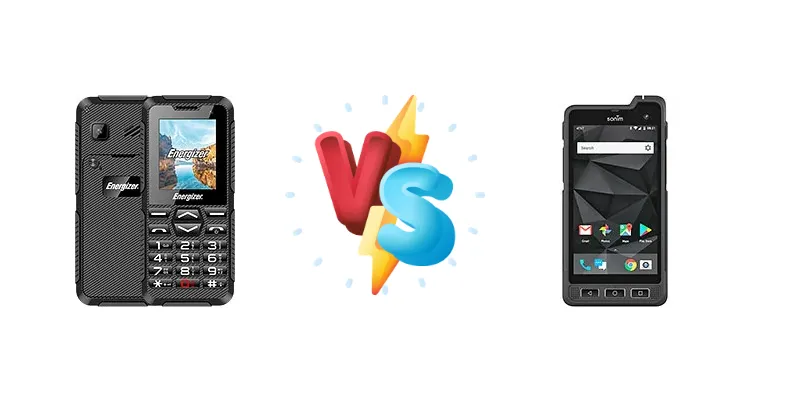
The Energizer Hardcase H10 and Sonim XP8 both target a niche market: users needing extreme durability. However, their approaches to achieving this, and the resulting user experience, differ significantly. The H10 represents a budget-focused entry, while the XP8 aims for a more robust, feature-rich experience, backed by Qualcomm's processing power.
🏆 Quick Verdict
For the average user prioritizing performance and future-proofing, the Sonim XP8 is the clear winner. Its Snapdragon 630 chipset delivers a significantly smoother experience than the H10’s Mediatek MT6261A. While the H10 offers basic functionality, the XP8’s 18W Quick Charge and more capable processor justify the price difference.
| Network |
|---|
| 2G bands | GSM 850 / 900 / 1800 / 1900 | GSM 850 / 900 / 1800 / 1900 |
| 3G bands | - | HSDPA 850 / 900 / 1700(AWS) / 1900 / 2100 |
| 4G bands | - | 1, 2, 3, 4, 5, 7, 8, 12, 13, 14, 20, 25, 26, 28, 29, 30, 38, 40, 41, 66 |
| EDGE | Yes | - |
| GPRS | Yes | - |
| Speed | - | HSPA 42.2/5.76 Mbps, LTE (3CA) Cat12 600/150 Mbps |
| Technology | GSM | GSM / CDMA / HSPA / EVDO / LTE |
| | - | CDMA2000 1xEV-DO |
| Launch |
|---|
| Announced | 2019, April. Released 2019, April | 2018, April. Released 2018, May |
| Status | Discontinued | Discontinued |
| Body |
|---|
| Dimensions | 109 x 49 x 15 mm (4.29 x 1.93 x 0.59 in) | 152 x 79.5 x 18 mm (5.98 x 3.13 x 0.71 in) |
| SIM | Dual SIM (Mini-SIM) | Nano-SIM + Nano-SIM |
| Weight | 80 g (2.82 oz) | 335 g (11.82 oz) |
| | IP54, dust and water resistant
Flashlight | IP69 dust proof and water resistant over 1 meter and 30 minutes
MIL-STD-810G |
| Display |
|---|
| Protection | - | Corning Gorilla Glass 3 |
| Resolution | 128 x 160 pixels (~114 ppi density) | 1080 x 1920 pixels, 16:9 ratio (~441 ppi density) |
| Size | 1.8 inches, 10.2 cm2 (~19.1% screen-to-body ratio) | 5.0 inches, 68.9 cm2 (~57.0% screen-to-body ratio) |
| Type | TFT LCD, 256K colors | IPS LCD |
| Platform |
|---|
| CPU | - | Octa-core 2.2 GHz Cortex-A53 |
| Chipset | Mediatek MT6261A | Qualcomm SDM630 Snapdragon 630 (14 nm) |
| GPU | - | Adreno 508 |
| OS | - | Android 7.0 (Nougat) |
| Memory |
|---|
| Call records | Yes | - |
| Card slot | microSDHC | microSDXC |
| Internal | 64MB 32MB RAM | 64GB 4GB RAM |
| Phonebook | Yes | - |
| Main Camera |
|---|
| Features | - | LED flash, HDR, panorama |
| Single | VGA | 12 MP, PDAF |
| Video | Yes | 1080p@30fps |
| Selfie camera |
|---|
| Single | VGA | 8 MP |
| Video | - | 1080p@30fps |
| Sound |
|---|
| 3.5mm jack | Yes | No |
| 35mm jack | Yes | No |
| Loudspeaker | Yes | Yes |
| Comms |
|---|
| Bluetooth | 3.0 | 5.0, A2DP, EDR, LE |
| NFC | No | Yes |
| Positioning | No | GPS, GLONASS |
| Radio | FM radio | FM radio |
| USB | microUSB | USB Type-C 2.0, magnetic connector |
| WLAN | No | Wi-Fi 802.11 a/b/g/n/ac, dual-band, Wi-Fi Direct |
| Features |
|---|
| Java | No | - |
| Messaging | SMS | - |
| Sensors | - | Accelerometer, gyro, proximity, compass, barometer |
| Battery |
|---|
| Charging | - | 18W wired, QC4 |
| Music play | - | Up to 70 h |
| Stand-by | - | Up to 720 h |
| Talk time | - | Up to 30 h |
| Type | Li-Ion 1000 mAh battery | Li-Ion 4900 mAh, removable |
| Misc |
|---|
| Colors | Black | Black |
| Models | - | XP8800 |
| Price | About 30 EUR | About 700 EUR |
Energizer Hardcase H10
- Extremely affordable price point
- Basic rugged functionality
- Long standby time (due to low power chipset)
- Very limited performance
- Poor app compatibility
- Slow charging
Sonim XP8
- Significantly better performance with Snapdragon 630
- 18W Quick Charge 4 support
- More responsive user experience
- Higher price than the H10
- Not a flagship-level camera
- Still a relatively basic display
Display Comparison
Display specifications are unavailable for the Energizer Hardcase H10, but given its price point, it likely utilizes a basic LCD panel with modest brightness. The Sonim XP8, while not boasting a high-end display, benefits from a more modern manufacturing process. The focus here isn't on visual fidelity, but on readability in direct sunlight and durability. Both phones will likely prioritize toughened glass, but the XP8’s Qualcomm chipset allows for potentially better image processing for display optimization.
Camera Comparison
Camera details for the H10 are scarce, but it’s reasonable to assume a low-resolution sensor focused on basic image capture. The Sonim XP8, while not a photography powerhouse, benefits from Qualcomm’s image signal processor (ISP) integrated within the Snapdragon 630. This allows for better image processing, noise reduction, and dynamic range compared to the H10. While neither phone will compete with flagship camera systems, the XP8 will deliver noticeably better image quality in most scenarios.
Performance
The performance gap is substantial. The Energizer H10’s Mediatek MT6261A is a feature phone chipset, designed for basic calling and texting. It will struggle with modern apps and multitasking. Conversely, the Sonim XP8’s Qualcomm Snapdragon 630 (14nm) is an octa-core processor capable of handling everyday tasks, moderate gaming, and running multiple applications simultaneously. The 14nm process node also contributes to better thermal efficiency, reducing the likelihood of throttling during sustained use. This translates to a far more responsive and usable experience on the XP8.
Battery Life
Battery capacity for both devices is unknown. However, the Sonim XP8’s 18W wired charging with Quick Charge 4 (QC4) support is a significant advantage. The H10 likely relies on slower, standard charging. QC4 allows the XP8 to replenish its battery much faster, minimizing downtime. Even with a similar battery capacity, the XP8’s more efficient Snapdragon 630 chipset will likely result in longer real-world battery life due to reduced power consumption.
Buying Guide
Buy the Energizer Hardcase H10 if you need a basic, extremely affordable rugged phone for essential communication – think construction workers needing a backup device or individuals in remote areas with limited connectivity. Buy the Sonim XP8 if you prefer a more capable smartphone experience with faster charging, a more responsive interface, and the assurance of Qualcomm’s platform for app compatibility and longevity. The XP8 is ideal for field service professionals, first responders, or anyone demanding reliable performance in harsh conditions.
Frequently Asked Questions
❓ Will the Energizer Hardcase H10 run popular apps like WhatsApp or Facebook smoothly?
The Mediatek MT6261A chipset in the H10 is extremely limited in processing power. While it *may* be able to run basic versions of these apps, expect significant lag, crashes, and a generally frustrating experience. It's not designed for modern app usage.
❓ Is the Sonim XP8 compatible with all carriers and network bands?
The Sonim XP8 is designed for broad compatibility, but it's crucial to verify support with your specific carrier before purchasing. Check Sonim’s website or contact your carrier to confirm compatibility with their network bands and technologies (e.g., VoLTE, 5G).
❓ How does the Sonim XP8’s ruggedness compare to other Sonim models?
The XP8 is built to MIL-STD-810H standards, offering protection against drops, shock, dust, and water. While Sonim offers even more rugged models (like the XP8s with integrated PTT), the XP8 provides a strong balance of durability and smartphone functionality for most demanding work environments.