
Energizer Hard Case G5 vs. Samsung Galaxy XCover Pro: A Rugged Smartphone Showdown
| Phones Images | |||||
|---|---|---|---|---|---|
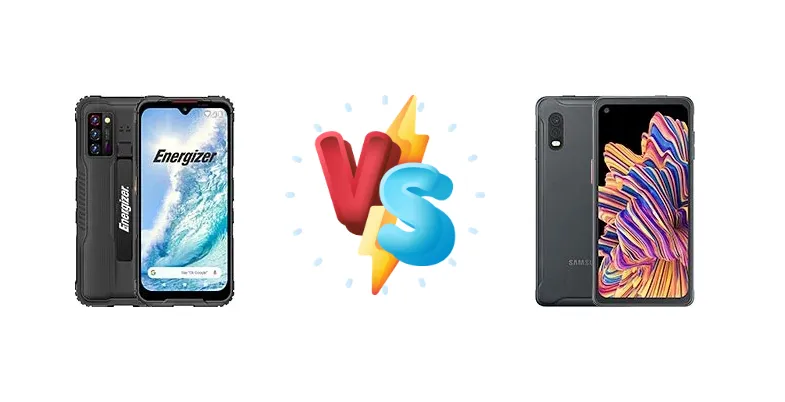
|
🏆 Quick Verdict
For most users needing a robust phone, the Energizer Hard Case G5 emerges as the stronger contender. Its Mediatek Dimensity 800U chipset offers a significant performance advantage over the Samsung Galaxy XCover Pro’s older Exynos 9611, translating to smoother multitasking and better gaming. While the XCover Pro benefits from Samsung’s software, the G5’s raw processing power provides a more future-proof experience.
| PHONES | ||
|---|---|---|
| Phone Names | Energizer Hard Case G5 | Samsung Galaxy XCover Pro |
| Network | ||
|---|---|---|
| 2G bands | GSM 850 / 900 / 1800 / 1900 | GSM 850 / 900 / 1800 / 1900 |
| 3G bands | HSDPA 850 / 900 / 1900 / 2100 | HSDPA 850 / 900 / 1900 / 2100 - International |
| 4G bands | 1, 2, 3, 5, 7, 8, 20, 28, 34, 38, 39, 40, 41 | 1, 2, 3, 5, 7, 8, 20, 28, 38, 40, 41 - International |
| 5G bands | 1, 3, 8, 28, 38, 41, 77, 78, 79 SA/NSA | - |
| Speed | HSPA, LTE, 5G | HSPA 42.2/5.76 Mbps, LTE (3CA) Cat11 600/50 Mbps |
| Technology | GSM / CDMA / HSPA / EVDO / LTE / 5G | GSM / HSPA / LTE |
| CDMA2000 1xEV-DO | 1, 2, 3, 4, 5, 7, 12, 13, 14, 20, 29, 38, 40, 41, 66 - Canada | |
| Launch | ||
|---|---|---|
| Announced | 2021, June 29. Released 2021, Q4 | 2020, January |
| Status | Discontinued | Available. Released 2020, January |
| Body | ||
|---|---|---|
| Dimensions | 167.7 x 78.2 x 13.7 mm (6.60 x 3.08 x 0.54 in) | 159.9 x 76.7 x 10 mm (6.30 x 3.02 x 0.39 in) |
| SIM | Nano-SIM + Nano-SIM | · Nano-SIM· Nano-SIM + Nano-SIM |
| Weight | - | 218 g (7.69 oz) |
| IP69 dust/water resistant (up to 1.2m for 30 min) Drop-to-concrete resistance from up to 1.2m | IP68 dust/water resistant (up to 1.5m for 35 min) Drop-to-concrete resistance from up to 1.5m MIL-STD-810G compliant* *does not guarantee ruggedness or use in extreme conditions | |
| Display | ||
|---|---|---|
| Protection | Corning Gorilla Glass 5 | Corning Gorilla Glass 5 |
| Resolution | 1080 x 2340 pixels, 19.5:9 ratio (~409 ppi density) | 1080 x 2340 pixels, 19.5:9 ratio (~409 ppi density) |
| Size | 6.3 inches, 97.4 cm2 (~74.3% screen-to-body ratio) | 6.3 inches, 97.4 cm2 (~79.4% screen-to-body ratio) |
| Type | IPS LCD | IPS LCD |
| Platform | ||
|---|---|---|
| CPU | Octa-core (2x2.0 GHz Cortex-A76 & 6x2.0 GHz Cortex-A55) | Octa-core (4x2.3 GHz Cortex-A73 & 4x1.7 GHz Cortex-A53) |
| Chipset | Mediatek Dimensity 800U (7 nm) | Exynos 9611 (10 nm) |
| GPU | Mali-G57 MC3 | Mali-G72 MP3 |
| OS | Android 11 | Android 10, upgradable to Android 13, One UI 5 |
| Memory | ||
|---|---|---|
| Card slot | microSDXC | microSDXC (dedicated slot) |
| Internal | 128GB 6GB RAM | 64GB 4GB RAM |
| eMMC 5.1 | - | |
| Main Camera | ||
|---|---|---|
| Dual | - | 25 MP, f/1.7, 26mm (wide), PDAF 8 MP, f/2.2, 123˚ (ultrawide), 1/4.0", 1.12µm |
| Features | LED flash | Dual-LED flash, HDR, panorama |
| Single | 8 MP | - |
| Triple | 48 MP, (wide), AF 20 MP, f/1.8 13 MP, f/2.4, (ultrawide) | - |
| Video | 1080p@30fps | 1080p@30fps |
| Selfie camera | ||
|---|---|---|
| Features | - | HDR |
| Single | 8 MP | 13 MP, f/2.0, (wide), 1/3.1", 1.12µm |
| Video | 1080p@30fps | 1080p@30fps |
| Sound | ||
|---|---|---|
| 3.5mm jack | No | Yes |
| 35mm jack | No | Yes |
| Loudspeaker | Yes | Yes |
| Comms | ||
|---|---|---|
| Bluetooth | 5.1, A2DP, LE | 5.0, A2DP, LE |
| NFC | Yes | Yes |
| Positioning | GPS | GPS, GLONASS, GALILEO, BDS |
| Radio | FM radio | FM radio (market/region dependent) |
| USB | USB Type-C 2.0, OTG | USB Type-C 2.0 |
| WLAN | Wi-Fi 802.11 a/b/g/n/ac, dual-band | Wi-Fi 802.11 a/b/g/n/ac/k/v/r, dual-band, Wi-Fi Direct |
| Features | ||
|---|---|---|
| Sensors | Fingerprint (rear-mounted), accelerometer, proximity, compass | Fingerprint (side-mounted), accelerometer, gyro, proximity, compass |
| - | ANT+ | |
| Battery | ||
|---|---|---|
| Charging | - | 15W wired |
| Type | Li-Po 5000 mAh | Li-Po 4050 mAh, removable |
| Misc | ||
|---|---|---|
| Colors | Black | Black |
| Models | - | SM-G715FN/DS, SM-G715FN, SM-G715F, SM-G715W, SM-G715U, SM-G715U1 |
| Price | About 500 EUR | About 120 EUR |
| SAR EU | - | 0.47 W/kg (head) 1.23 W/kg (body) |
Energizer Hard Case G5
- Significantly more powerful chipset (Dimensity 800U)
- More efficient 7nm process node
- Potentially better gaming performance
- Likely longer battery life due to chipset efficiency
- Unknown battery capacity
- Limited brand recognition compared to Samsung
Samsung Galaxy XCover Pro
- Samsung’s software ecosystem and potential for updates
- Established brand reputation
- 15W wired charging
- Rugged design
- Outdated Exynos 9611 chipset
- Slower performance compared to the G5
- Slow 15W charging
- Potentially limited software support in the long term
Display Comparison
Neither device boasts a cutting-edge display. Details regarding panel type, resolution, and refresh rate are absent for the G5, suggesting a standard LCD. The XCover Pro also utilizes an LCD. The key difference lies in processing power impacting UI smoothness. While both are likely to offer adequate outdoor visibility, the G5’s more powerful GPU could potentially drive higher brightness levels, though this is unconfirmed. Bezels are expected to be substantial on both, prioritizing durability over a modern, edge-to-edge design.
Camera Comparison
Camera details are sparse for both devices. The XCover Pro’s camera setup is likely more refined due to Samsung’s image processing expertise, but the G5’s chipset could offer faster image processing speeds. Without sensor size or aperture information, it’s difficult to make a definitive judgment. The presence of a 2MP macro camera on the XCover Pro is largely a marketing gimmick and unlikely to deliver significant image quality improvements. The G5’s image quality will likely be adequate for casual use, but the XCover Pro may offer slightly better results in optimal conditions.
Performance
The core of the difference lies in the chipsets. The Energizer G5’s Mediatek Dimensity 800U (7nm) is a clear upgrade over the Samsung Galaxy XCover Pro’s Exynos 9611 (10nm). The Dimensity 800U’s Cortex-A76 cores, clocked at 2.0 GHz, offer significantly better single-core performance than the XCover Pro’s Cortex-A73 cores at 2.3 GHz. The 7nm process node also provides superior power efficiency. The XCover Pro’s older architecture will struggle with demanding tasks and multitasking compared to the G5. The G5’s GPU will also provide a better gaming experience. While the XCover Pro has 4GB of RAM, the G5’s RAM configuration is unknown, but the chipset advantage will be the dominant factor.
Battery Life
Battery capacity is unknown for the G5, while the XCover Pro supports 15W wired charging. The Dimensity 800U’s power efficiency should translate to longer battery life on the G5, even with a potentially smaller battery capacity. The XCover Pro’s 15W charging is relatively slow by modern standards, requiring a significant amount of time to reach a full charge. The G5’s chipset advantage will likely result in more efficient power consumption during both active use and standby.
Buying Guide
Buy the Energizer Hard Case G5 if you prioritize performance for demanding applications, occasional gaming, and want a more modern chipset. This phone is ideal for users who need a responsive device for work or play. Buy the Samsung Galaxy XCover Pro if you value Samsung’s software ecosystem, reliable updates (though potentially limited), and prefer a brand with a strong track record in the Android space, even if it means sacrificing some processing power.