
Motorola Defy 2 vs. Energizer Hard Case G5: A Deep Dive into Mid-Range Rugged Performance
| Phones Images | |||||
|---|---|---|---|---|---|
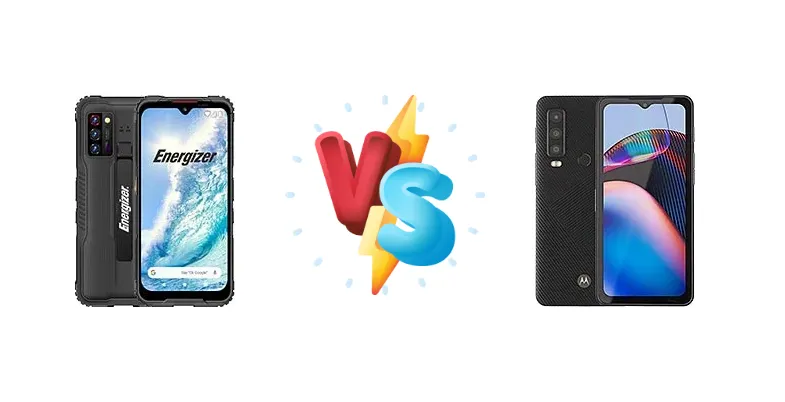
|
🏆 Quick Verdict
For most users, the Motorola Defy 2 emerges as the superior choice. Its Dimensity 930 chipset provides a noticeable performance uplift over the G5’s Dimensity 800U, and the addition of 15W wireless charging adds a convenience factor the Energizer lacks. While both prioritize durability, the Defy 2 offers a more modern and capable experience.
| PHONES | ||
|---|---|---|
| Phone Names | Energizer Hard Case G5 | Motorola Defy 2 |
| Network | ||
|---|---|---|
| 2G bands | GSM 850 / 900 / 1800 / 1900 | GSM 850 / 900 / 1800 / 1900 |
| 3G bands | HSDPA 850 / 900 / 1900 / 2100 | HSDPA 850 / 900 / 1700(AWS) / 1900 / 2100 |
| 4G bands | 1, 2, 3, 5, 7, 8, 20, 28, 34, 38, 39, 40, 41 | 1, 2, 3, 4, 5, 7, 8, 12, 13, 14, 17, 20, 25, 26, 28, 30, 38, 40, 41, 46, 48, 66, 71 |
| 5G bands | 1, 3, 8, 28, 38, 41, 77, 78, 79 SA/NSA | 2, 5, 23, 25, 26, 28, 38, 41, 48, 66, 70, 71, 77, 78, 255, 256 SA/NSA/Sub6/mmWave |
| Speed | HSPA, LTE, 5G | HSPA, LTE, 5G |
| Technology | GSM / CDMA / HSPA / EVDO / LTE / 5G | GSM / HSPA / LTE / 5G |
| CDMA2000 1xEV-DO | - | |
| Launch | ||
|---|---|---|
| Announced | 2021, June 29. Released 2021, Q4 | 2023, February 24 |
| Status | Discontinued | Available. Released 2023, October |
| Body | ||
|---|---|---|
| Build | - | Glass front (Gorilla Glass Victus), plastic back, aluminum frame |
| Dimensions | 167.7 x 78.2 x 13.7 mm (6.60 x 3.08 x 0.54 in) | 171 x 80 x 11.9 mm (6.73 x 3.15 x 0.47 in) |
| SIM | Nano-SIM + Nano-SIM | Nano-SIM + Nano-SIM |
| Weight | - | 268 g (9.45 oz) |
| IP69 dust/water resistant (up to 1.2m for 30 min) Drop-to-concrete resistance from up to 1.2m | IP68/IP69 dust/water resistant (up to 5m for 35 min) Drop-to-concrete resistance from up to 1.8m MIL-STD-810H compliant | |
| Display | ||
|---|---|---|
| Protection | Corning Gorilla Glass 5 | Corning Gorilla Glass Victus |
| Resolution | 1080 x 2340 pixels, 19.5:9 ratio (~409 ppi density) | 1080 x 2408 pixels, 20:9 ratio (~400 ppi density) |
| Size | 6.3 inches, 97.4 cm2 (~74.3% screen-to-body ratio) | 6.6 inches, 104.9 cm2 (~76.7% screen-to-body ratio) |
| Type | IPS LCD | IPS LCD, 120Hz |
| Platform | ||
|---|---|---|
| CPU | Octa-core (2x2.0 GHz Cortex-A76 & 6x2.0 GHz Cortex-A55) | Octa-core (2x2.2 GHz Cortex-A78 & 6x2.0 GHz Cortex-A55) |
| Chipset | Mediatek Dimensity 800U (7 nm) | Mediatek Dimensity 930 (6 nm) |
| GPU | Mali-G57 MC3 | IMG BXM-8-256 |
| OS | Android 11 | Android 12 |
| Memory | ||
|---|---|---|
| Card slot | microSDXC | microSDXC (uses shared SIM slot) |
| Internal | 128GB 6GB RAM | 128GB 6GB RAM |
| eMMC 5.1 | - | |
| Main Camera | ||
|---|---|---|
| Features | LED flash | Dual-LED flash, HDR, panorama |
| Single | 8 MP | - |
| Triple | 48 MP, (wide), AF 20 MP, f/1.8 13 MP, f/2.4, (ultrawide) | 50 MP, f/1.8, (wide), PDAF 8 MP, f/2.2, (ultrawide) 2 MP (macro) |
| Video | 1080p@30fps | 1080p@30fps |
| Selfie camera | ||
|---|---|---|
| Single | 8 MP | 8 MP, f/2.0, (wide) |
| Video | 1080p@30fps | 1080p@30fps |
| Sound | ||
|---|---|---|
| 3.5mm jack | No | No |
| 35mm jack | No | No |
| Loudspeaker | Yes | Yes |
| Comms | ||
|---|---|---|
| Bluetooth | 5.1, A2DP, LE | 5.1, A2DP, LE |
| NFC | Yes | Yes |
| Positioning | GPS | GPS (L1+L5), GLONASS, GALILEO, BDS |
| Radio | FM radio | Unspecified |
| USB | USB Type-C 2.0, OTG | USB Type-C 2.0, OTG |
| WLAN | Wi-Fi 802.11 a/b/g/n/ac, dual-band | Wi-Fi 802.11 a/b/g/n/ac, dual-band |
| Features | ||
|---|---|---|
| Sensors | Fingerprint (rear-mounted), accelerometer, proximity, compass | Fingerprint (rear-mounted), accelerometer, gyro, proximity, compass |
| - | Emergency SOS via satellite (Bullitt Satellite Connect service) | |
| Battery | ||
|---|---|---|
| Charging | - | 15W wireless |
| Type | Li-Po 5000 mAh | Li-Po 5000 mAh |
| Misc | ||
|---|---|---|
| Colors | Black | Black |
| Models | - | BM1S1B |
| Price | About 500 EUR | About 570 EUR |
Energizer Hard Case G5
- Potentially lower price point
- Rugged design for durability
- Reliable Mediatek Dimensity 800U chipset
- Older chipset with lower performance
- No wireless charging
- Likely less advanced camera system
Motorola Defy 2
- More powerful Mediatek Dimensity 930 chipset
- 15W wireless charging support
- Improved power efficiency for longer battery life
- Potentially higher price
- Rugged design may add bulk
- Software support may be limited
Display Comparison
Neither device’s display specifications are provided, so a direct comparison is limited. However, given the market positioning, we can infer the Energizer G5 likely utilizes an LCD panel, while the Defy 2 may incorporate a more advanced IPS LCD. The chipset difference suggests the Defy 2 could potentially support a higher refresh rate, leading to smoother scrolling and animations. Bezels are likely similar, focusing on impact resistance rather than minimizing size. Color accuracy will likely be adequate for both, prioritizing visibility in outdoor conditions over color fidelity.
Camera Comparison
Without specific camera sensor details, a detailed comparison is challenging. However, the Dimensity 930 in the Defy 2 generally supports more advanced image signal processors (ISPs) than the Dimensity 800U. This means the Defy 2 is likely to offer better image processing capabilities, resulting in improved dynamic range, noise reduction, and overall image quality. The ISP can also enable features like faster autofocus and more sophisticated computational photography techniques. It’s reasonable to assume the Defy 2 will have a more capable main camera sensor, potentially with optical image stabilization (OIS), which the G5 may lack. The inclusion of a 2MP macro camera on either device is unlikely to significantly impact image quality and should be considered a secondary feature.
Performance
The Motorola Defy 2’s Mediatek Dimensity 930 (6nm) represents a significant step up from the Energizer G5’s Dimensity 800U (7nm). The 6nm process node inherently offers better power efficiency, translating to improved battery life and reduced thermal throttling under sustained loads. The Defy 2’s CPU configuration – 2x2.2 GHz Cortex-A78 cores paired with 6x2.0 GHz Cortex-A55 cores – provides a performance advantage over the G5’s 2x2.0 GHz Cortex-A76 and 6x2.0 GHz Cortex-A55 setup. The A78 cores are architecturally superior, delivering more instructions per clock cycle. This translates to faster app loading times, smoother multitasking, and a more responsive overall user experience, particularly for demanding applications and games. While both phones likely feature similar RAM configurations, the Defy 2’s chipset will be able to manage that RAM more efficiently.
Battery Life
Battery capacity isn’t specified for either device, but the Dimensity 930’s superior power efficiency in the Defy 2 will likely result in longer battery life despite potentially having a similar capacity to the G5. The Defy 2’s inclusion of 15W wireless charging is a significant advantage, offering a convenient alternative to wired charging. The G5 is limited to wired charging only, which is less versatile. While 15W isn’t exceptionally fast, it’s a valuable feature for users who frequently travel or prefer a cable-free charging experience. The 6nm process of the Dimensity 930 will also contribute to reduced heat generation during charging, potentially extending battery lifespan.
Buying Guide
Buy the Energizer Hard Case G5 if your primary concern is absolute affordability and you need a basic, durable phone for essential tasks. It’s a solid option for those on a tight budget who prioritize longevity over cutting-edge performance. Buy the Motorola Defy 2 if you value a smoother user experience, faster processing speeds for multitasking and gaming, and the convenience of wireless charging. It’s ideal for users who need a rugged phone that can keep up with their active lifestyle without compromising on functionality.