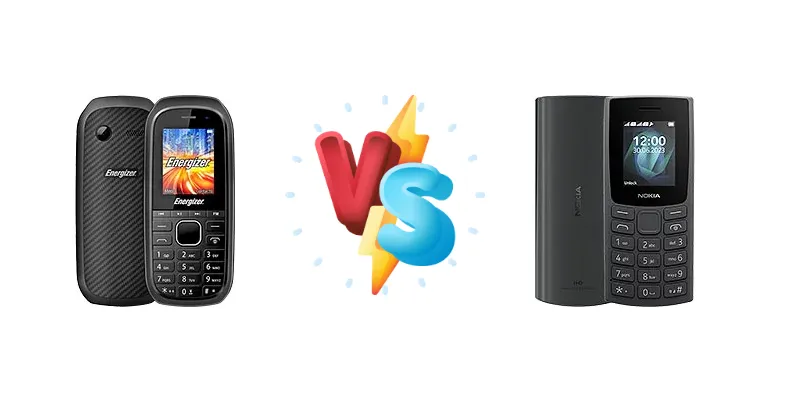
In a market saturated with expensive smartphones, the Energizer Energy E12 and Nokia 105 4G 2nd Edition represent a return to simplicity and affordability. This comparison focuses on the core functionality and value proposition of these two devices, catering to users prioritizing basic communication and extended battery life over advanced features.
🏆 Quick Verdict
For users needing confirmed specifications and a known chipset, the Energizer Energy E12 is the better choice, offering a Spreadtrum SC6531E processor. The Nokia 105 4G 2nd Edition relies on Nokia's brand recognition and presumed reliability for basic 4G connectivity, but lacks detailed public specifications.
| Network |
|---|
| 2G bands | GSM 850 / 900 / 1800 / 1900 | GSM 900 / 1800 |
| 3G bands | - | HSDPA 850 / 900 / 1700(AWS) / 1900 / 2100 |
| 4G bands | - | LTE |
| EDGE | Yes | - |
| GPRS | Yes | - |
| Speed | - | HSPA, LTE |
| Technology | GSM | GSM / HSPA / LTE |
| Launch |
|---|
| Announced | 2019, April. Released 2019, June | 2024, December |
| Status | Discontinued | Available. Released 2024, December |
| Body |
|---|
| Dimensions | 117 x 51 x 15 mm (4.61 x 2.01 x 0.59 in) | 121.5 x 50 x 14.4 mm (4.78 x 1.97 x 0.57 in) |
| SIM | Dual SIM (Mini-SIM) | · Nano-SIM· Nano-SIM + Nano-SIM |
| Weight | 91 g (3.21 oz) | 93 g (3.28 oz) |
| | - Flashlight | - |
| Display |
|---|
| Resolution | 128 x 160 pixels (~114 ppi density) | 120 x 160 pixels, 4:3 ratio (~111 ppi density) |
| Size | 1.8 inches, 10.2 cm2 (~17.1% screen-to-body ratio) | 1.8 inches, 10.0 cm2 (~16.5% screen-to-body ratio) |
| Type | TFT LCD, 256K colors | IPS LCD |
| Platform |
|---|
| Chipset | Spreadtrum SC6531E | - |
| Memory |
|---|
| Call records | Yes | Yes |
| Card slot | microSDHC | microSDHC |
| Internal | 4MB 4MB RAM | 48MB 128MB RAM |
| Phonebook | Yes | Yes |
| Main Camera |
|---|
| Single | VGA | - |
| Video | Yes | - |
| Sound |
|---|
| 3.5mm jack | Yes | - |
| 35mm jack | Yes | Yes |
| Loudspeaker | Yes | Yes |
| Comms |
|---|
| Bluetooth | 2.1 | 5.0, A2DP |
| NFC | No | No |
| Positioning | No | No |
| Radio | FM radio | Wireless FM radio |
| USB | microUSB 2.0 | USB Type-C |
| WLAN | No | No |
| Features |
|---|
| Games | - | Yes |
| Java | No | No |
| Messaging | SMS, MMS | SMS |
| Battery |
|---|
| Type | Li-Ion 1000 mAh battery | Li-Ion 1450 mAh, removable |
| Misc |
|---|
| Colors | Black | Charcoal |
| Price | About 10 EUR | About 50 EUR |
Energizer Energy E12
- Known chipset (Spreadtrum SC6531E) provides transparency.
- Potential for software updates due to chipset documentation.
- Energizer brand recognition for battery life.
- Likely limited features beyond basic communication.
- Display quality will be basic.
Nokia 105 4G 2nd Edition
- Nokia's reputation for durability and reliability.
- Minimalist user experience.
- Compact and lightweight design.
- Lack of publicly available specifications.
- Uncertain chipset performance and capabilities.
Display Comparison
Neither device is expected to feature a high-resolution or color-accurate display. Both will likely utilize basic LCD panels optimized for readability rather than visual fidelity. Given the lack of specifications for the Nokia 105 4G 2nd Edition, it's reasonable to assume a similar display quality to the Energizer E12, prioritizing power efficiency over visual experience. Bezels will be substantial on both devices, maximizing screen real estate within their compact form factors.
Camera Comparison
Both devices are unlikely to offer compelling camera experiences. Any camera present will be primarily for basic image capture, and image quality will be limited by low-resolution sensors and lack of image stabilization. Focusing on camera performance is irrelevant for these devices; their primary function is communication, not photography.
Performance
The Energizer Energy E12's Spreadtrum SC6531E chipset provides a defined level of performance, enabling basic 4G connectivity, calling, and texting. The Nokia 105 4G 2nd Edition's chipset remains unspecified, but given its market positioning, it's likely a similarly low-power solution focused on essential functions. The SC6531E's architecture, while not powerful, allows for a degree of software optimization and potential feature expansion that the Nokia device may lack due to its unknown hardware.
Battery Life
Both phones are designed for exceptional battery life, prioritizing days of standby time over rapid charging. The Energizer brand often emphasizes battery capacity, but without specific mAh ratings for either device, it's difficult to definitively compare. The low-power chipsets and basic displays contribute significantly to their longevity. Charging times will likely be slow, reflecting the low wattage charging capabilities typical of these devices.
Buying Guide
Buy the Energizer Energy E12 if you need a feature phone with a documented chipset for compatibility and potential software updates. This is ideal for users who want a degree of certainty in their device's capabilities. Buy the Nokia 105 4G 2nd Edition if you prioritize brand trust and a minimalist experience, accepting that detailed specifications are unavailable and relying on Nokia's reputation for durable, basic phones.
Frequently Asked Questions
❓ What network bands does the Energizer Energy E12 support?
The Energizer Energy E12, powered by the Spreadtrum SC6531E, supports standard 2G, 3G, and 4G LTE bands commonly used by most carriers. Specific band compatibility will vary by region, so checking with your carrier is recommended.
❓ Does the Nokia 105 4G 2nd Edition support VoLTE (Voice over LTE)?
While Nokia typically includes VoLTE support in its 4G devices, the lack of detailed specifications for the 105 4G 2nd Edition makes it uncertain. VoLTE compatibility is crucial for continued voice service on some carrier networks as they phase out 3G.
❓ Can I use WhatsApp on either of these phones?
Basic WhatsApp functionality is possible on both devices, but the experience will be limited. The phones need to support the WhatsApp application, and the small screen size and limited processing power will impact usability. Expect slow loading times and a less-than-ideal user interface.