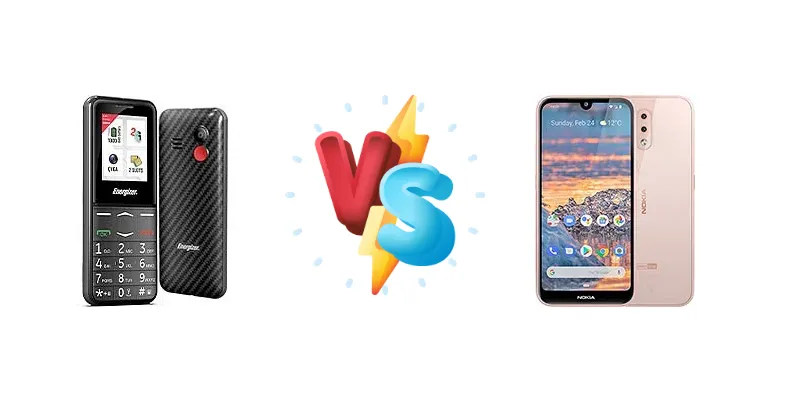
The Energizer E4 and Nokia 4.2 represent the extreme end of the budget smartphone market. While both aim to deliver essential smartphone functionality at a low price, they take drastically different approaches to achieving this. The E4 relies on the Unisoc SC6531DA, while the Nokia 4.2 leverages Qualcomm’s Snapdragon 439. This comparison dissects these choices, revealing which phone offers the best experience for the money.
🏆 Quick Verdict
For the average user prioritizing responsiveness and a smoother overall experience, the Nokia 4.2 is the clear winner. Its Snapdragon 439 chipset, with its octa-core configuration and 12nm process, provides a substantial performance advantage over the Energizer E4’s aging Unisoc SC6531DA, making everyday tasks noticeably faster.
| Network |
|---|
| 2G bands | GSM 850 / 900 / 1800 / 1900 | GSM 850 / 900 / 1800 / 1900 |
| 3G bands | N/A | HSDPA 850 / 900 / 2100 - Global |
| 4G bands | N/A | 1, 3, 5, 7, 8, 20, 28, 38, 40, 41 - EMEA, APAC, MENA |
| EDGE | No | - |
| GPRS | Yes | - |
| Speed | No | HSPA 42.2/5.76 Mbps, LTE Cat4 150/50 Mbps |
| Technology | GSM | GSM / HSPA / LTE |
| | - | 1, 3, 5, 8, 40, 41 - India |
| Launch |
|---|
| Announced | 2022, June | 2019, February 24. Released 2019, May 07 |
| Status | Available. Released 2022, August | Discontinued |
| Body |
|---|
| Build | - | Glass front, glass back, plastic frame |
| Dimensions | 115 x 46 x 13.5 mm (4.53 x 1.81 x 0.53 in) | 149 x 71.3 x 8.4 mm (5.87 x 2.81 x 0.33 in) |
| SIM | Dual SIM (Mini-SIM, dual stand-by) | Nano-SIM + Nano-SIM |
| Weight | 65 g (2.29 oz) | 161 g (5.68 oz) |
| Display |
|---|
| Resolution | 128 x 160 pixels (~116 ppi density) | 720 x 1520 pixels, 19:9 ratio (~295 ppi density) |
| Size | 1.77 inches, 9.9 cm2 (~18.6% screen-to-body ratio) | 5.71 inches, 81.4 cm2 (~76.6% screen-to-body ratio) |
| Type | TFT | IPS LCD |
| Platform |
|---|
| CPU | 312 MHz | Octa-core (4x1.95 GHz Cortex-A53 & 4x1.45 GHz Cortex A53) |
| Chipset | Unisoc SC6531DA | Qualcomm SDM439 Snapdragon 439 (12 nm) |
| GPU | - | Adreno 505 |
| OS | - | Android 9.0 (Pie), upgradable to Android 11, Android One |
| Memory |
|---|
| Call records | Yes | - |
| Card slot | microSDHC | microSDXC (dedicated slot) |
| Internal | 4MB | 16GB 2GB RAM, 32GB 3GB RAM |
| Phonebook | Yes | - |
| | - | eMMC 5.1 |
| Main Camera |
|---|
| Dual | - | 13 MP, f/2.2, 1/3.1", 1.12µm, PDAF
Auxiliary lens |
| Features | - | LED flash |
| Single | QVGA | - |
| Video | Yes | 1080p@30fps |
| Selfie camera |
|---|
| Single | - | 8 MP, f/2.0, 1/4.0", 1.12µm |
| Video | - | 1080p@30fps |
| Sound |
|---|
| 3.5mm jack | Yes | Yes |
| 35mm jack | Yes | Yes |
| Loudspeaker | Yes | Yes |
| Comms |
|---|
| Bluetooth | 2.0 | 4.2, A2DP, LE, aptX |
| NFC | No | Yes (market dependent) |
| Positioning | No | GPS, GLONASS, BDS |
| Radio | FM radio | FM radio |
| USB | microUSB | microUSB 2.0, OTG |
| WLAN | No | Wi-Fi 802.11 b/g/n |
| Features |
|---|
| Java | No | - |
| Messaging | SMS | - |
| Sensors | No | Fingerprint (rear-mounted), accelerometer, proximity |
| | SOS feature | - |
| Battery |
|---|
| Type | Li-Ion 1000 mAh battery, removable | Li-Ion 3000 mAh, non-removable |
| Misc |
|---|
| Colors | Black, Blue, Red, Gold, Silver | Black, Pink Sand |
| Models | - | TA-1184, TA-1133, TA-1149, TA-1150, TA-1157, TA-1152 |
| Price | About 10 EUR | About 130 EUR |
| SAR | - | 0.43 W/kg (head) 1.08 W/kg (body) |
| SAR EU | - | 0.45 W/kg (head) 1.53 W/kg (body) |
Energizer E4
- Lowest possible price point
- Potentially longer battery life due to simpler hardware
- Basic smartphone functionality
- Extremely limited performance
- Laggy user experience
- Outdated chipset
Nokia 4.2
- Significantly faster performance
- Smoother user experience
- More efficient chipset
- Slightly higher price
- May not have significantly better battery life than E4
- Still an entry-level device
Display Comparison
Neither device is expected to boast a high-end display. Specifics are missing, but given the price point, both likely feature LCD panels. However, the Nokia 4.2 benefits from the more modern Snapdragon 439’s image signal processor (ISP), potentially leading to slightly better color reproduction and image processing for photos viewed on the screen. The Energizer E4’s display is likely limited by the Unisoc chipset’s less capable ISP.
Camera Comparison
Without detailed camera specifications, it’s difficult to make a definitive judgment. However, the Nokia 4.2’s Snapdragon 439 includes a more advanced ISP, which will likely result in better image processing, dynamic range, and noise reduction compared to the Energizer E4. While both phones likely feature basic camera sensors, the Qualcomm chipset’s superior image processing capabilities will give the Nokia 4.2 an edge in real-world photo quality. Expect any 'macro' lenses on either device to be of limited utility.
Performance
The performance gap is the most significant differentiator. The Energizer E4’s Unisoc SC6531DA, with its single-core 312 MHz CPU, is severely outmatched by the Nokia 4.2’s Snapdragon 439. The Snapdragon 439’s octa-core configuration (4x1.95 GHz Cortex-A53 & 4x1.45 GHz Cortex A53) provides a substantial boost in multi-tasking and app loading times. The 12nm manufacturing process of the Snapdragon 439 also contributes to better power efficiency and potentially less thermal throttling compared to the likely larger node process used for the Unisoc chip. This translates to a smoother, more responsive user experience on the Nokia 4.2.
Battery Life
Battery life will depend heavily on usage patterns. While mAh capacity isn’t specified for either device, the Snapdragon 439’s 12nm process generally offers better power efficiency than older, larger-node chipsets. This means the Nokia 4.2 could potentially achieve comparable or even better battery life despite having a similar or smaller battery capacity than the Energizer E4. Charging speeds are also likely to be slow on both devices, given their budget nature.
Buying Guide
Buy the Energizer E4 if you absolutely need the lowest possible price and are willing to tolerate significant performance limitations. It’s suitable for very basic tasks like calls, texts, and light web browsing. Buy the Nokia 4.2 if you value a more responsive user experience, even for simple tasks, and want a phone capable of handling occasional social media browsing and light app usage without frustrating lag.
Frequently Asked Questions
❓ Will the Nokia 4.2 struggle with popular apps like Facebook or WhatsApp?
While the Snapdragon 439 isn't a powerhouse, it's capable of running apps like Facebook and WhatsApp reasonably well. Expect some loading times and occasional lag, but it should be usable for basic social media interaction. The Energizer E4 will likely struggle significantly more with these apps.
❓ Is the Unisoc SC6531DA chipset in the Energizer E4 suitable for gaming?
No, the Unisoc SC6531DA is not suitable for gaming. Its limited processing power and graphics capabilities will result in extremely low frame rates and a poor gaming experience, even with simple 2D games. The Nokia 4.2 can handle very light gaming, but don't expect to play demanding titles.
❓ How much storage does each phone typically offer, and can it be expanded?
While not specified, both phones likely come with 16GB or 32GB of internal storage. Crucially, both are expected to support microSD card expansion, which is essential given the limited internal storage. This allows users to add more space for photos, videos, and apps.
❓ What version of Android do these phones run, and will they receive updates?
The Nokia 4.2 originally launched with Android 9 Pie and was part of the Android One program, promising at least two years of OS updates and three years of security patches. The Energizer E4 likely runs an older version of Android and is unlikely to receive significant updates. This is a major advantage for the Nokia 4.2 in terms of security and features.