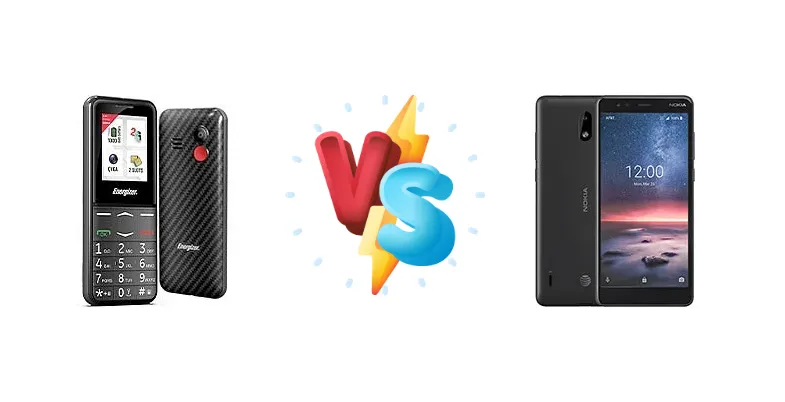
The Energizer E4 and Nokia 3.1 A represent the extreme end of the smartphone price spectrum. Both aim to deliver basic functionality at an incredibly low cost, but they achieve this with vastly different approaches to processing power. This comparison dissects the core hardware differences – specifically the Unisoc SC6531DA in the E4 versus the Qualcomm Snapdragon 429 in the 3.1 A – to determine which device offers the best user experience for the money.
🏆 Quick Verdict
For the average user, the Nokia 3.1 A is the superior choice. While both phones are entry-level, the Snapdragon 429’s quad-core Cortex-A53 architecture running at 1.8 GHz provides a significantly smoother and more responsive experience than the Energizer E4’s aging 312 MHz Unisoc SC6531DA. The 10W charging is a bonus, offering a faster path to a full charge.
| Network |
|---|
| 2G bands | GSM 850 / 900 / 1800 / 1900 | GSM 850 / 900 / 1800 / 1900 |
| 3G bands | N/A | HSDPA 850 / 1700(AWS) / 1900 |
| 4G bands | N/A | 2, 4, 5, 12, 14, 29, 30 |
| EDGE | No | - |
| GPRS | Yes | - |
| Speed | No | HSPA 42.2/5.76 Mbps, LTE Cat4 150/50 Mbps |
| Technology | GSM | GSM / HSPA / LTE |
| Launch |
|---|
| Announced | 2022, June | 2019, June. Released 2019, June |
| Status | Available. Released 2022, August | Discontinued |
| Body |
|---|
| Dimensions | 115 x 46 x 13.5 mm (4.53 x 1.81 x 0.53 in) | 152.7 x 71.9 x 9.4 mm (6.01 x 2.83 x 0.37 in) |
| SIM | Dual SIM (Mini-SIM, dual stand-by) | Nano-SIM |
| Weight | 65 g (2.29 oz) | 156 g (5.50 oz) |
| Display |
|---|
| Resolution | 128 x 160 pixels (~116 ppi density) | 720 x 1440 pixels, 18:9 ratio (~295 ppi density) |
| Size | 1.77 inches, 9.9 cm2 (~18.6% screen-to-body ratio) | 5.45 inches, 76.7 cm2 (~69.8% screen-to-body ratio) |
| Type | TFT | IPS LCD |
| Platform |
|---|
| CPU | 312 MHz | Quad-core 1.8 GHz Cortex-A53 |
| Chipset | Unisoc SC6531DA | Qualcomm SDM429 Snapdragon 429 (12 nm) |
| GPU | - | Adreno 504 |
| OS | - | Android 9.0 (Pie) |
| Memory |
|---|
| Call records | Yes | - |
| Card slot | microSDHC | microSDXC (dedicated slot) |
| Internal | 4MB | 32GB 2GB RAM |
| Phonebook | Yes | - |
| | - | eMMC 5.1 |
| Main Camera |
|---|
| Features | - | LED flash, HDR, panorama |
| Single | QVGA | 8 MP, f/2.0, AF |
| Video | Yes | 1080p@30fps |
| Selfie camera |
|---|
| Features | - | HDR |
| Single | - | 5 MP, f/2.2 |
| Video | - | 720p@30fps |
| Sound |
|---|
| 3.5mm jack | Yes | Yes |
| 35mm jack | Yes | Yes |
| Loudspeaker | Yes | Yes |
| Comms |
|---|
| Bluetooth | 2.0 | 5.0, A2DP, LE |
| NFC | No | No |
| Positioning | No | GPS, GLONASS, BDS |
| Radio | FM radio | FM radio |
| USB | microUSB | USB Type-C 2.0 |
| WLAN | No | Wi-Fi 802.11 b/g/n |
| Features |
|---|
| Java | No | - |
| Messaging | SMS | - |
| Sensors | No | Accelerometer, gyro, proximity |
| | SOS feature | - |
| Battery |
|---|
| Charging | - | 10W wired |
| Type | Li-Ion 1000 mAh battery, removable | Li-Ion 2990 mAh, non-removable |
| Misc |
|---|
| Colors | Black, Blue, Red, Gold, Silver | Black |
| Models | - | TA1140 |
| Price | About 10 EUR | - |
| SAR | - | 1.11 W/kg (head) 0.81 W/kg (body) |
Energizer E4
- Potentially the absolute lowest price point.
- Functional for basic calling and texting.
- May have longer standby time due to lower power CPU (though this is offset by inefficiency).
- Extremely slow processor (312 MHz).
- Laggy user interface.
- Poor multitasking capabilities.
- Likely limited software support.
Nokia 3.1 A
- Significantly faster processor (1.8 GHz quad-core).
- More responsive user experience.
- 10W wired charging.
- Better software support from Nokia.
- More efficient 12nm process.
- Still an entry-level device with limitations.
- May not be suitable for demanding apps or games.
- Potentially slightly higher price than the E4.
Display Comparison
Neither device boasts a standout display. Given the price point, details like panel type and resolution are not provided. However, the focus should be on usability, and a faster processor (Nokia 3.1 A) will contribute more to a smooth UI experience than display improvements in this segment. Expect both to have basic LCD panels.
Camera Comparison
Both devices likely feature basic camera setups geared towards casual snapshots. Without specific sensor details, it’s difficult to make a direct comparison. However, the processing power of the Snapdragon 429 in the Nokia 3.1 A will likely result in slightly better image processing and faster capture times. Expect both to struggle in low-light conditions. The presence of a 2MP macro camera on either device is largely a marketing gimmick and should not be a deciding factor.
Performance
The performance gap is the defining characteristic of this comparison. The Nokia 3.1 A’s Qualcomm Snapdragon 429, built on a 12nm process, features a quad-core 1.8 GHz Cortex-A53 CPU. This is a modern, efficient architecture designed for entry-level smartphones. In contrast, the Energizer E4 utilizes the Unisoc SC6531DA with a drastically slower 312 MHz CPU. This difference translates to significantly slower app loading times, sluggish multitasking, and an overall less responsive user experience on the E4. The 12nm process of the Snapdragon 429 also implies better thermal efficiency, reducing the likelihood of performance throttling during sustained use.
Battery Life
Battery capacity isn't specified for either device. However, the Nokia 3.1 A benefits from 10W wired charging, which will significantly reduce charging times compared to the likely slower charging capabilities of the Energizer E4. While a larger battery capacity is always preferable, the efficiency of the Snapdragon 429 could offset a slightly smaller battery size in the Nokia 3.1 A, resulting in comparable real-world battery life.
Buying Guide
Buy the Energizer E4 if your primary need is a functional phone for extremely basic tasks like calls and texts, and you prioritize absolute lowest cost above all else. It's a 'dumbphone-plus' experience. Buy the Nokia 3.1 A if you want a smartphone that can handle light multitasking, social media browsing, and occasional app usage without frustrating lag. The Snapdragon 429 offers a tangible performance advantage for everyday use.
Frequently Asked Questions
❓ Will the Nokia 3.1 A be able to run popular social media apps like Facebook and Instagram smoothly?
Yes, the Snapdragon 429 in the Nokia 3.1 A is capable of running Facebook and Instagram without significant lag. While it won't offer a high-end experience, it will provide a usable and reasonably smooth experience for browsing and basic interactions. The Energizer E4’s processor is likely to struggle with these apps.
❓ Is the Energizer E4 suitable for someone who primarily uses their phone for making calls and sending texts?
Yes, the Energizer E4 is perfectly adequate for basic calling and texting. Its slow processor won't be a hindrance for these core functions. However, if you anticipate using any apps beyond basic communication, the Nokia 3.1 A is a far better choice.
❓ Can I expect regular software updates on the Nokia 3.1 A?
Nokia has a relatively good track record for providing software updates, even on their budget devices. While you shouldn't expect the same level of support as a flagship phone, the Nokia 3.1 A is more likely to receive security patches and potentially even Android version updates compared to the Energizer E4, which likely has limited software support.