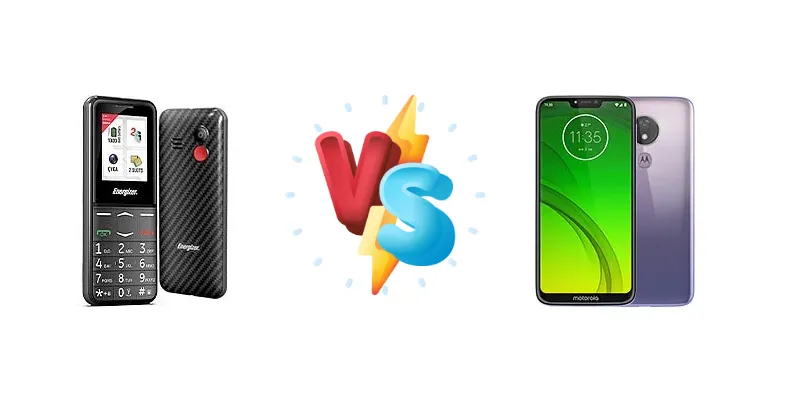
The Energizer E4 and Motorola Moto G7 Power represent opposite ends of the ultra-budget smartphone spectrum. The E4 prioritizes extreme affordability, while the Moto G7 Power aims for a balance of features, notably extended battery life. This comparison dissects their core components to determine which device best suits users seeking a functional, no-frills mobile experience.
🏆 Quick Verdict
For the average user needing a functional, reliable smartphone, the Motorola Moto G7 Power is the clear winner. Its Qualcomm Snapdragon 632 chipset provides a significantly smoother experience than the Energizer E4’s Unisoc SC6531DA, making everyday tasks more responsive despite the similar battery endurance ratings.
| Network |
|---|
| 2G bands | GSM 850 / 900 / 1800 / 1900 | GSM 850 / 900 / 1800 / 1900 |
| 3G bands | N/A | HSDPA 850 / 900 / 1900 / 2100 - Europe |
| 4G bands | N/A | 1, 2, 3, 4, 5, 7, 8, 19, 20, 28, 38, 40, 41 - Europe |
| EDGE | No | - |
| GPRS | Yes | - |
| Speed | No | HSPA 42.2/5.76 Mbps, LTE (2CA) Cat7 300/50 Mbps |
| Technology | GSM | GSM / HSPA / LTE |
| Launch |
|---|
| Announced | 2022, June | 2019, February 07. Released 2019, February 15 |
| Status | Available. Released 2022, August | Discontinued |
| Body |
|---|
| Build | - | Glass front (Gorilla Glass 3), plastic back, plastic frame |
| Dimensions | 115 x 46 x 13.5 mm (4.53 x 1.81 x 0.53 in) | 159.4 x 76 x 9.3 mm (6.28 x 2.99 x 0.37 in) |
| SIM | Dual SIM (Mini-SIM, dual stand-by) | · Nano-SIM· Nano-SIM + Nano-SIM |
| Weight | 65 g (2.29 oz) | 193 g (6.81 oz) |
| Display |
|---|
| Protection | - | Corning Gorilla Glass 3 (market dependent) |
| Resolution | 128 x 160 pixels (~116 ppi density) | 720 x 1570 pixels, 19.5:9 ratio (~279 ppi density) |
| Size | 1.77 inches, 9.9 cm2 (~18.6% screen-to-body ratio) | 6.2 inches, 94.0 cm2 (~77.6% screen-to-body ratio) |
| Type | TFT | IPS LCD |
| Platform |
|---|
| CPU | 312 MHz | Octa-core (4x1.8 GHz Kryo 250 Gold & 4x1.8 GHz Kryo 250 Silver) |
| Chipset | Unisoc SC6531DA | Qualcomm SDM632 Snapdragon 632 (14 nm) |
| GPU | - | Adreno 506 |
| OS | - | Android 9.0 (Pie), upgradable to Android 10 |
| Memory |
|---|
| Call records | Yes | - |
| Card slot | microSDHC | microSDXC (dedicated slot) |
| Internal | 4MB | 32GB 3GB RAM, 64GB 3GB RAM, 64GB 4GB RAM |
| Phonebook | Yes | - |
| Main Camera |
|---|
| Features | - | LED flash, panorama, HDR |
| Single | QVGA | 12 MP, f2.0, 1/2.8", 1.25µm, PDAF |
| Video | Yes | 4K@30fps, 1080p@30fps |
| Selfie camera |
|---|
| Features | - | HDR |
| Single | - | 8 MP, f/2.2, 1/4.0", 1.12µm |
| Video | - | 1080p@30fps |
| Sound |
|---|
| 3.5mm jack | Yes | Yes |
| 35mm jack | Yes | Yes |
| Loudspeaker | Yes | Yes |
| Comms |
|---|
| Bluetooth | 2.0 | 4.2, A2DP, LE |
| NFC | No | Yes (market dependent) |
| Positioning | No | GPS, GLONASS |
| Radio | FM radio | FM radio |
| USB | microUSB | USB Type-C 2.0, OTG |
| WLAN | No | Wi-Fi 802.11 b/g/n |
| Features |
|---|
| Java | No | - |
| Messaging | SMS | - |
| Sensors | No | Fingerprint (rear-mounted), accelerometer, gyro, proximity, compass (market dependent) |
| | SOS feature | - |
| Battery |
|---|
| Charging | - | 15W / 18W wired (market dependent) |
| Type | Li-Ion 1000 mAh battery, removable | Li-Po 5000 mAh, non-removable |
| Misc |
|---|
| Colors | Black, Blue, Red, Gold, Silver | Ceramic Black, Marine Blue, Iced Violet |
| Models | - | XT1955, XT1955-4 |
| Price | About 10 EUR | About 200 EUR |
| SAR | - | 0.86 W/kg (head) 1.44 W/kg (body) |
| SAR EU | - | 0.49 W/kg (head) 0.86 W/kg (body) |
| Tests |
|---|
| Audio quality | - |
Noise -90.6dB / Crosstalk -89.9dB |
| Battery life | - |
Endurance rating 147h
|
| Camera | - |
Photo / Video |
| Display | - |
Contrast ratio: 1674:1 (nominal), 3.176 (sunlight) |
| Loudspeaker | - |
Voice 75dB / Noise 75dB / Ring 82dB
|
| Performance | - |
AnTuTu: 107495 (v7)
GeekBench: 4534 (v4.4)
GFXBench: 7.7fps (ES 3.1 onscreen) |
Energizer E4
- Extremely low price point
- Decent battery endurance (147h)
- Functional for basic communication
- Severely underpowered processor
- Likely low-quality display
- Limited app compatibility
Motorola Moto G7 Power
- Significantly faster processor
- Better multitasking capabilities
- Faster charging support (15W/18W)
- Good display contrast ratio
- Higher price than the Energizer E4
- Still an entry-level device
- Camera performance is basic
Display Comparison
Both devices share a similar display contrast ratio of 1674:1 (nominal) and 3.176 (sunlight), suggesting comparable visibility in bright conditions. However, the lack of detailed display specifications for the Energizer E4 – such as resolution and panel type – suggests a lower-quality panel overall. The Moto G7 Power’s contrast ratio, while not exceptional, is a positive indicator of its display performance, offering a more defined image compared to what the E4 likely delivers.
Camera Comparison
Both phones list 'Photo / Video' capabilities, but lack specific details. Given the price points, image quality will be basic on both. The absence of sensor size or aperture information makes a direct comparison impossible. However, it’s reasonable to assume the Moto G7 Power benefits from Qualcomm’s image signal processing (ISP) within the Snapdragon 632, potentially resulting in slightly better image quality and video stabilization compared to the E4’s Unisoc-powered camera.
Performance
The performance disparity is stark. The Energizer E4’s Unisoc SC6531DA, with its 312 MHz CPU, is significantly underpowered compared to the Motorola Moto G7 Power’s Qualcomm Snapdragon 632 (14 nm). The Snapdragon 632’s octa-core configuration (4x1.8 GHz Kryo 250 Gold & 4x1.8 GHz Kryo 250 Silver) provides a substantial boost in processing power, enabling smoother multitasking and app loading. The 14nm manufacturing process of the Snapdragon 632 also contributes to better power efficiency, despite the E4’s attempt at battery longevity.
Battery Life
Both the Energizer E4 and Motorola Moto G7 Power boast an endurance rating of 147 hours, indicating similar battery life under typical usage. However, this doesn’t tell the whole story. The Moto G7 Power supports 15W/18W wired charging (market dependent), offering faster replenishment compared to the likely slower charging speeds of the E4. While both will last a full day for light users, the Moto G7 Power’s faster charging is a practical advantage.
Buying Guide
Buy the Energizer E4 if you absolutely need the lowest possible price point and basic calling/texting functionality is your sole priority. It’s a viable option for emergency use or as a temporary device. Buy the Motorola Moto G7 Power if you value a more responsive user experience, even for simple tasks, and appreciate the added benefit of a more capable chipset for light app usage and a slightly better display contrast ratio.
Frequently Asked Questions
❓ Is the Motorola Moto G7 Power suitable for playing demanding games?
While the Snapdragon 632 can handle some light gaming, the Moto G7 Power is not designed for graphically intensive titles. Expect to play older or less demanding games at lower settings. The Energizer E4’s Unisoc chipset is even less capable for gaming.
❓ How much storage does the Motorola Moto G7 Power offer, and is it expandable?
While the base storage isn't specified in the provided data, the Moto G7 Power typically came in configurations with expandable storage via microSD card. This is a significant advantage over the Energizer E4, which likely has limited internal storage and may not offer expansion.
❓ What Android version do these phones run, and will they receive updates?
Both phones likely launched with older versions of Android. Given their price points and age, receiving major Android updates is unlikely. The Moto G7 Power may have received a single update, but long-term software support is limited for both devices.