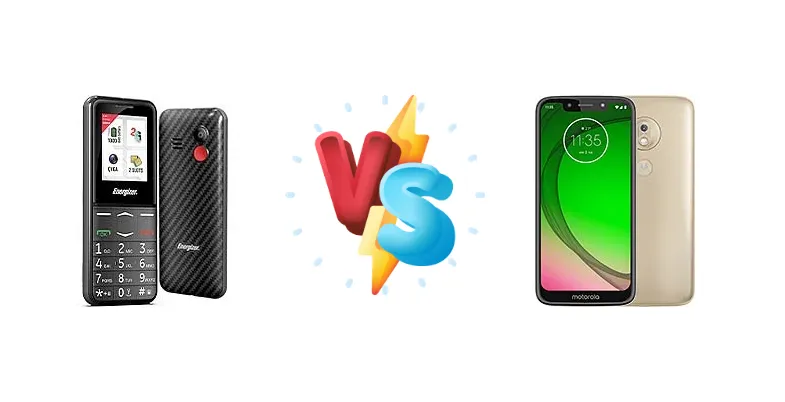
The Energizer E4 and Motorola Moto G7 Play represent opposite ends of the ultra-budget smartphone spectrum. The E4 aims for extreme affordability, while the Moto G7 Play attempts to balance cost with a more usable experience. This comparison dissects their key differences to help you determine which device best suits your needs.
🏆 Quick Verdict
For most users, the Motorola Moto G7 Play is the superior choice. Its Qualcomm Snapdragon 632 chipset provides a significantly more responsive experience than the Energizer E4’s Unisoc SC6531DA, making everyday tasks and even light multitasking far smoother. While both offer similar battery endurance, the G7 Play’s overall performance justifies its slightly higher price.
| Network |
|---|
| 2G bands | GSM 850 / 900 / 1800 / 1900 | GSM 850 / 900 / 1800 / 1900 |
| 3G bands | N/A | HSDPA 850 / 900 / 1700(AWS) / 1900 / 2100 |
| 4G bands | N/A | 1, 2, 3, 4, 5, 7, 8, 20, 28, 38, 40, 41 - Europe |
| EDGE | No | - |
| GPRS | Yes | - |
| Speed | No | HSPA 42.2/5.76 Mbps, LTE (2CA) Cat7 300/50 Mbps |
| Technology | GSM | GSM / HSPA / LTE |
| | - | 1, 2, 3, 4, 5, 7, 8, 12, 13, 14, 17, 20, 25, 26, 29, 30, 38, 39, 40, 41, 41, 66, 71 - USA |
| Launch |
|---|
| Announced | 2022, June | 2019, February. Released 2019, March |
| Status | Available. Released 2022, August | Discontinued |
| Body |
|---|
| Build | - | Glass front (Gorilla Glass 3), plastic back, plastic frame |
| Dimensions | 115 x 46 x 13.5 mm (4.53 x 1.81 x 0.53 in) | 147.3 x 71.5 x 8 mm (5.80 x 2.81 x 0.31 in) |
| SIM | Dual SIM (Mini-SIM, dual stand-by) | · Nano-SIM· Nano-SIM + Nano-SIM |
| Weight | 65 g (2.29 oz) | 149 g (5.26 oz) |
| | - | Splash resistant (market dependent) |
| Display |
|---|
| Protection | - | Corning Gorilla Glass 3 (market dependent) |
| Resolution | 128 x 160 pixels (~116 ppi density) | 720 x 1512 pixels, 19:9 ratio (~294 ppi density) |
| Size | 1.77 inches, 9.9 cm2 (~18.6% screen-to-body ratio) | 5.7 inches, 81.4 cm2 (~77.3% screen-to-body ratio) |
| Type | TFT | IPS LCD |
| Platform |
|---|
| CPU | 312 MHz | Octa-core (4x1.8 GHz Kryo 250 Gold & 4x1.8 GHz Kryo 250 Silver) |
| Chipset | Unisoc SC6531DA | Qualcomm SDM632 Snapdragon 632 (14 nm) |
| GPU | - | Adreno 506 |
| OS | - | Android 9.0 (Pie), upgradable to Android 10 |
| Memory |
|---|
| Call records | Yes | - |
| Card slot | microSDHC | microSDXC (dedicated slot) |
| Internal | 4MB | 32GB 2GB RAM, 32GB 3GB RAM |
| Phonebook | Yes | - |
| | - | eMMC 5.1 |
| Main Camera |
|---|
| Features | - | LED flash, panorama, HDR |
| Single | QVGA | 13 MP, f/2.0, 1/3.1", 1.12µm, PDAF |
| Video | Yes | 4K@30fps, 1080p@30fps |
| Selfie camera |
|---|
| Features | - | LED flash |
| Single | - | 8 MP, f/2.2, 1/4.0", 1.12µm |
| Video | - | 1080p@30fps |
| Sound |
|---|
| 3.5mm jack | Yes | Yes |
| 35mm jack | Yes | Yes |
| Loudspeaker | Yes | Yes |
| Comms |
|---|
| Bluetooth | 2.0 | 4.2, A2DP, LE |
| NFC | No | No |
| Positioning | No | GPS, GLONASS |
| Radio | FM radio | FM radio |
| USB | microUSB | USB Type-C 2.0, OTG |
| WLAN | No | Wi-Fi 802.11 b/g/n |
| Features |
|---|
| Java | No | - |
| Messaging | SMS | - |
| Sensors | No | Fingerprint (rear-mounted), accelerometer, gyro, proximity, compass |
| | SOS feature | - |
| Battery |
|---|
| Charging | - | 10W wired |
| Type | Li-Ion 1000 mAh battery, removable | Li-Ion 3000 mAh, non-removable |
| Misc |
|---|
| Colors | Black, Blue, Red, Gold, Silver | Deep indigo, Fine Gold, Starry Black |
| Models | - | XT1952-4, XT1952-5 |
| Price | About 10 EUR | About 160 EUR |
| SAR | - | 0.74 W/kg (head) 1.40 W/kg (body) |
| SAR EU | - | 0.84 W/kg (head) 0.85 W/kg (body) |
| Tests |
|---|
| Audio quality | - |
Noise -90.0dB / Crosstalk -92.9dB |
| Battery life | - | Endurance rating 103h |
| Camera | - |
Photo / Video |
| Display | - |
Contrast ratio: 1468:1 (nominal), 3.180 (sunlight) |
| Loudspeaker | - |
Voice 66dB / Noise 74dB / Ring 81dB |
| Performance | - |
AnTuTu: 97230 (v7)
GeekBench: 4154 (v4.4)
GFXBench: 7.7fps (ES 3.1 onscreen) |
Energizer E4
- Extremely affordable price point
- Long battery endurance (103h)
- Basic functionality for essential communication
- Very slow processor (Unisoc SC6531DA)
- Limited app performance
- Lack of detailed specifications
Motorola Moto G7 Play
- Significantly faster processor (Snapdragon 632)
- More responsive user experience
- 10W wired charging
- Slightly higher price than the Energizer E4
- Camera quality likely limited by budget constraints
- Display isn't high-end
Display Comparison
Both the Energizer E4 and Motorola Moto G7 Play share a contrast ratio of 1468:1 (nominal) and 3180:1 (sunlight). This suggests similar outdoor visibility, though the actual panel quality likely differs. The G7 Play benefits from a larger display, which is more conducive to media consumption. However, neither device is expected to offer exceptional color accuracy or brightness beyond basic usability. The lack of detailed display specifications for the E4 makes a precise comparison difficult, but the G7 Play’s larger size is a clear advantage.
Camera Comparison
Both phones feature a 'Photo / Video' camera, but lack specific details in the provided data. Given the price points, image quality is unlikely to be a strong suit for either device. The Moto G7 Play likely benefits from Qualcomm’s image signal processing (ISP) capabilities within the Snapdragon 632, potentially offering slightly better image quality and faster processing times. The E4’s Unisoc chipset lacks the same level of optimization. Without further information, it’s safe to assume that both cameras are best suited for casual snapshots in good lighting conditions.
Performance
The performance gap between these two devices is substantial. The Motorola Moto G7 Play’s Qualcomm Snapdragon 632 (14nm) is an octa-core processor featuring both performance (Kryo 250 Gold) and efficiency (Kryo 250 Silver) cores, clocked at 1.8 GHz. This architecture allows for smoother multitasking and more responsive app launches. In contrast, the Energizer E4 is powered by the Unisoc SC6531DA, a significantly less powerful processor clocked at only 312 MHz. This difference translates to a sluggish user experience on the E4, particularly when running multiple apps or demanding tasks. The 14nm process node of the Snapdragon 632 also contributes to better thermal efficiency, reducing the likelihood of performance throttling under sustained load.
Battery Life
Both the Energizer E4 and Motorola Moto G7 Play boast an impressive endurance rating of 103 hours. This suggests comparable battery life under similar usage patterns. However, the Moto G7 Play includes 10W wired charging, which allows for faster replenishment of the battery. The E4’s charging capabilities are unknown, but likely slower. While the battery capacity isn’t specified for either device, the Snapdragon 632’s efficiency may contribute to slightly longer real-world usage on the G7 Play, despite the identical endurance rating.
Buying Guide
Buy the Energizer E4 if you absolutely need the cheapest possible smartphone for basic communication – calls and texts – and have minimal expectations for app performance. It’s a viable option for a first phone for a child or as a temporary backup device. Buy the Motorola Moto G7 Play if you prioritize a usable smartphone experience, even on a tight budget. The Snapdragon 632 offers a noticeable performance boost for social media, web browsing, and light gaming, making it a more versatile and enjoyable daily driver.
Frequently Asked Questions
❓ Is the Motorola Moto G7 Play capable of running popular social media apps like Facebook and Instagram smoothly?
Yes, the Qualcomm Snapdragon 632 processor in the Moto G7 Play is capable of running Facebook, Instagram, and other popular social media apps with reasonable smoothness. While it won't offer a flagship-level experience, it provides a significantly more responsive experience than the Energizer E4, which would likely struggle with these apps.
❓ How much of a performance difference will I notice between the Unisoc SC6531DA and the Snapdragon 632 in everyday tasks?
The performance difference is substantial. The Snapdragon 632 is a much more powerful processor, offering a significantly faster and smoother experience for tasks like web browsing, app launching, and multitasking. The Unisoc SC6531DA is a very basic processor that will result in noticeable lag and slowdowns, especially when running multiple apps.
❓ Given the similar battery endurance ratings, does the 10W charging on the Moto G7 Play make a significant difference?
Yes, the 10W charging on the Moto G7 Play is a notable advantage. While both phones last roughly the same amount of time on a single charge, the G7 Play will recharge much faster, minimizing downtime. The Energizer E4’s charging speed is unknown, but is likely to be slower.