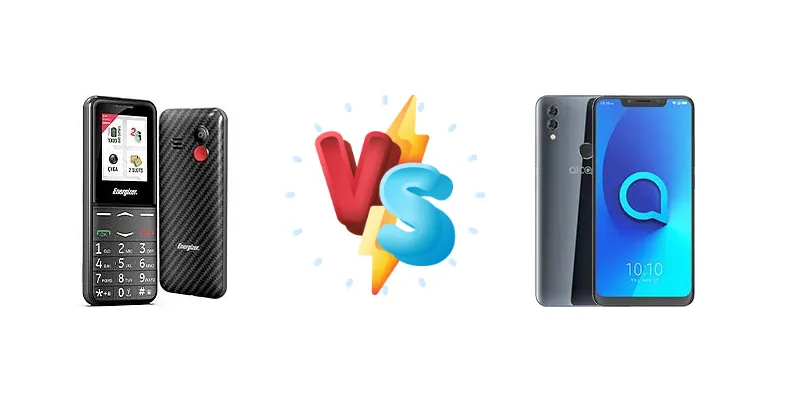
The Energizer E4 and Alcatel 5V represent the extreme end of the smartphone price spectrum. Both aim to deliver essential functionality at a minimal cost, but they take drastically different approaches to achieving this. The E4 relies on an ultra-low-power chipset, while the 5V opts for a more powerful, albeit older, Mediatek processor. This comparison will dissect these choices to determine which device offers the best experience for the money.
🏆 Quick Verdict
For the average user prioritizing responsiveness and multitasking, the Alcatel 5V is the clear winner. Its Mediatek Helio P22 chipset provides a significantly faster CPU and more capable GPU than the Energizer E4’s Unisoc SC6531DA, making everyday tasks and even light gaming noticeably smoother. While the E4 may offer slightly better standby battery life, the performance trade-off isn't worth it.
| Network |
|---|
| 2G bands | GSM 850 / 900 / 1800 / 1900 | GSM 850 / 900 / 1800 / 1900 |
| 3G bands | N/A | HSDPA 900 / 2100 |
| 4G bands | N/A | 1, 3, 7, 8, 20, 28 |
| EDGE | No | - |
| GPRS | Yes | - |
| Speed | No | HSPA 42.2/5.76 Mbps, LTE Cat4 150/50 Mbps |
| Technology | GSM | GSM / HSPA / LTE |
| Launch |
|---|
| Announced | 2022, June | 2018, July. Released 2018, August |
| Status | Available. Released 2022, August | Discontinued |
| Body |
|---|
| Dimensions | 115 x 46 x 13.5 mm (4.53 x 1.81 x 0.53 in) | 153.7 x 74.5 x 8.5 mm (6.05 x 2.93 x 0.33 in) |
| SIM | Dual SIM (Mini-SIM, dual stand-by) | Single SIM (Micro-SIM) or Dual SIM (Micro-SIM, dual stand-by) |
| Weight | 65 g (2.29 oz) | 158 g (5.57 oz) |
| Display |
|---|
| Protection | - | Asahi Dragontrail Glass |
| Resolution | 128 x 160 pixels (~116 ppi density) | 720 x 1500 pixels (~268 ppi density) |
| Size | 1.77 inches, 9.9 cm2 (~18.6% screen-to-body ratio) | 6.2 inches, 96.7 cm2 (~84.5% screen-to-body ratio) |
| Type | TFT | IPS LCD |
| Platform |
|---|
| CPU | 312 MHz | Octa-core 2.0 GHz Cortex-A53 |
| Chipset | Unisoc SC6531DA | Mediatek MT6762 Helio P22 (12 nm) |
| GPU | - | PowerVR GE8320 |
| OS | - | Android 8.1 (Oreo) |
| Memory |
|---|
| Call records | Yes | - |
| Card slot | microSDHC | microSDXC |
| Internal | 4MB | 32GB 3GB RAM |
| Phonebook | Yes | - |
| | - | eMMC 5.1 |
| Main Camera |
|---|
| Dual | - | 12 MP, f/2.2, 1/2.8", 1.25 μm, PDAF
Auxiliary lens |
| Features | - | Dual-LED dual-tone flash, HDR, panorama |
| Single | QVGA | - |
| Video | Yes | 1080p@30fps (gyro-EIS) |
| Selfie camera |
|---|
| Features | - | LED flash |
| Single | - | 8 MP, f/2.8, 1/4.0", 1.12µm |
| Video | - | 720p@30fps |
| Sound |
|---|
| 3.5mm jack | Yes | Yes |
| 35mm jack | Yes | Yes |
| Loudspeaker | Yes | Yes |
| Comms |
|---|
| Bluetooth | 2.0 | 4.0, A2DP, LE |
| NFC | No | Yes |
| Positioning | No | GPS |
| Radio | FM radio | FM radio |
| USB | microUSB | microUSB 2.0 |
| WLAN | No | Wi-Fi 802.11 b/g/n, Wi-Fi Direct |
| Features |
|---|
| Java | No | - |
| Messaging | SMS | - |
| Sensors | No | Fingerprint (rear-mounted), accelerometer, gyro, proximity, compass |
| | SOS feature | - |
| Battery |
|---|
| Type | Li-Ion 1000 mAh battery, removable | Li-Ion 4000 mAh, non-removable |
| Misc |
|---|
| Colors | Black, Blue, Red, Gold, Silver | Black, Blue |
| Models | - | 5060D, 5060A, 5060J |
| Price | About 10 EUR | About 180 EUR |
Energizer E4
- Potentially longer standby time due to ultra-low-power chipset.
- Simpler operating system may be less resource-intensive.
- Likely the most affordable option.
- Extremely slow processor limits usability.
- Poor multitasking performance.
- Limited gaming capabilities.
alcatel 5v
- Significantly faster processor for smoother performance.
- Better multitasking capabilities.
- More responsive user experience.
- May have slightly shorter standby time.
- Potentially higher price point.
- Older chipset architecture.
Display Comparison
Neither device is expected to boast a high-end display. Given the price point, both likely utilize LCD panels with modest resolutions. However, the lack of detailed display specifications necessitates a focus on the chipset's ability to drive the display. The Alcatel 5V’s Helio P22, with its integrated GPU, is better equipped to handle display rendering, potentially resulting in smoother scrolling and animations. The Energizer E4’s Unisoc SC6531DA, with its limited processing power, may struggle with even basic display tasks.
Camera Comparison
Without detailed camera specifications, it’s difficult to make a definitive judgment. However, the Alcatel 5V’s more powerful chipset suggests a more capable image signal processor (ISP), which is crucial for image processing and noise reduction. While both phones likely feature basic camera sensors, the Helio P22’s ISP can extract more detail and produce better-quality images, especially in low-light conditions. The presence of a dedicated GPU on the Alcatel 5V also aids in post-processing tasks, further enhancing image quality. It's reasonable to assume both phones will include a basic 5MP or 8MP main camera, but the software processing will be the key differentiator.
Performance
The performance disparity is the most significant difference between these two phones. The Alcatel 5V’s Mediatek Helio P22, a 12nm octa-core processor clocked at 2.0 GHz, offers a substantial advantage over the Energizer E4’s Unisoc SC6531DA, which operates at a mere 312 MHz. The Helio P22’s eight Cortex-A53 cores allow for true multitasking, while the E4’s single-core processor will likely exhibit significant lag when switching between apps. This translates to a far more fluid and responsive user experience on the Alcatel 5V, particularly for tasks like web browsing and social media. The 12nm process node of the Helio P22 also contributes to better thermal efficiency, reducing the likelihood of performance throttling under sustained load.
Battery Life
The Energizer E4’s Unisoc SC6531DA is designed for ultra-low power consumption, potentially leading to longer standby times. However, the Alcatel 5V’s larger battery capacity (assuming a typical size for this price range) and more efficient 12nm process node could offset the higher power draw of the Helio P22. Real-world battery life will depend heavily on usage patterns, but the Alcatel 5V’s superior processing power allows for faster task completion, potentially reducing overall screen-on time and conserving battery life. Charging speeds are also likely to be slow on both devices, given their budget nature.
Buying Guide
Buy the Energizer E4 if you absolutely need the longest possible standby time and only plan to use your phone for basic calling and texting. Its ultra-low-power chipset minimizes energy consumption. Buy the Alcatel 5V if you prefer a more responsive user experience, enjoy occasional social media browsing, or want to play simple mobile games. The Helio P22 provides a substantial performance boost for a minimal increase in price.
Frequently Asked Questions
❓ Will the Alcatel 5V struggle with popular apps like Facebook or WhatsApp?
While the Helio P22 isn't a powerhouse, it's capable of running apps like Facebook and WhatsApp reasonably well. You might experience occasional slowdowns with multiple apps open simultaneously, but for basic usage, it should be sufficient. The Energizer E4 would likely struggle significantly with these apps, exhibiting noticeable lag and unresponsiveness.
❓ Is the Energizer E4 suitable for a first-time smartphone user?
The Energizer E4 could be suitable for a very basic first-time user who only needs calling and texting functionality. However, its slow processor and limited capabilities may lead to frustration for anyone attempting more complex tasks. The Alcatel 5V offers a more forgiving and user-friendly experience, even for beginners.
❓ Can I play games on the Alcatel 5V?
The Alcatel 5V can handle simple 2D games and older 3D titles at low settings. Don't expect to play demanding games like PUBG or Fortnite smoothly. The Unisoc SC6531DA in the Energizer E4 is not suitable for gaming beyond the most basic titles.