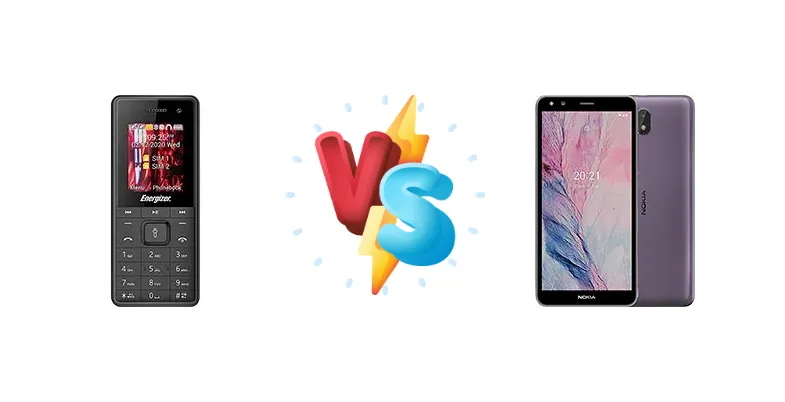
The Energizer E3 and Nokia C01 Plus represent the absolute bottom end of the smartphone market, targeting users who prioritize affordability above all else. Both devices aim to deliver basic smartphone functionality at an incredibly low price point, but they achieve this with significantly different hardware. This comparison dissects those differences to determine which offers the best value.
🏆 Quick Verdict
For the average user seeking a functional, if basic, smartphone experience, the Nokia C01 Plus emerges as the slightly better choice. Its Unisoc SC9863A chipset, with its octa-core configuration, provides a noticeable performance advantage over the Energizer E3’s Spreadtrum SC6531E, making everyday tasks smoother.
| Network |
|---|
| 2G bands | GSM 850 / 900 / 1800 / 1900 | GSM 850 / 900 / 1800 / 1900 |
| 3G bands | - | HSDPA 850 / 900 / 2100 - International |
| 4G bands | - | 1, 3, 5, 7, 8, 20, 28, 38, 40, 41 - International |
| EDGE | No | - |
| GPRS | Yes | - |
| Speed | - | HSPA 21.1/5.76 Mbps, LTE Cat4 150/50 Mbps |
| Technology | GSM | GSM / HSPA / LTE |
| | - | 2, 4, 5, 7, 8, 28 - LATAM |
| Launch |
|---|
| Announced | 2021, April. Released 2021, April | 2021, June 08 |
| Status | Discontinued | Available. Released 2021, June 28 |
| Body |
|---|
| Build | - | Plastic back, plastic frame |
| Dimensions | 113.9 x 48 x 14 mm (4.48 x 1.89 x 0.55 in) | 148 x 71.8 x 9.3 mm (5.83 x 2.83 x 0.37 in) |
| SIM | Dual SIM (Mini-SIM) | Nano-SIM + Nano-SIM |
| Weight | 70 g (2.47 oz) | 157 g (5.54 oz) |
| Display |
|---|
| Resolution | 128 x 160 pixels (~116 ppi density) | 720 x 1440 pixels, 18:9 ratio (~295 ppi density) |
| Size | 1.77 inches, 9.9 cm2 (~18.0% screen-to-body ratio) | 5.45 inches, 76.7 cm2 (~72.1% screen-to-body ratio) |
| Type | TFT LCD, 256K colors | IPS LCD |
| Platform |
|---|
| CPU | - | Octa-core (4x1.6 GHz Cortex-A55 & 4x1.2 GHz Cortex-A55) |
| Chipset | Spreadtrum SC6531E | Unisoc SC9863A (28 nm) |
| GPU | - | IMG8322 |
| OS | - | Android 11 (Go edition) |
| Memory |
|---|
| Call records | Yes | - |
| Card slot | microSD | microSDXC |
| Internal | - | 16GB 1GB RAM, 16GB 2GB RAM, 32GB 1GB RAM, 32GB 2GB RAM |
| Phonebook | Yes | - |
| | - | eMMC 5.1 |
| Main Camera |
|---|
| Features | - | LED flash, HDR |
| Single | QVGA | 5 MP |
| Video | Yes | 720p@30fps |
| Selfie camera |
|---|
| Features | - | LED flash, HDR |
| Single | QVGA | 5 MP |
| Video | - | 720p@30fps |
| Sound |
|---|
| 3.5mm jack | Yes | Yes |
| 35mm jack | Yes | Yes |
| Loudspeaker | Yes | Yes |
| Comms |
|---|
| Bluetooth | 2.1 | 4.2, A2DP, LE |
| NFC | No | No |
| Positioning | No | GPS |
| Radio | FM radio | FM radio |
| USB | microUSB | microUSB 2.0 |
| WLAN | No | Wi-Fi 802.11 b/g/n |
| Features |
|---|
| Games | No | - |
| Java | No | - |
| Messaging | SMS | - |
| Sensors | - | Accelerometer, proximity |
| Battery |
|---|
| Type | Li-Ion 1000 mAh battery | Li-Ion 3000 mAh, removable |
| Misc |
|---|
| Colors | Black, Gray, Blue, White, Green, Brown, Yellow | Blue, Purple |
| Models | - | TA-1383, TA-1387, TA-1391 |
| Price | About 10 EUR | About 90 EUR |
| SAR | - | 1.13 W/kg (head) 0.84 W/kg (body) |
| SAR EU | - | 0.59 W/kg (head) 1.41 W/kg (body) |
Energizer E3
- Potentially the absolute lowest price point.
- Simple and straightforward user experience.
- Compact size (likely)
- Significantly slower performance.
- Limited multitasking capabilities.
- Poor camera quality.
Nokia C01 Plus
- Octa-core processor for smoother performance.
- Slightly better multitasking capabilities.
- Potentially better battery efficiency.
- Still limited performance overall.
- Low-resolution display.
- Camera quality remains basic.
Display Comparison
Neither device boasts a particularly impressive display. Specifications are limited, but both likely feature low-resolution panels. The Nokia C01 Plus benefits from a slightly larger screen size, potentially offering a more immersive viewing experience, though both will struggle with outdoor visibility. Color accuracy and viewing angles are expected to be poor on both, typical of this price bracket. The absence of any mention of PWM dimming suggests both may not be ideal for users sensitive to flicker.
Camera Comparison
Camera performance on both devices is expected to be extremely limited. Details are scarce, but both likely feature basic sensors. Focusing on megapixel counts alone is misleading at this price point. Image quality will be heavily reliant on software processing, and results will likely be noisy and lack detail, especially in low-light conditions. Any 'macro' camera present on either device is likely a 2MP sensor offering minimal practical benefit. The Nokia C01 Plus may have a slight edge due to potentially better image processing capabilities within the Unisoc chipset.
Performance
The core difference lies in the chipsets. The Energizer E3 utilizes the Spreadtrum SC6531E, a quad-core processor designed for extremely basic functionality. In contrast, the Nokia C01 Plus features the Unisoc SC9863A, an octa-core processor built on a 28nm process. This means the Nokia C01 Plus has twice the number of cores, split into a cluster of four Cortex-A55 cores clocked at 1.6 GHz and another four at 1.2 GHz. This architecture allows for better multitasking and smoother performance in apps, even if those apps are lightweight. The 28nm process node of the Unisoc chip, while older, is still more efficient than what the Spreadtrum likely uses, potentially leading to slightly better battery life under load. The Energizer E3 will likely struggle with even moderately demanding tasks.
Battery Life
Battery capacity is not specified for either device. However, given their target market, both likely feature batteries in the 3000-4000 mAh range. The Unisoc SC9863A’s slightly more efficient architecture in the Nokia C01 Plus could translate to marginally longer battery life, especially during moderate usage. Charging speeds are also likely to be slow on both, with neither device supporting fast charging technologies. Expect several hours to fully charge from 0-100%.
Buying Guide
Buy the Energizer E3 if you absolutely need the lowest possible price and are willing to accept significantly slower performance and limited multitasking capabilities. It's a viable option for very basic communication. Buy the Nokia C01 Plus if you prioritize a more responsive user experience, even for simple tasks, and appreciate the benefits of an octa-core processor for slightly improved app loading and switching times. It's a better all-around choice for most first-time smartphone buyers.
Frequently Asked Questions
❓ Will the Nokia C01 Plus be able to run popular social media apps like Facebook and WhatsApp smoothly?
Yes, the Nokia C01 Plus, with its octa-core Unisoc SC9863A processor, should be able to run Facebook and WhatsApp without significant lag. However, expect slower loading times compared to more powerful smartphones. Running multiple apps simultaneously may still cause performance slowdowns.
❓ Is the Energizer E3 suitable for a first-time smartphone user who only needs basic calling and texting?
The Energizer E3 is a viable option for a first-time smartphone user with extremely basic needs – primarily calling and texting. However, be aware that its performance is limited, and even simple tasks may feel sluggish. If the user anticipates using any apps beyond basic communication, the Nokia C01 Plus is a better choice.
❓ Can either of these phones handle mobile gaming?
Neither the Energizer E3 nor the Nokia C01 Plus are suitable for mobile gaming. Their processors lack the graphical power to run even basic games smoothly. Expect significant lag and low frame rates. These phones are designed for communication and very light usage, not gaming.
❓ What version of Android do these phones run?
Both devices likely run Android Go Edition, a lightweight version of Android designed for smartphones with limited resources. This helps to optimize performance and reduce storage usage, but it also means some features found in the full Android experience may be missing.