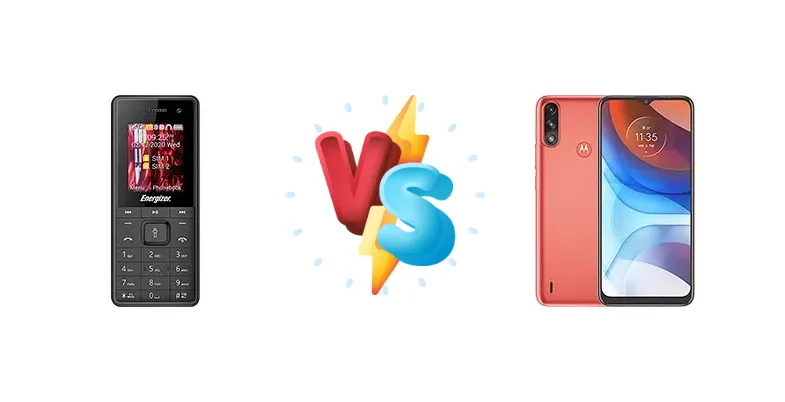
The Energizer E3 and Motorola Moto E7i Power represent the extreme end of the smartphone price spectrum. Both aim to deliver essential functionality at a minimal cost, but they achieve this with significantly different hardware. This comparison dissects their core components to determine which device offers the best value for users prioritizing affordability.
🏆 Quick Verdict
For the average user seeking a functional, if basic, smartphone experience, the Motorola Moto E7i Power emerges as the better choice. Its Unisoc SC9863A chipset, with its octa-core configuration, provides a noticeable performance advantage over the Energizer E3’s Spreadtrum SC6531E, making everyday tasks smoother.
| Network |
|---|
| 2G bands | GSM 850 / 900 / 1800 / 1900 | GSM 850 / 900 / 1800 / 1900 |
| 3G bands | - | HSDPA 850 / 900 / 1700(AWS) / 1900 / 2100 |
| 4G bands | - | LTE |
| EDGE | No | - |
| GPRS | Yes | - |
| Speed | - | HSPA, LTE |
| Technology | GSM | GSM / HSPA / LTE |
| Launch |
|---|
| Announced | 2021, April. Released 2021, April | 2021, February 23 |
| Status | Discontinued | Available. Released 2021, March 15 |
| Body |
|---|
| Build | - | Glass front, plastic back, plastic frame |
| Dimensions | 113.9 x 48 x 14 mm (4.48 x 1.89 x 0.55 in) | 165.1 x 75.9 x 9.2 mm (6.5 x 2.99 x 0.36 in) |
| SIM | Dual SIM (Mini-SIM) | Nano-SIM + Nano-SIM |
| Weight | 70 g (2.47 oz) | 200 g (7.05 oz) |
| | - | Water-repellent design |
| Display |
|---|
| Resolution | 128 x 160 pixels (~116 ppi density) | 720 x 1600 pixels, 20:9 ratio (~270 ppi density) |
| Size | 1.77 inches, 9.9 cm2 (~18.0% screen-to-body ratio) | 6.51 inches, 102.3 cm2 (~81.7% screen-to-body ratio) |
| Type | TFT LCD, 256K colors | IPS LCD, 380 nits (typ) |
| Platform |
|---|
| CPU | - | Octa-core (4x1.6 GHz Cortex-A55 & 4x1.2 GHz Cortex-A55) |
| Chipset | Spreadtrum SC6531E | Unisoc SC9863A (28 nm) |
| GPU | - | IMG8322 |
| OS | - | Android 10 (Go edition) |
| Memory |
|---|
| Call records | Yes | - |
| Card slot | microSD | microSDXC (uses shared SIM slot) |
| Internal | - | 32GB 2GB RAM |
| Phonebook | Yes | - |
| | - | eMMC 5.1 |
| Main Camera |
|---|
| Dual | - | 13 MP, f/2.0, 26mm (wide), 1/3.1", 1.12µm, PDAF
2 MP (macro) |
| Features | - | LED flash, HDR, panorama |
| Single | QVGA | - |
| Video | Yes | 1080p@30fps |
| Selfie camera |
|---|
| Features | - | HDR |
| Single | QVGA | 5 MP, f/2.2, 27mm (wide), 1.12µm |
| Video | - | 1080p@30fps |
| Sound |
|---|
| 3.5mm jack | Yes | Yes |
| 35mm jack | Yes | Yes |
| Loudspeaker | Yes | Yes |
| Comms |
|---|
| Bluetooth | 2.1 | 4.2, A2DP |
| NFC | No | No |
| Positioning | No | GPS, GLONASS, GALILEO |
| Radio | FM radio | Unspecified |
| USB | microUSB | USB Type-C 2.0 |
| WLAN | No | Wi-Fi 802.11 b/g/n |
| Features |
|---|
| Games | No | - |
| Java | No | - |
| Messaging | SMS | - |
| Sensors | - | Fingerprint (rear-mounted), accelerometer, proximity |
| Battery |
|---|
| Charging | - | 10W wired |
| Type | Li-Ion 1000 mAh battery | Li-Ion 5000 mAh |
| Misc |
|---|
| Colors | Black, Gray, Blue, White, Green, Brown, Yellow | Tahiti Blue, Coral Red |
| Models | - | XT2097-13 |
| Price | About 10 EUR | About 120 EUR |
Energizer E3
- Potentially longer standby time due to simpler hardware.
- Ultra-affordable price point.
- Basic functionality for essential communication.
- Significantly slower performance compared to the Moto E7i Power.
- Likely outdated chipset architecture.
- Poor camera performance.
Motorola Moto E7i Power
- Octa-core processor for smoother multitasking.
- More responsive user experience.
- More modern chipset architecture (Unisoc SC9863A).
- Slow 10W charging.
- Basic camera capabilities.
- Limited RAM and storage options.
Display Comparison
Neither device boasts a standout display. Given the lack of display specifications for the Energizer E3, we can assume it utilizes a basic LCD panel common in this price bracket. The Moto E7i Power also features an LCD, but its focus is on power efficiency rather than visual fidelity. Expect low peak brightness and limited color accuracy on both. Bezels are likely to be substantial on both devices, maximizing screen real estate within a compact form factor.
Camera Comparison
Camera performance is expected to be minimal on both devices. Without detailed sensor information for the Energizer E3, it’s safe to assume a low-resolution primary sensor. The Moto E7i Power likely features a similar setup, with a primary sensor and potentially a depth or macro lens of negligible quality. Image processing will be basic, resulting in soft details and limited dynamic range. Users should not expect high-quality photos or videos from either device.
Performance
The core difference lies in the chipsets. The Energizer E3’s Spreadtrum SC6531E is a quad-core processor designed for ultra-low-cost devices. In contrast, the Motorola Moto E7i Power’s Unisoc SC9863A is an octa-core unit built on a 28nm process. This means the Moto E7i Power benefits from more processing cores (4x1.6 GHz Cortex-A55 & 4x1.2 GHz Cortex-A55) and a more modern architecture, resulting in significantly improved multitasking and app loading times. While neither chipset is suited for demanding games, the Unisoc chip will handle basic social media and web browsing with greater ease. The lack of LPDDR RAM specifications for both devices suggests they utilize slower memory standards, further limiting performance.
Battery Life
The Motorola Moto E7i Power’s 10W wired charging is a limiting factor, but the Unisoc SC9863A’s 28nm process, while not the most efficient, is more modern than the likely older process node used by the Spreadtrum SC6531E. The battery capacity of both devices is not specified, but given the target market, both are likely to be in the 3000-4000 mAh range. The Moto E7i Power’s more efficient chipset may translate to slightly longer real-world battery life despite potentially similar capacity.
Buying Guide
Buy the Energizer E3 if you need a phone for absolutely basic communication – calls and texts – and prioritize simplicity above all else. Its minimal hardware footprint may translate to slightly longer standby times. Buy the Motorola Moto E7i Power if you prefer a more responsive user experience, even for light multitasking, and appreciate the benefits of an octa-core processor for running modern apps, albeit at a basic level.
Frequently Asked Questions
❓ Will the Unisoc SC9863A in the Moto E7i Power struggle with popular apps like WhatsApp and Facebook?
While the Unisoc SC9863A isn't a powerhouse, it's capable of running apps like WhatsApp and Facebook without significant issues. Expect some loading times and occasional lag when switching between apps, but it should provide a usable experience for basic social media interaction.
❓ Is the 10W charging on the Moto E7i Power painfully slow?
Yes, 10W charging is relatively slow by modern standards. A full charge from 0% will take several hours. However, given the likely small battery capacity and the phone's intended use case (basic communication), this isn't a critical drawback for most users.
❓ Can either of these phones handle any mobile games?
Neither phone is well-suited for gaming. Simple, 2D games might be playable at low settings, but demanding 3D titles will likely be unplayable due to the limited processing power and graphics capabilities of both chipsets.
❓ What kind of storage options are available on these devices?
Both devices typically come with limited internal storage (likely 32GB or 64GB) and support microSD card expansion. This is crucial, as the limited internal storage will fill up quickly with apps and photos.