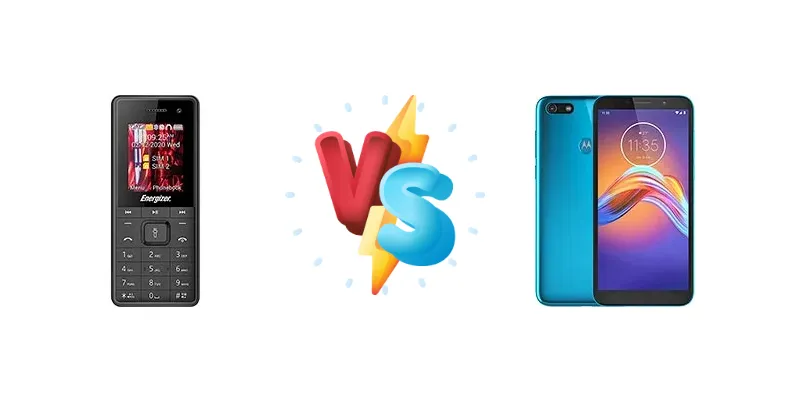
The Energizer E3 and Motorola Moto E6 Play represent the extreme end of the smartphone price spectrum. Both aim to deliver basic functionality at an incredibly low cost, but they achieve this with different hardware approaches. This comparison dissects those differences to determine which device offers the best value for users prioritizing affordability.
🏆 Quick Verdict
For the average user seeking a functional, no-frills smartphone, the Motorola Moto E6 Play is the slightly better choice. Its Mediatek MT6739 chipset, while still entry-level, provides a demonstrable performance advantage over the Energizer E3’s Spreadtrum SC6531E, making it more responsive for everyday tasks.
| Network |
|---|
| 2G bands | GSM 850 / 900 / 1800 / 1900 | GSM 850 / 900 / 1800 / 1900 |
| 3G bands | - | HSDPA 850 / 900 / 1900 / 2100 |
| 4G bands | - | 1, 3, 5, 7, 8, 20, 38, 40, 41 |
| EDGE | No | - |
| GPRS | Yes | - |
| Speed | - | HSPA, LTE |
| Technology | GSM | GSM / HSPA / LTE |
| Launch |
|---|
| Announced | 2021, April. Released 2021, April | 2019, October. Released 2019, November |
| Status | Discontinued | Discontinued |
| Body |
|---|
| Build | - | Glass front, plastic back, plastic frame |
| Dimensions | 113.9 x 48 x 14 mm (4.48 x 1.89 x 0.55 in) | 146.5 x 70.9 x 8.3 mm (5.77 x 2.79 x 0.33 in) |
| SIM | Dual SIM (Mini-SIM) | Nano-SIM + Nano-SIM |
| Weight | 70 g (2.47 oz) | 140 g (4.94 oz) |
| Display |
|---|
| Resolution | 128 x 160 pixels (~116 ppi density) | 720 x 1440 pixels, 18:9 ratio (~295 ppi density) |
| Size | 1.77 inches, 9.9 cm2 (~18.0% screen-to-body ratio) | 5.5 inches, 77.0 cm2 (~74.1% screen-to-body ratio) |
| Type | TFT LCD, 256K colors | IPS LCD |
| Platform |
|---|
| CPU | - | Quad-core 1.5 GHz Cortex-A53 |
| Chipset | Spreadtrum SC6531E | Mediatek MT6739 (28 nm) |
| GPU | - | PowerVR GE8100 |
| OS | - | Android 9.0 (Pie) |
| Memory |
|---|
| Call records | Yes | - |
| Card slot | microSD | microSDXC (dedicated slot) |
| Internal | - | 32GB 2GB RAM |
| Phonebook | Yes | - |
| | - | eMMC 5.1 |
| Main Camera |
|---|
| Features | - | LED flash, HDR, panorama |
| Single | QVGA | 13 MP, f/2.2, 1/3.1", 1.12µm, PDAF |
| Video | Yes | 1080p@30fps |
| Selfie camera |
|---|
| Features | - | HDR |
| Single | QVGA | 5 MP, f/2.2, 1/5.0", 1.12µm |
| Video | - | 1080p@30fps |
| Sound |
|---|
| 3.5mm jack | Yes | Yes |
| 35mm jack | Yes | Yes |
| Loudspeaker | Yes | Yes |
| Comms |
|---|
| Bluetooth | 2.1 | 4.2, A2DP, LE |
| NFC | No | No |
| Positioning | No | GPS, GLONASS |
| Radio | FM radio | FM radio |
| USB | microUSB | microUSB 2.0, OTG |
| WLAN | No | Wi-Fi 802.11 b/g/n |
| Features |
|---|
| Games | No | - |
| Java | No | - |
| Messaging | SMS | - |
| Sensors | - | Fingerprint (rear-mounted), accelerometer, proximity |
| Battery |
|---|
| Type | Li-Ion 1000 mAh battery | Li-Po 3000 mAh, non-removable |
| Misc |
|---|
| Colors | Black, Gray, Blue, White, Green, Brown, Yellow | Turquoise Blue, Anthracite |
| Models | - | XT2029, XT2029-1 |
| Price | About 10 EUR | About 160 EUR |
| SAR EU | - | 0.55 W/kg (head) 1.78 W/kg (body) |
Energizer E3
- Potentially lower price point
- Simple and easy to use interface
- Durable build quality (Energizer brand reputation)
- Significantly weaker performance
- Outdated chipset
- Limited app compatibility
Motorola Moto E6 Play
- More responsive performance
- Modern chipset architecture
- Slightly better power efficiency
- May be slightly more expensive
- Basic camera capabilities
- Limited storage space
Display Comparison
Neither Energizer nor Motorola provide detailed display specifications for these models. Given their price point, it’s safe to assume both utilize LCD panels with resolutions around 480x854. The lack of detailed specs suggests neither prioritizes display quality. Expect basic viewing angles and color reproduction. Bezels are likely substantial on both devices, maximizing screen real estate within a compact form factor.
Camera Comparison
Camera performance on both devices will be limited. Detailed sensor information is unavailable, but it’s reasonable to expect a basic 5-8MP main camera on both. Image quality will suffer in low light, and detail will be limited. The presence of a 2MP macro camera on the Moto E6 Play is largely a marketing gimmick; its impact on image quality will be minimal. Image processing will be basic, prioritizing speed over quality. Users should not expect flagship-level camera capabilities.
Performance
The core difference lies in the chipsets. The Motorola Moto E6 Play’s Mediatek MT6739, fabricated on a 28nm process, features a quad-core Cortex-A53 CPU clocked at 1.5 GHz. This represents a more modern architecture than the Energizer E3’s Spreadtrum SC6531E. While both are entry-level, the MT6739’s Cortex-A53 cores offer better single-core performance, translating to snappier app launches and smoother multitasking. The 28nm process also suggests slightly better power efficiency compared to the likely larger node process used for the SC6531E. RAM configurations are likely similar (1-2GB), further emphasizing the chipset as the primary performance differentiator.
Battery Life
Battery capacity is not specified for either device. However, given their target market, both likely feature batteries in the 2500-3000 mAh range. The Mediatek MT6739’s slightly better power efficiency could translate to marginally longer battery life on the Moto E6 Play. Charging speeds are likely slow, utilizing Micro-USB, and 0-100% charge times will likely exceed 3 hours.
Buying Guide
Buy the Energizer E3 if you need a phone primarily for calls and texts, and absolute simplicity is paramount. Its minimal feature set and likely lower price point (depending on retailer) make it a viable option for those with extremely limited needs. Buy the Motorola Moto E6 Play if you prefer a slightly more capable device that can handle basic app usage and occasional web browsing without significant lag. The MT6739 chipset offers a smoother, more responsive experience for a small price premium.
Frequently Asked Questions
❓ Will the Mediatek MT6739 in the Moto E6 Play struggle with popular apps like Facebook or WhatsApp?
While the MT6739 is an entry-level chipset, it should be capable of running Facebook and WhatsApp without significant issues. However, expect some lag when switching between apps or loading complex content. It's not designed for demanding applications or heavy multitasking.
❓ Is the Energizer E3 a good choice for a first smartphone for a senior citizen?
The Energizer E3's simplicity could make it suitable for a senior citizen who primarily needs a phone for calls and texts. However, its limited performance might be frustrating if they attempt to use more complex apps. Consider the Moto E6 Play if they might want to explore basic internet browsing.
❓ Can either of these phones be used for mobile gaming?
Neither phone is suitable for serious mobile gaming. The chipsets lack the processing power and graphics capabilities to run modern games at playable frame rates. Simple, older games might be playable at low settings, but don't expect a good gaming experience.