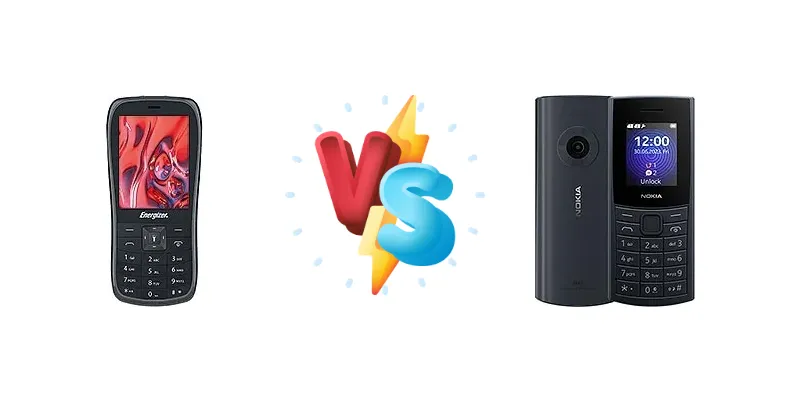
In a market dominated by smartphones, basic feature phones continue to serve a vital role for those prioritizing simplicity, affordability, and long battery life. The Energizer E29 and Nokia 110 4G 2nd Edition represent two contenders in this space, both offering 4G connectivity. However, a closer look reveals a key difference: the Energizer E29 boasts a specified chipset, while the Nokia 110 4G 2nd Edition's internal components remain largely undisclosed, necessitating an analysis based on brand reputation and market positioning.
🏆 Quick Verdict
For users needing a slightly more capable feature phone with a known chipset, the Energizer E29 is the better choice. Its Unisoc 6531E processor, while basic, provides a defined level of performance, whereas the Nokia 110 4G 2nd Edition relies on Nokia's established reliability in the ultra-budget segment.
| Network |
|---|
| 2G bands | GSM 850 / 900 / 1800 / 1900 | GSM 900 / 1800 |
| 3G bands | - | HSDPA 850 / 900 / 1700(AWS) / 1900 / 2100 |
| 4G bands | - | LTE |
| EDGE | No | - |
| GPRS | Yes | - |
| Speed | - | HSPA, LTE |
| Technology | GSM | GSM / HSPA / LTE |
| Launch |
|---|
| Announced | 2023, October | 2024, December |
| Status | Available. Released 2023, November | Available. Released 2024, December |
| Body |
|---|
| Dimensions | 137.6 x 62.5 x 15.6 mm (5.42 x 2.46 x 0.61 in) | 121.5 x 50 x 14.4 mm (4.78 x 1.97 x 0.57 in) |
| SIM | Dual SIM (Mini-SIM) | · Nano-SIM· Nano-SIM + Nano-SIM |
| Weight | - | 94.5 g (3.35 oz) |
| Display |
|---|
| Resolution | 240 x 320 pixels, 4:3 ratio (~143 ppi density) | 120 x 160 pixels, 4:3 ratio (~111 ppi density) |
| Size | 2.8 inches, 24.3 cm2 (~28.2% screen-to-body ratio) | 1.8 inches, 10.0 cm2 (~16.5% screen-to-body ratio) |
| Type | TFT LCD | IPS LCD |
| Platform |
|---|
| CPU | Single-core 312 MHz | - |
| Chipset | Unisoc 6531E | - |
| Memory |
|---|
| Call records | Yes | Yes |
| Card slot | microSDHC | microSDHC |
| Internal | - | 48MB 128MB RAM |
| Phonebook | Yes | Yes |
| Main Camera |
|---|
| Features | LED flash | - |
| Single | VGA | QVGA |
| Video | Yes | Yes |
| Sound |
|---|
| 35mm jack | Yes | Yes |
| Loudspeaker | Yes | Yes |
| Comms |
|---|
| Bluetooth | 2.1 | 5.0, A2DP |
| NFC | No | No |
| Positioning | No | No |
| Radio | FM radio | Wireless FM radio |
| USB | microUSB | USB Type-C |
| WLAN | No | No |
| Features |
|---|
| Games | No | Yes |
| Java | No | No |
| Messaging | SMS | SMS |
| Battery |
|---|
| Type | Li-Ion 1700 mAh battery | Li-Ion 1450 mAh, removable |
| Misc |
|---|
| Colors | Black | Midnight Blue, Arctic Purple |
| Price | About 20 EUR | About 60 EUR |
Energizer E29
- Known Unisoc 6531E chipset provides defined performance.
- 4G connectivity for basic data access.
- Energizer brand recognition for battery life.
- Limited processing power for demanding tasks.
- Basic camera capabilities.
Nokia 110 4G 2nd Edition
- Nokia’s reputation for reliability and software optimization.
- 4G connectivity.
- Potentially simpler user interface.
- Undisclosed chipset and specifications.
- Performance characteristics are unknown.
Display Comparison
Neither device is expected to offer a high-resolution or particularly vibrant display. Given the target market, both likely utilize basic LCD panels. Without specific details on the Nokia 110 4G 2nd Edition’s display, it’s reasonable to assume it’s comparable to other phones in its price range – prioritizing readability over visual fidelity. The Energizer E29’s display quality will be limited by the processing power available to drive it.
Camera Comparison
Both devices are unlikely to excel in photography. Feature phones in this category typically include basic cameras for occasional snapshots. Without specifications for the Nokia 110 4G 2nd Edition, it’s safe to assume its camera is comparable to other ultra-budget options. The Energizer E29’s camera performance will be constrained by the Unisoc 6531E’s image signal processor capabilities, meaning image quality will be basic.
Performance
The Energizer E29’s Unisoc 6531E chipset, featuring a single-core 312 MHz CPU, represents the core performance differentiator. While not powerful by any modern standard, this chipset provides a defined baseline for functionality, including 4G connectivity and basic app support. The Nokia 110 4G 2nd Edition, lacking published chipset information, likely employs a similarly low-power processor, but its performance characteristics are unknown. Nokia historically focuses on optimized software to maximize performance on limited hardware, but the Energizer E29’s specified processor offers a degree of predictability.
Battery Life
Both phones are designed for extended battery life, a key selling point for feature phones. The Energizer brand is known for emphasizing battery capacity, but specific mAh ratings are not provided for either device. The low-power Unisoc 6531E in the E29 contributes to efficient energy consumption. The Nokia 110 4G 2nd Edition likely prioritizes software optimization to maximize battery life, a strength Nokia has historically demonstrated in this segment.
Buying Guide
Buy the Energizer E29 if you need a feature phone with a known processor for potential compatibility with specific apps or services, or if you value having a defined specification. Buy the Nokia 110 4G 2nd Edition if you prioritize brand reliability, a potentially simpler user interface, and are content with a no-frills experience where internal specs are less critical.
Frequently Asked Questions
❓ What kind of apps can I run on the Energizer E29 with its Unisoc 6531E processor?
The Unisoc 6531E is capable of running basic Java-based apps and potentially some lightweight Android Go apps, depending on the software implementation. However, don't expect to run demanding applications like social media apps or games smoothly. It's primarily designed for calling, texting, and basic internet browsing.
❓ Does the Nokia 110 4G 2nd Edition support WhatsApp?
While the Nokia 110 4G 2nd Edition supports 4G connectivity, WhatsApp's requirements have evolved. It's unlikely to run the full WhatsApp application reliably due to limited processing power and memory. However, WhatsApp may offer a limited text-only version for basic feature phones, but compatibility isn't guaranteed.
❓ How important is the 4G connectivity on these phones?
4G connectivity allows for faster internet browsing and potentially VoLTE (Voice over LTE) calls, offering improved call quality in areas with 4G coverage. However, the limited processing power of both phones will restrict the overall browsing experience. It's most useful for occasional data checks or using basic online services.