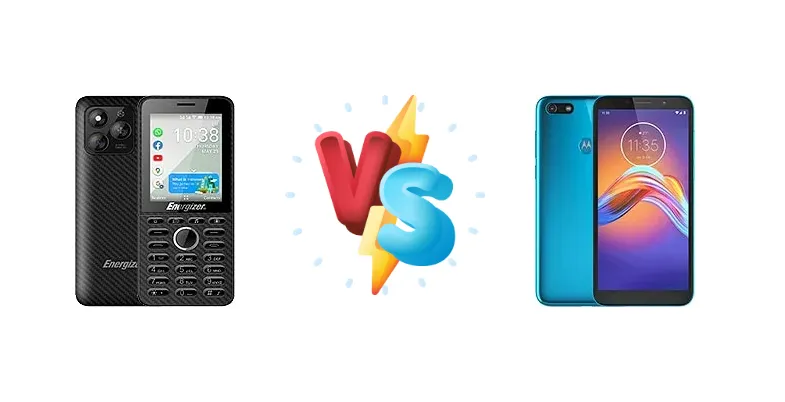
The Energizer E288s and Motorola Moto E6 Play represent the extreme end of the smartphone price spectrum. Both devices aim to deliver basic smartphone functionality at an incredibly affordable price point, but they achieve this with slightly different approaches to hardware. This comparison dissects their key specifications to determine which offers the best value for users on a tight budget.
🏆 Quick Verdict
For the average user prioritizing slightly smoother performance, the Motorola Moto E6 Play is the better choice. Its 1.5 GHz CPU, while based on the same Mediatek MT6739 chipset, provides a noticeable edge in responsiveness for everyday tasks compared to the Energizer E288s' 1.3 GHz processor.
| Network |
|---|
| 2G bands | GSM 850 / 900 / 1800 / 1900 | GSM 850 / 900 / 1800 / 1900 |
| 3G bands | HSDPA 850 / 900 / 2100 | HSDPA 850 / 900 / 1900 / 2100 |
| 4G bands | 1, 2, 3, 4, 5, 7, 8, 12, 13, 17, 20, 26, 28, 38, 40, 41, 66 | 1, 3, 5, 7, 8, 20, 38, 40, 41 |
| Speed | HSPA, LTE | HSPA, LTE |
| Technology | GSM / HSPA / LTE | GSM / HSPA / LTE |
| Launch |
|---|
| Announced | 2024, April | 2019, October. Released 2019, November |
| Status | Available. Released 2024, August | Discontinued |
| Body |
|---|
| Build | - | Glass front, plastic back, plastic frame |
| Dimensions | 138 x 58.2 x 12.8 mm (5.43 x 2.29 x 0.50 in) | 146.5 x 70.9 x 8.3 mm (5.77 x 2.79 x 0.33 in) |
| SIM | Nano-SIM + Nano-SIM | Nano-SIM + Nano-SIM |
| Weight | 116 g (4.09 oz) | 140 g (4.94 oz) |
| Display |
|---|
| Resolution | 240 x 320 pixels, 4:3 ratio (~143 ppi density) | 720 x 1440 pixels, 18:9 ratio (~295 ppi density) |
| Size | 2.8 inches, 24.3 cm2 (~30.2% screen-to-body ratio) | 5.5 inches, 77.0 cm2 (~74.1% screen-to-body ratio) |
| Type | TFT | IPS LCD |
| Platform |
|---|
| CPU | Quad-core 1.3 GHz | Quad-core 1.5 GHz Cortex-A53 |
| Chipset | Mediatek MT6739WW (28 nm) | Mediatek MT6739 (28 nm) |
| GPU | - | PowerVR GE8100 |
| OS | KaiOS 2.X | Android 9.0 (Pie) |
| Memory |
|---|
| Card slot | microSDXC | microSDXC (dedicated slot) |
| Internal | 4GB 512MB RAM | 32GB 2GB RAM |
| | - | eMMC 5.1 |
| Main Camera |
|---|
| Features | LED flash | LED flash, HDR, panorama |
| Single | 0.3 MP | 13 MP, f/2.2, 1/3.1", 1.12µm, PDAF |
| Video | Yes | 1080p@30fps |
| Selfie camera |
|---|
| Features | - | HDR |
| Single | Yes | 5 MP, f/2.2, 1/5.0", 1.12µm |
| Video | - | 1080p@30fps |
| Sound |
|---|
| 3.5mm jack | - | Yes |
| 35mm jack | Yes | Yes |
| Loudspeaker | Yes | Yes |
| Comms |
|---|
| Bluetooth | 4.2, A2DP | 4.2, A2DP, LE |
| NFC | No | No |
| Positioning | GPS | GPS, GLONASS |
| Radio | FM radio | FM radio |
| USB | USB Type-C | microUSB 2.0, OTG |
| WLAN | Yes | Wi-Fi 802.11 b/g/n |
| Features |
|---|
| Sensors | No | Fingerprint (rear-mounted), accelerometer, proximity |
| Battery |
|---|
| Type | Li-Ion 2000 mAh, removable | Li-Po 3000 mAh, non-removable |
| Misc |
|---|
| Colors | Black | Turquoise Blue, Anthracite |
| Models | - | XT2029, XT2029-1 |
| Price | - | About 160 EUR |
| SAR EU | - | 0.55 W/kg (head) 1.78 W/kg (body) |
Energizer E288s
- Potentially longer battery life due to lower CPU clock speed.
- May be more readily available in certain regions.
- Energizer brand recognition for durability (though not necessarily reflected in this model).
- Slower CPU performance compared to the Moto E6 Play.
- Likely less responsive user experience.
- Limited camera capabilities.
Motorola Moto E6 Play
- Faster CPU clock speed for improved performance.
- Slightly smoother multitasking and app launches.
- Motorola’s clean Android software experience.
- Potentially shorter battery life compared to the Energizer E288s.
- Similar limited camera capabilities.
- May be slightly more expensive.
Display Comparison
Neither device boasts a standout display. Both likely utilize LCD panels, typical for this price bracket. Specifics like resolution and brightness are unavailable, but we can assume they are optimized for power efficiency rather than visual fidelity. Bezels are expected to be substantial on both, maximizing screen real estate within a compact form factor. Color accuracy will likely be standard for budget phones, leaning towards warmer tones.
Camera Comparison
Camera performance on both devices will be limited. Details on sensor size and aperture are unavailable, but it’s safe to assume both feature basic sensors. Image quality will be acceptable in well-lit conditions, but will suffer significantly in low light. The presence of a secondary camera on both is likely for depth sensing or macro photography, but the low resolution of these sensors (typically 2MP) renders them largely ineffective for serious photography. Image processing will be minimal, relying heavily on software algorithms to enhance photos.
Performance
The core difference lies in the CPU clock speed. The Motorola Moto E6 Play’s 1.5 GHz quad-core Cortex-A53 processor offers a 15.4% clock speed advantage over the Energizer E288s’ 1.3 GHz processor, both built on the Mediatek MT6739. While both chipsets are based on the same 28nm process, the higher clock speed translates to faster processing of instructions, resulting in quicker app launches and smoother multitasking. The MT6739’s integrated GPU is modest, limiting gaming performance to basic titles at low settings. Thermal management is unlikely to be a concern given the low power draw of these processors.
Battery Life
Battery capacity is not specified for either device. However, given their target market and hardware, both likely feature batteries in the 3000-3500 mAh range. The Energizer E288s, with its lower CPU clock speed, may exhibit slightly better battery life under moderate usage. Charging wattage is also unknown, but is expected to be limited to 5W or 10W, resulting in relatively slow charging times – likely exceeding 3 hours for a full charge.
Buying Guide
Buy the Energizer E288s if you need a phone primarily for basic communication – calls, texts, and occasional light browsing – and prioritize a potentially longer battery life due to the lower clock speed. Buy the Motorola Moto E6 Play if you prefer a slightly more responsive user experience for navigating apps, social media, and light multitasking, even if it means potentially sacrificing a small amount of battery longevity.
Frequently Asked Questions
❓ Will the Motorola Moto E6 Play struggle with popular social media apps like Facebook and Instagram?
While the Moto E6 Play can run these apps, expect some lag when scrolling through feeds or loading images. The Mediatek MT6739 is a basic processor, and these apps are resource-intensive. Optimizing app settings and limiting background processes can help improve performance.
❓ Is either phone suitable for playing mobile games like PUBG or Call of Duty?
Neither phone is well-suited for demanding games like PUBG or Call of Duty. The integrated GPU in the Mediatek MT6739 is too weak to deliver a playable experience at acceptable frame rates. You may be able to run simpler 2D games, but don't expect a smooth gaming experience.
❓ Do either of these phones support fast charging?
It's highly unlikely that either phone supports fast charging. Given their price point, they likely ship with a standard 5W charger, resulting in charging times of 3+ hours from 0 to 100%.
❓ What version of Android do these phones run?
The Motorola Moto E6 Play likely shipped with Android 9 Pie (Go Edition), optimized for low-RAM devices. The Energizer E288s may also run Android Go, or a heavily customized version of Android. Updates are unlikely to be provided beyond the initial release.