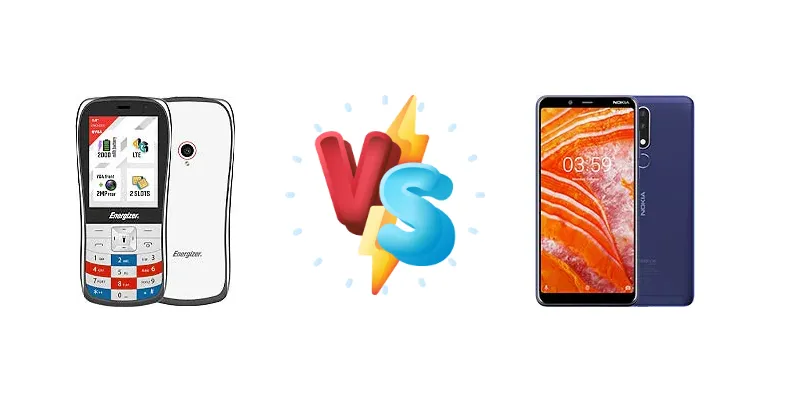
The Energizer E284S and Nokia 3.1 Plus represent the extreme end of the smartphone price spectrum. Both aim to deliver basic functionality at an incredibly low cost, but they take vastly different approaches to achieving this. The E284S prioritizes simplicity, while the Nokia 3.1 Plus attempts to offer a more robust experience with a more powerful chipset, albeit with regional variations.
🏆 Quick Verdict
For the average user, the Nokia 3.1 Plus is the clear winner. Its Mediatek Helio P22 (or Snapdragon 439 in the US) provides a significantly faster and more responsive experience than the Energizer E284S’s Unisoc T117. While both phones are limited, the Nokia offers a better chance of handling everyday tasks smoothly.
| Network |
|---|
| 2G bands | GSM 850 / 900 / 1800 / 1900 | GSM 850 / 900 / 1800 / 1900 |
| 3G bands | HSDPA 850 / 900 / 2100 | HSDPA 850 / 900 / 1900 / 2100 |
| 4G bands | 1, 3, 7, 8, 20, 28, 38, 40, 41 | 2, 4, 5, 12, 14, 29, 30 - USA |
| Speed | HSPA, LTE | HSPA 42.2/5.76 Mbps, LTE Cat4 150/50 Mbps |
| Technology | GSM / HSPA / LTE | GSM / HSPA / LTE |
| | - | HSDPA 850 / 1700(AWS) / 1900 - USA |
| Launch |
|---|
| Announced | 2021, December. Released 2022, Q2 | 2018, October. Released 2018, October |
| Status | Discontinued | Discontinued |
| Body |
|---|
| Build | - | Glass front, aluminum back, aluminum frame |
| Dimensions | 137.6 x 62.5 x 15.6 mm (5.42 x 2.46 x 0.61 in) | 156.9 x 76.4 x 8.2 mm (6.18 x 3.01 x 0.32 in) |
| SIM | Nano-SIM + Nano-SIM | Nano-SIM + Nano-SIM |
| Weight | 131 g (4.62 oz) | 180 g (6.35 oz) |
| Display |
|---|
| Resolution | 240 x 320 pixels, 4:3 ratio (~143 ppi density) | 720 x 1440 pixels, 18:9 ratio (~268 ppi density) |
| Size | 2.8 inches, 24.3 cm2 (~28.2% screen-to-body ratio) | 6.0 inches, 92.9 cm2 (~77.5% screen-to-body ratio) |
| Type | TFT LCD | IPS LCD |
| Platform |
|---|
| CPU | 1 GHz | Octa-core 2.0 GHz Cortex-A53 - GlobalOcta-core (4x1.95 GHz Cortex-A53 & 4x1.45 GHz Cortex A53) - USA |
| Chipset | Unisoc T117 | Mediatek MT6762 Helio P22 (12 nm) - GlobalQualcomm SDM439 Snapdragon 439 (12 nm) - USA |
| GPU | - | PowerVR GE8320 - GlobalAdreno 505 - USA |
| OS | - | Android 8.1 (Oreo), upgradable to Android 10, Android One |
| Memory |
|---|
| Call records | Yes | - |
| Card slot | microSDHC | microSDXC (dedicated slot) |
| Internal | 128MB, 64MB RAM | 16GB 2GB RAM, 32GB 2GB RAM, 32GB 3GB RAM |
| Phonebook | Yes | - |
| | eMMC | eMMC 5.1 |
| Main Camera |
|---|
| Dual | - | 13 MP, f/2.0, AF
Auxiliary lens |
| Features | LED flash | LED flash, HDR, panorama |
| Single | 2 MP | - |
| Video | Yes | 1080p@30fps |
| Selfie camera |
|---|
| Features | - | LED flash, HDR |
| Single | VGA | 8 MP, f/2.2 |
| Video | Yes | 720p@30fps |
| Sound |
|---|
| 3.5mm jack | Yes | Yes |
| 35mm jack | Yes | Yes |
| Loudspeaker | Yes | Yes |
| Comms |
|---|
| Bluetooth | 2.1 | 4.1, A2DP, LE |
| NFC | No | Yes (USA, APAC & EMEA) |
| Positioning | No | GPS, GLONASS, BDS, GALILEO |
| Radio | FM radio | FM radio |
| USB | microUSB | microUSB 2.0, OTG |
| WLAN | Yes | Wi-Fi 802.11 b/g/n, Wi-Fi Direct |
| Features |
|---|
| Games | Downloadable | - |
| Java | No | - |
| Messaging | SMS | - |
| Sensors | No | Fingerprint (rear-mounted), accelerometer, gyro, proximity, compass |
| Battery |
|---|
| Charging | - | 10W wired |
| Type | Li-Ion 2000 mAh, removable | Li-Ion 3500 mAh, non-removable |
| Misc |
|---|
| Colors | Black, Blue, Red, Green | Blue, White, Gray |
| Models | - | TA-1118, TA-1125, TA-1113, TA-1117, TA-1124, TA-1125 |
| Price | About 50 EUR | About 120 EUR |
| SAR EU | - | 0.41 W/kg (head) 1.58 W/kg (body) |
Energizer E284S
- Extremely low price point
- Simple and easy to use
- Potentially longer standby time due to low power processor
- Very limited performance
- Basic camera capabilities
- Likely poor software support
Nokia 3.1 Plus
- Significantly faster processor
- More responsive user experience
- Better software support (Nokia brand)
- Still an entry-level device
- Limited camera quality
- 10W charging is relatively slow
Display Comparison
Neither device boasts a standout display. Details regarding panel type, resolution, or brightness are absent for the Energizer E284S, suggesting a very basic LCD. The Nokia 3.1 Plus also utilizes an LCD, but its focus is on efficiency rather than visual fidelity. The lack of information on PWM dimming rates for either device means we cannot assess potential eye strain concerns. Bezels are likely substantial on both, reflecting their budget nature.
Camera Comparison
Camera performance on both devices will be limited. Details are scarce, but it’s safe to assume both rely on basic sensors. The Nokia 3.1 Plus likely benefits from Mediatek’s image signal processor (ISP), which offers some level of image enhancement. The Energizer E284S’s ISP is likely very basic. Expect subpar low-light performance and limited dynamic range on both. Any secondary cameras (often 2MP macro lenses) are unlikely to provide meaningful improvements.
Performance
The performance gap is the most significant differentiator. The Energizer E284S is equipped with the Unisoc T117, a 1 GHz processor designed for minimal power consumption. In contrast, the Nokia 3.1 Plus features the Mediatek Helio P22 (12nm) globally, or the Qualcomm Snapdragon 439 (12nm) in the US. The Helio P22’s octa-core Cortex-A53 configuration running at 2.0 GHz provides a substantial performance advantage over the single-core T117. The 12nm process node on the Mediatek/Qualcomm chip also contributes to better efficiency. This translates to faster app loading times, smoother multitasking, and a more responsive overall experience on the Nokia 3.1 Plus. The Nokia's CPU architecture is far more capable of handling modern Android workloads.
Battery Life
Battery capacity details are missing for the Energizer E284S, but given its focus on simplicity, it likely has a modest battery. The Nokia 3.1 Plus supports 10W wired charging. While not fast, it’s a standard rate for this price point. The Nokia’s more efficient chipset will likely translate to longer real-world battery life, even if the battery capacity is similar. The difference in processing power means the Energizer will likely spend less time actively processing, but the Nokia's efficiency will still be a benefit.
Buying Guide
Buy the Energizer E284S if you need an extremely basic phone for calls, texts, and very light use – think a secondary device or a phone for someone unfamiliar with smartphones. Buy the Nokia 3.1 Plus if you prefer a phone capable of running more apps, handling occasional social media browsing, and offering a generally smoother user experience, even if it's still an entry-level device.
Frequently Asked Questions
❓ Is the Unisoc T117 chipset in the Energizer E284S sufficient for running WhatsApp and making calls?
Yes, the Unisoc T117 is capable of handling basic tasks like WhatsApp and phone calls. However, expect slow loading times and potential lag when switching between apps. It's designed for minimal functionality, not multitasking.
❓ Does the Nokia 3.1 Plus's Helio P22/Snapdragon 439 chip overheat during prolonged use?
The Mediatek Helio P22 and Snapdragon 439 are relatively efficient chips. While they can get warm during extended gaming or video playback, they are unlikely to overheat significantly due to their low power draw and the phone's basic thermal design. Throttling may occur under sustained load, reducing performance slightly.
❓ What kind of storage options are available on each device, and can it be expanded?
Storage details are not provided in the context data. However, given the price point, both devices likely offer limited internal storage (e.g., 16GB or 32GB). It's highly probable that both include a microSD card slot for storage expansion, which is common in this segment.
❓ How well does the Nokia 3.1 Plus handle popular mobile games like PUBG Mobile?
The Nokia 3.1 Plus can *run* PUBG Mobile, but not at high settings. Expect to play at the lowest graphics settings and frame rates to maintain a playable experience. The Helio P22/Snapdragon 439 is not a gaming chipset, and performance will be limited.